I was three steps from my son’s front door when the man next door came off his porch running, his arms waving like he was trying to flag down a train.
“Don’t go in,” he said, grabbing my arm. “I already called 911. Don’t go in that house.”
My name is Clifton Barrow, and I am 64 years old. I spent 31 years as a structural engineer for the city of Columbus, Ohio. I am not a man who frightens easily. I have walked into condemned buildings. I have argued with politicians and contractors and union bosses, but the look on that man’s face—a retired firefighter named Ruiz, who lived in the gray house to the left—stopped me cold on the walkway of my son’s property, like I had walked into a wall of invisible glass.
“What happened?” I said. My voice came out steady, but only because of muscle memory. “What did you hear?”
“Yelling,” he said. “A woman screaming, then something heavy crashing. Then it went quiet. That kind of quiet means something went wrong.”
My son Elliot and his wife Nadell live in a suburb outside Columbus. It’s a nice street, wide lots, old oak trees overhanging the sidewalks. Elliot is 36. He works in logistics management. He is not a loud man. He is not a man who yells. He has always been the kind of person who goes quiet when he’s upset, the kind who retreats inward. I had always respected that about him, even when I didn’t understand it.
His wife, Nadell, I had never trusted. She came from money, not generational wealth, but her parents had done well in commercial real estate in Atlanta, and she had never quite let anyone forget it. She had a way of talking that made every compliment sound like a comparison. She never called me Dad. She called me Clifton, always with a small pause before it, like she was reminding herself of my name.
Our relationship had been cordial for 7 years, which is another way of saying that we performed politeness at each other across holiday tables and birthday dinners and never once got to the truth.
I had driven up from Dayton that afternoon. My wife, Loretta, had been staying with Elliot for nearly 2 weeks. The reason given to me was that Elliot had been having some trouble with anxiety, with work pressure, and that Loretta wanted to be close by in case he needed her.
That was Loretta’s way. She was a fixer. She couldn’t sit still when someone she loved was struggling. She drove to them. She cooked for them. She stayed. But something had been wrong with her voice on the phone the last few days.
I know my wife’s voice the way you know a road you’ve driven a thousand times. I know every gear change, every slight turn. And Loretta had been different. Not sad, not worried exactly. Something more contained. Something held behind her back.
I should have come sooner. Every instinct I had was telling me that. But I had trusted her when she said everything was fine. I had respected the distance she was putting between us because Loretta has always been private and I have always been a man who respects private things.
Standing on that walkway with Ruiz’s hand on my sleeve and the sirens already rising in the distance, I understood that I had made a terrible mistake.
The story is still unfolding. Type “LOVE,” and I’ll share the rest.
Part 2:
The police came, two officers, one of them not more than 30. Ruiz explained what he’d heard. They moved toward the front door, one on each side. They announced themselves. Silence. They knocked again harder. Silence.
One of them looked back at me. “Who else is in there?”
“My wife and my daughter-in-law,” I said. “Loretta and Nadell Barrow. My son Elliot may be at work.”
The officer nodded. They breached the door on the third kick. I did not wait on the lawn. I followed them in.
The smell hit me first. Not blood. Not right away. Candles, actually. Vanilla candles that Nadell burned constantly, a habit of hers I had always found excessive. But underneath it, something else, something sharp and wrong.
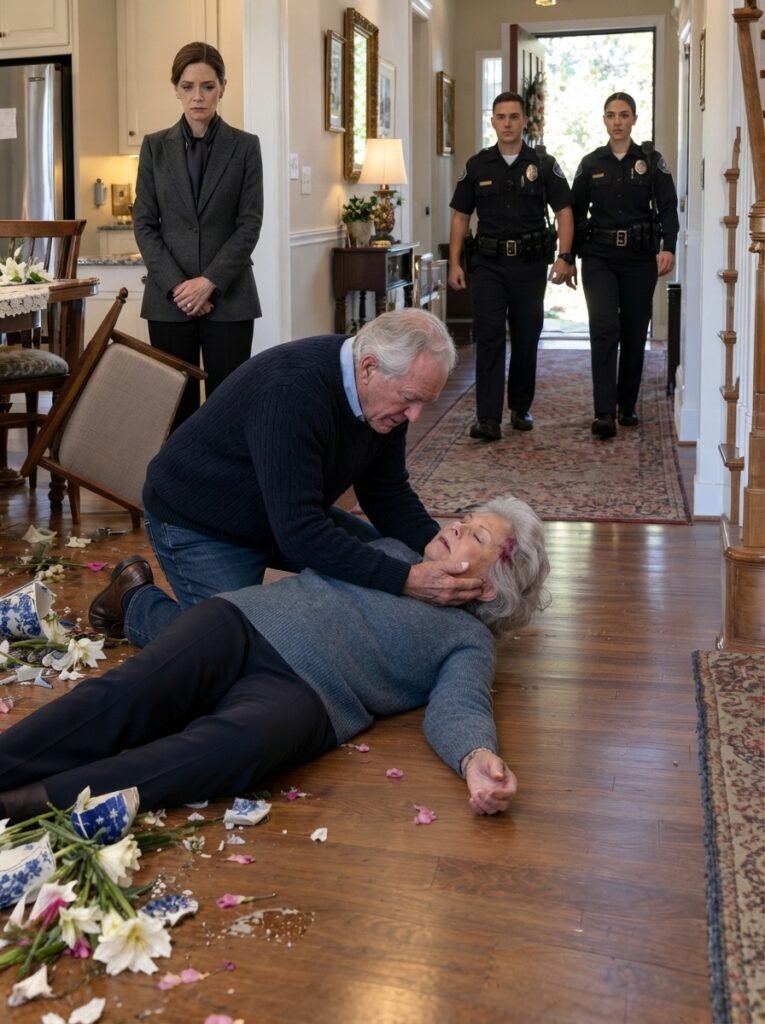
The living room was in pieces. A floor lamp was on its side. A glass vase had been shattered against the far wall, the flowers still scattered on the hardwood, petals crushed into the grain of the wood. A dining chair was overturned.
“In here,” the female officer’s voice came from the hallway.
I went toward it.
Loretta was on the floor of the hallway that led from the kitchen to the garage door. She was on her back, her right arm extended outward, palm up. She was 61 years old and she looked very small. There was blood coming from somewhere above her left ear, matted into her silver hair. Her eyes were closed. Her chest was moving.
I don’t remember getting down on my knees. I was just there beside her, my hand on her face.
“Loretta,” I said. “Baby, I’m here. I’m right here.”
“Sir.” The officer put a hand on my shoulder. “Don’t move her. EMS is coming. Don’t move her.”
I lifted my face. The room was tilting, but I held myself together by focusing on Loretta’s chest, watching it rise and fall, making sure it kept doing that.
That is when I heard my daughter-in-law.
Nadell was in the kitchen doorway. She was standing upright, which was the first detail I registered. She was not injured. She was not crouched down. She was standing in the kitchen doorway in a silk blouse I’d never seen before, her arms folded across her chest, watching me kneel beside my wife with an expression on her face that I can only describe as controlled. She looked like a person watching a situation they already understood.
“She fell,” Nadell said. Her voice was even. “We were arguing, and she got upset and she fell.”
I looked up at her.
“She fell. It was an accident.”
Something cold moved through me. Not anger yet, not the full thing, just its first edge.
“Where is Elliot?” I said.
Her expression shifted just a fraction. “He’s not here.”
“Where is he?”
“He had to step out.”
The paramedics came then, and the next hour was the hospital, the gurney, the automatic doors, the waiting room with its institutional hum. The young doctor used words like subdural and pressure and monitoring. He said she was stable. He said they were watching her. He said she had not regained consciousness.
I sat in a plastic chair and I tried to think clearly.
Nadell had not ridden in the ambulance. She had said she would follow. She had not arrived.
I called Elliot’s cell phone four times. On the fourth try, he answered. His voice was strange, flat, and very careful, like a man walking on ice.
“Dad,” he said.
“Your mother is in the hospital,” I said. “She has a head injury. Where are you?”
A long silence, the kind that costs something.
“I know,” he said. “I know she does. I’m sorry. I needed to— I needed to get out of the house before something else happened.”
“Before something else happened,” I repeated. “Elliot, tell me what happened right now.”
Another silence.
“Not on the phone,” he said. “Are you at Riverside?”
“Yes.”
“I’ll come. I’ll come now. Dad, I’m sorry. I should have called you weeks ago.”
He arrived 40 minutes later. He looked like he hadn’t slept in a week. He was wearing a rumpled Oxford shirt with the collar open. And his face had that gray, scraped quality that comes from chronic stress, from not eating right, from lying awake at 3:00 in the morning too many times in a row.
I knew that look because I had seen it in my mirror once years ago during a crisis at work. But this was worse. This was a man coming apart at the seams.
He sat down beside me. He put his elbows on his knees and his face in his hands.
“Tell me,” I said.
He told me it started, he said, about 18 months ago. Nadell had always been a spender. I knew that. But he had always managed it, always kept the budget in balance, always caught things before they went too far.
Then she discovered sports betting. Not in a dramatic way, just casually, the way things begin. A friend told her about an app. She won $200 her first week. She told him about it like it was a funny story.
6 months later, she had lost $27,000. He found out by accident. He went online to pay their homeowner’s insurance, and the joint account was nearly empty.
He confronted her. She cried. She promised it was over. She said she had a problem, but that she was going to get help. He believed her because he loved her and because she was convincing and because sometimes love makes you want to believe the story that keeps things intact.
She did not get help. She found new accounts. She hid them better.
12 months later, the number was $63,000. $63,000. Their entire savings, the down payment they had spent 5 years building up together. The money that was supposed to be the foundation of the next part of their life.
I stared at my son while he told me this. I watched his hands. They were shaking.
“Why didn’t you tell us?” I said. “Why didn’t you tell your mother?”
He looked at the floor.
“Because I was ashamed,” he said. “Because I thought I could fix it. Because I kept thinking, one more month. One more month and I’ll get her into treatment and we’ll start paying it back and nobody will have to know how bad it got.”
He shook his head slowly.
“And because you never liked her, Dad. You never tried to like her. And I didn’t want to give you the satisfaction.”
That landed like a stone in still water. He was right. I had never tried. I had made up my mind about Nadell in the first year and I had kept that judgment polished and ready ever since.
“What happened today?” I said.
He closed his eyes.
“Mom found the statements. She was here in the guest room. She came up to visit. She said she just wanted to see me, but I think she knew something was wrong. She’s always known when something is wrong. She found the statements in my desk, the credit card bills I’d been hiding, three cards in collections. She confronted Nadell while I was on a work call upstairs.”
He pressed his palms together.
“I heard them. I came downstairs. They were in the hallway and Mom was holding the statements and she was telling Nadell that this had to stop, that we needed to call someone, that this family wasn’t going to keep a secret this size.”
His voice went quiet.
“And Nadell grabbed her. She grabbed Mom’s arm and told her to mind her own business. Mom tried to get past her to call me, and Nadell shoved her.”
I made myself stay very still.
“She shoved my mother,” I said.
“She shoved her hard. Dad.”
“Mom hit the wall and went down. I was on the stairs. I saw it.”
He finally looked up at me. His eyes were red.
“I called 911. Nadell was screaming at me that Mom had tripped, that it was an accident, that if I called the police, I would ruin our marriage. I called anyway. And then I just—I couldn’t be in that house. I drove around for an hour. I know that was wrong. I know I should have stayed.”
I put my hand on the back of his neck the way I used to when he was a boy and sick with something. He was trembling.
“You did right calling,” I said. “The rest we’ll sort out.”
We sat there until a nurse came out to tell us that Loretta was awake and asking for us.
She was in a bed with a bandage above her left ear and an IV in her arm. She looked smaller than she had in the hallway, which I would not have thought possible, but her eyes were open and they were clear. And when she saw me come through the door, they filled up immediately with the kind of tears that mean relief.
I took her hand. I didn’t say anything for a moment. I just held it.
“I found the statements,” she said.
Her voice was—I know.
“She shoved me, Clifton. It wasn’t a fall. I want you to know that.”
“I know,” I said again. “Elliot told me.”
She looked at our son, who was standing at the foot of the bed. Something passed between them. An old, deep communication that I recognized, the language of two people who know each other without having to explain.
“The detective came while you were upstairs,” she said to Elliot.
He nodded.
Then she turned to me and her expression changed. It got quieter, more careful.
“There’s something I need to tell you,” she said. “Something that’s part of all this, even if it doesn’t seem like it is.”
I waited.
“My mother’s house,” she said, “when she died 8 years ago. You remember we thought she had nothing.”
“She had the house,” I said. “And the car. We paid for the funeral.”
Loretta shook her head.
“She had more than the house. She had a CD account and a savings bond account that she never told anyone about. She was afraid to touch money. After what your father did to his family—the gambling debts, the bankruptcy—she was terrified of ever being broke. So she saved every single dollar she made from the laundry service for 30 years. And she never touched it, and she never talked about it.”
Loretta looked at me steadily.
“She left it to me. The house and everything in it.”
“I sold the house altogether, including the CD accounts. It came to just over $380,000.”
The room was very quiet.
“$380,000,” I said.
“I put it in a separate account,” she said. “Just in my name. I was going to tell you. I kept meaning to tell you, but then the years went by and I was afraid of what you would think. That I’d been hiding it. That I didn’t trust you. And the longer I waited, the worse it got. So I just kept it separate and I told myself it was our emergency net. I told myself I would tell you when the right time came.”
Her voice broke slightly.
“And then Nadell found out.”
I stared at my wife.
“She found the account statement in my suitcase when she went through my things,” Loretta said. “That was what they were really fighting about, Clifton. She didn’t want me calling the police because of what she’d done to Elliot’s savings. She wanted me to give her money. She said if I gave her enough to cover the debts, she would get help. Nobody would have to know.”
She said it like a business transaction. She stood there in that hallway and said, “I need $300,000 and then this all goes away.”
Loretta’s jaw tightened.
“I told her no. I told her I was going to call you and we were going to get Elliot into family counseling and she was going to answer for what she’d done. And that’s when she grabbed me.”
I sat there for a long time without speaking.
$380,000, 8 years.
I thought about every conversation we’d had about money in those 8 years. I thought about the roof we debated brilliantly last spring. I thought about Loretta carefully clipping grocery coupons at the kitchen table on Sunday mornings. I thought about the way she had sat beside me when I went through my retirement calculations and never said a word.
The betrayal was real. I won’t pretend it wasn’t. It sat in my chest like a piece of gravel pressing into something soft.
But my wife was in a hospital bed with a bandage on her head. And the person who had put her there was my daughter-in-law. And whatever Loretta had done or not done, she had not brought anyone down a hallway; she had stood in that house and said no to a woman who thought money could make wrongdoing disappear.
That took more backbone than most people have.
I looked at her. She was watching me with the expression of a person bracing for a verdict.
“We’ll talk about the account,” I said. “Later, when you’re home.”
I squeezed her hand.
“Right now, the only thing that matters is that you’re awake.”
She let out a breath that sounded like it had been stored for days.
Nadell was arrested that evening.
I did not go back to Elliot’s house that night. Elliot drove me to a motel three blocks from the hospital, and we sat in the parking lot for a while without getting out of the car.
“The neighbor,” I said. “Ruiz. He’s the one who stopped me.”
“He’s a good man,” Elliot said. “He’s been trying to tell me for months that things seemed wrong next door. I didn’t listen.”
“Why not?”
My son looked out the windshield.
“Because I was afraid of what listening would mean,” he said. “If I listened to him, I’d have to face it, and I wasn’t ready to face it.”
I understood that. I had spent 7 years not listening either. Not to my instincts about Nadell. Not to the small wrong notes in Loretta’s voice on the phone. Not to the particular silence that falls over a family when it’s protecting a wound.
“I should have come sooner,” I said.
“Yeah,” he said.
He didn’t say it to hurt me. He just said it because it was true.
The detective assigned to the case was a woman named Flores. She came to the hospital the next morning. She was thorough. She took Loretta’s statement, then mine, then Elliot’s.
She told us that Ruiz had provided a statement as well, that he had heard the confrontation clearly through his open windows, and that what he heard was consistent with Loretta’s account. He had heard a woman’s voice saying, “I said, ‘Get out of my way.’” And then a crash, and then silence. He had been very clear about which voice was which because he had spoken to both women over the back fence many times over the years.
“He said he’d been concerned for a while,” Detective Flores told me. “He said he noticed changes in the patterns at the house. More tension.”
“He’s observant. He’s a retired firefighter,” I said. “They’re trained to notice things.”
She nodded.
“He also said he tried to speak with your son about it once about 3 months ago. Your son thanked him and said everything was under control.”
I looked at Elliot. He looked at the floor.
3 months, I thought. 3 months ago, a neighbor had tried to throw him a line and he’d waved it away.
“Is this going to be a problem?” I asked Flores.
She shook her head.
“The evidence is consistent. The account statements corroborate the motive. And the injury to your wife is not consistent with a simple fall. The angle, the point of impact—there was force involved.”
She paused.
“Mrs. Barrow was lucky.”
Lucky? I have thought about that word every day since.
The next weeks were difficult in ways that aren’t easy to describe. Loretta came home to Dayton after 10 days and started her recovery. It was not a fast recovery. She had headaches that came in waves. She got tired very easily. She couldn’t drive for 6 weeks. I took leave from my consulting work and stayed home. I cooked. I drove her to appointments. I sat with her in the evenings and we watched things on television, and we did not always talk about the things that needed to be said.
But we got to them. We got to all of them eventually.
The account, the money from her mother. I will tell you honestly that it was harder than I expected. Not because of the money itself. $380,000 is significant, but it was not the number that bothered me. It was the silence. It was knowing that she had sat beside me for 8 years holding something that large and had chosen to keep it to herself.
That was the thing I had to work through. That required more than one evening.
Loretta explained it to me slowly over many conversations. The way you peel back layers of something that was wrapped tight. Her mother had grown up watching my father-in-law gamble away everything they had. Her mother had survived by hiding. She had passed that instinct directly to Loretta, like an inheritance that came before the money.
“The hiding was not about distrust. It was about fear. It was the reflex of a woman who had learned at a young age that money kept in the open gets taken. She taught me to never let anyone know what you have,” Loretta said one night. “Even people you love, especially people you love, because you never know when things will change.”
“I would never have taken it from you,” I said.
“I know that now.”
“I’ve known it for a long time. But knowing it and unlearning the fear are two different things.”
I thought about my own father, who had been a hard, distant man who kept his feelings sealed away and called it strength. I thought about the things I carry from him that I did not choose. I thought about how long it can take to unlearn the things you were taught by someone who loved you badly or fearfully or with the wrong shape of protection.
“Okay,” I said.
“Just okay?” She looked at me.
“Just okay,” I said. “It’s your mother’s money. It came from her fear and her work and her loneliness, and you kept it because that’s what she taught you. I’m angry at the silence. I won’t pretend I’m not, but I understand it.”
I paused.
“We’ll decide what to do with it together. All of it. Going forward.”
She nodded. She put her hand over mine. The tremor in her grip was less than it had been the week before.
Elliot was the harder conversation.
I drove up to see him a month after Loretta came home. He was still in the house. Nadell had been denied bail and the divorce proceedings had already begun. He was the only one in those rooms now.
I knocked, which felt strange. He opened the door and we stood in the entryway for a moment just looking at each other.
We went to the kitchen. He made coffee. We sat at the table where Loretta had found the statements.
“I want you to tell me about the moment you knew how bad it really was,” I said. “Not the $63,000. The real moment when you knew it was beyond what you could fix.”
He held his mug with both hands.
“About 8 months ago,” he said, “she had gone through a credit card in my name, applied for it herself online with my information, and ran it up to the limit without telling me. When I found out, I sat down and did the real math for the first time. All of it. Every account, every card, every debt she’d told me about and everyone she hadn’t.”
He looked up at the window.
“It was over six figures by then. More than we could ever dig out of on our salaries alone.”
“And you still didn’t call us,” I said.
“No.”
“Why?”
He was quiet for a moment, then said, “Because I thought you’d say, ‘I told you so.’”
I sat with that.
I had told him so. Not about the gambling. I hadn’t known about that, but I had told him in a dozen indirect ways over the years that I didn’t think Nadell was the right person for him. I had said it through my silences at dinners and my reluctance to ask about her and my barely concealed disinterest in her stories. I had communicated it the way people communicate the things they’re too proud to say out loud.
And my son had spent 8 months drowning rather than call me because he was afraid I would confirm that he had chosen wrong.
I am 64 years old. I have made many mistakes. But that one, the long, slow accumulation of judgment that I wore around my daughter-in-law for 7 years, that one will follow me for the rest of my life.
“You were right that I didn’t like her,” I said. “But you were wrong about why.”
I looked at him directly.
“I was afraid of losing you. When you married her, I felt like I lost some piece of you to a world I didn’t understand. And instead of saying that, I just decided she wasn’t good enough. It was easier than being honest.”
I took a breath.
“I’m sorry for that, Elliot. I should have been the kind of father you could call.”
He didn’t say anything for a long time. The refrigerator hummed. Somewhere outside a dog was barking.
“Yeah,” he said at last. “You should have been.”
We drank our coffee. We talked for three more hours. We talked about Nadell, about the early years of his marriage, about the moments he had been happy because there were some. She had not always been what she became under the pressure of the addiction.
We talked about his grandfather, my father, and about fathers in general, about the ways we receive the shapes of our silences from the men who raised us and how long it takes to see them.
Before I left, I stopped in the hallway. I looked at the wall where Loretta had hit. There was a small scuff in the paint, barely visible. Elliot had not repainted it.
“You should paint that,” I said.
“I know,” he said. “I keep thinking about it.”
“Or don’t,” I said. “But make the decision. Don’t just let it sit there.”
He looked at me. Something shifted in his face.
“When did you get philosophical?”
“When your mother got pushed down a hallway by a woman I had seven years to learn the truth about,” I said. “It tends to clarify things.”
He almost smiled. It was the first time in weeks.
The trial began 4 months after the arrest. Loretta was recovered enough to testify. She walked into the courtroom with a slight favor toward her left side that the neurologist said might be permanent. She sat in the witness chair with her hands in her lap and told the truth in a clear, quiet voice without once looking away from the jury.
Nadell’s attorney did what attorneys do. He painted a picture of a household in crisis, of a mother-in-law who had inserted herself into her son’s marriage, of a confrontation that had gotten out of hand. He brought up the account Loretta had kept hidden. He called it deception. He suggested to the jury that a woman willing to hide $300,000 from her own husband for 8 years was perhaps not the most reliable narrator of events.
Loretta did not flinch.
“I kept a secret from my husband that I should not have kept. That is true, but I did not put my hands on anyone. Those are two separate truths.”
The jury found Nadell guilty on the assault charge. The sentencing was 5 years, with the possibility of parole after three.
I watched my daughter-in-law as the verdict was read. She looked at me once across the courtroom, and in her eyes I did not see remorse. I saw calculation. She was already working on the next move. I recognized it because I had spent 7 years looking at her and choosing not to see.
After the sentencing, Ruiz found me in the courthouse hallway. He was wearing a blazer over a collared shirt, dressed up for the occasion.
“Mr. Barrow,” he said, extending his hand.
I shook it with both of mine.
“I owe you a debt,” I said. “You stopped me from walking into something I wasn’t prepared for, and you told the truth when it would have been easier to stay out of it.”
He shrugged. The gesture was modest but not uncomfortable.
“I’ve got nothing but time on my hands and good ears,” he said. “And I believe in minding my business right up until the point where someone’s going to get hurt.”
“You’ve got better instincts than I did,” I said. “And I’m an engineer. I spent 30 years assessing structural integrity.”
He smiled at that, just slightly.
“Structures and families are different,” he said. “Structures don’t hide things. Families always do.”
We shook hands again and went our separate ways.
That was 7 months ago.
Elliot has since sold the house. He took a significant loss on it. The market was soft and the memories weren’t worth waiting for. But he said he could breathe easier the moment the sign came down.
He has a small apartment now in a building closer to his office. He is in therapy, which I had to hear about secondhand from Loretta before I worked up the nerve to ask him directly. When I did, he said it was helping. He said the therapist had told him that people from families that manage difficulty through silence tend to find partners who make the silence necessary. He said that had landed hard the first time he heard it.
I told him it landed hard on me too, and I wasn’t even in the room.
Loretta and I have dealt with the account. We spent it, most of it, not frivolously. We paid off the mortgage on our house in Dayton. We gave Elliot a significant amount to help him start over without the weight of the debt his wife had left him. And we endowed a small scholarship at the university where Loretta got her nursing degree in her mother’s name.
We had a small ceremony for it, just the three of us, and a dean who was very kind about the whole thing. Loretta cried. I held her hand.
The scar above her ear is visible when she wears her hair up. She does not try to hide it. She says it reminds her of the things that happen when silence is allowed to grow too long in a dark place.
I think about Ruiz often. I think about what it means that a man who did not know me, who owed me nothing, ran across a lawn and grabbed my arm and said, “Stop. Don’t go in. Let me tell you what I heard.”
I think about how close I came to walking into that house alone without the police, without any understanding of what had happened inside. I think about what might have been different.
Not all of it can be recovered. I lost seven years of a relationship with my son to my own stubbornness. I lost the version of my marriage in which there were no secrets. My daughter-in-law is a person I still find difficult to extend compassion toward. Though I am trying, because Elliot spent 8 years trying and it seems like the least I can do.
But some things were found in all that loss. I found out that my wife is made of something harder than I knew. I found out that my son has a courage that doesn’t look like courage from the outside. It looks like quietness, like absorbing things, like staying in a burning house longer than anyone should because he loves the people inside it.
And I found out that sometimes the person who tells you the truth is someone you’ve never met, standing on his own porch, watching a street you thought you understood.
Last week, Elliot came down to Dayton for Sunday dinner. He brought a pie from a bakery near his apartment. He sat at our kitchen table and ate two pieces and told us about a project at work he was excited about. Something about rerouting a distribution network, and the color was back in his face while he talked about it.
After dinner, he helped me clear the table. We were side by side at the sink, and I said without planning to say it, “I’m proud of you.”
He looked at me.
“You called 911,” I said, “when it was the hardest thing you could have done. You called.”
He nodded slowly, looking down at the dish in his hands.
“I almost didn’t,” he said.
“But you did,” I said. “That’s the part that counts.”
Outside, the October light was going low and golden over the backyard. Through the kitchen window, I could see the maple tree Loretta and I planted the year Elliot was born. It had dropped most of its leaves. The yard was quiet.
Loretta was in the living room with her book, her reading glasses on, her legs tucked up beneath her on the couch.
I had come within five steps of not knowing any of this. Five steps and a stranger’s voice saying, “Stop.”
I dried my hands. I went and sat down beside my wife. She didn’t look up from her book. She just shifted slightly, making room for me the way she has for 39 years.
That is the whole of it. That is what I have to say. The truth was there all along, waiting to be heard by anyone patient or frightened enough to finally