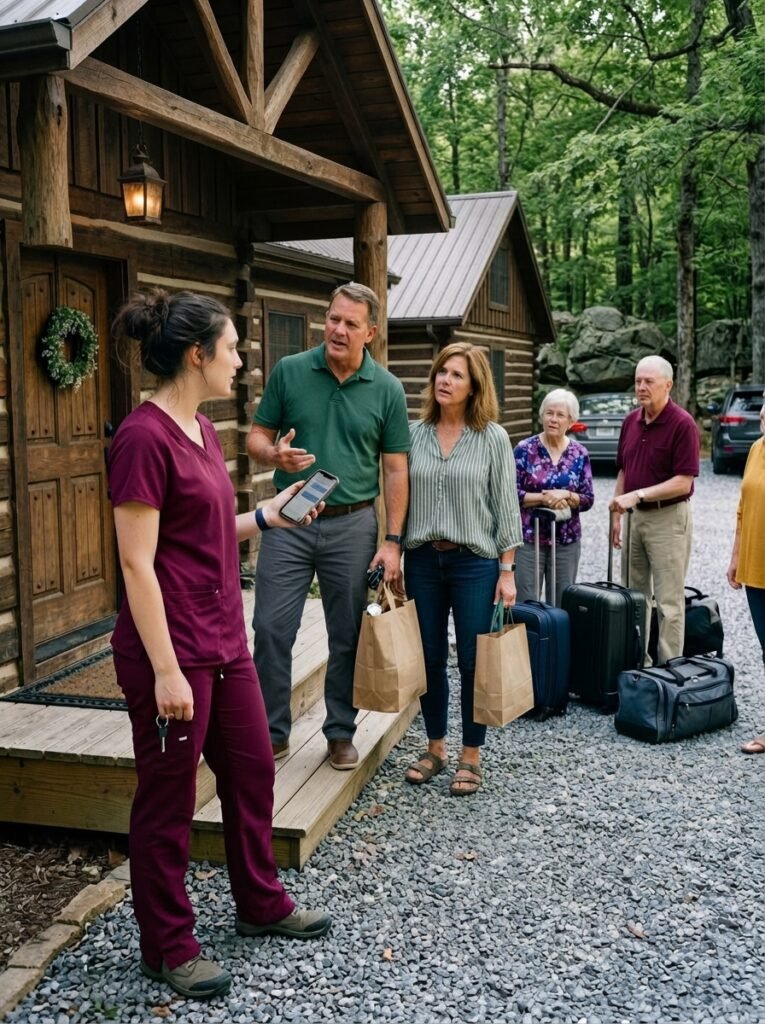
My mother responded in less than thirty seconds.
“You really think you can stop us? Arden, we are your parents.”
My father followed.
“Do not start drama at your age.”
I looked at the messages.
Then I put my phone face down.
For the next four hours, I did my job.
I checked vitals.
I changed an IV bag.
I reassured a frightened husband whose wife was going for an emergency procedure.
I held the hand of an eighty-year-old man while we waited for cardiology.
I documented medication.
I answered call buttons.
I kept moving because sometimes the only way to survive something personal is to become extremely professional.
At 7:12 a.m., my shift ended.
I changed in the staff locker room, drove home through early Charlotte traffic, and walked into my apartment feeling as if my body were made of wet cement.
I should have slept.
Instead, I opened my laptop.
The family messages had multiplied.
Twenty guests had become twenty-three.
Someone was bringing two dogs.
Another cousin wanted to park an RV in my driveway.
Aunt Liora had requested the upstairs bedroom because of her knees.
Hollis wanted to bring a jet ski.
My mother wrote:
“Arden is being difficult because she is tired. Ignore her.”
Then:
“She’ll get over it.”
My father:
“She knows family comes first.”
Keaton:
“She doesn’t even use the place every weekend.”
That sentence finally made me laugh.
One short laugh.
Cold.
Because that had always been the argument.
I did not use something enough, therefore they should be allowed to use it.
I did not have children, therefore I had more money.
I worked holidays, therefore everyone else’s holiday mattered more.
I was single, therefore my schedule was flexible.
I owned two bedrooms, therefore relatives should sleep in them.
My sacrifices had somehow become evidence that I owed them more.
I opened a new browser window and searched for a locksmith near Lake Norman.
Then I called.
“Can you change exterior locks today?”
“Yes.”
“All of them?”
“Yes.”
“I need the old keys completely useless.”
“That won’t be a problem.”
I booked the appointment.
Next, I called the security company that had installed cameras when I first bought the house.
I had cameras facing the dock and rear entrance, but not the front because I never imagined I needed to protect the house from my own parents.
I upgraded the system.
Front door.
Driveway.
Side gate.
Motion alerts.
Remote access.
Door sensors.
Then I called my neighbor, Mr. Bennett.
He was seventy-two, retired, and lived at the lake year-round.
“Arden?”
“Morning. I’m sorry to call early.”
“You sound terrible.”
“Night shift.”
“That explains it.”
I hesitated.
“Did you happen to see my family at the house Memorial Day weekend?”
Silence.
Not guilty silence.
Uncomfortable silence.
“Yes.”
“How many times have they been there?”
Another pause.
“Arden…”
“How many?”
“I’ve seen your parents there three times since spring.”
Three.
I sat down.
He continued.
“I assumed you knew. Your father told me you gave them full access.”
“Did anyone stay overnight?”
“Yes.”
My stomach tightened.
“Did they ever damage anything?”
“Well…”
That word told me everything.
“What?”
“Your dock ladder was bent after Memorial Day. And someone backed into the wooden post near the driveway. I thought you knew.”
I closed my eyes.
I had noticed the bent ladder.
Dad had blamed storm debris.
The post had been cracked.
Mom had told me maybe delivery drivers had hit it.
They had not simply used my house.
They had damaged it.
Then lied to my face.
“Thank you,” I said.
“Do you want me to keep an eye on the place?”
“Yes.”
“That I can do.”
I drove to Lake Norman that afternoon without sleeping.
Every mile made me angrier.
Not wild anger.
Not screaming anger.
Something more useful.
The kind that sharpens your thinking.
When I arrived, I walked through the house room by room.
At first, everything looked normal.
Then I started noticing things.
A wineglass from a set of six was missing.
The guest bathroom had a stain on one towel.
There were scratches near the hallway wall.
One patio chair had been repaired badly with tape.
The mattress protector in the loft was gone.
Two expensive kitchen knives were missing.
And in the back of a closet, I found a plastic bag filled with children’s pool toys.
They had left supplies behind.
Because they planned to return.
I took photographs of everything.
Every scratch.
Every damaged item.
Every missing inventory space I could document.
Then the locksmith arrived.
By four o’clock, every exterior lock was changed.
By five, the security company had finished.
By six, my old garage keypad no longer worked.
I changed the Wi-Fi password.
I disabled the guest network.
I moved important documents and valuables from the house.
Then I opened the refrigerator.
My mother had ordered me to fill it.
So I unplugged it.
I emptied everything that might spoil.
I shut off the ice maker.
I covered the furniture.
Not because I was afraid they would get inside.
Because I was done preparing anything for them.
Before leaving, I placed one sheet of paper on the inside of the front window.
PRIVATE PROPERTY.
ENTRY BY OWNER’S PERMISSION ONLY.
NO FAMILY ACCESS WITHOUT EXPRESS CONSENT.
Then I drove back to Charlotte.
I slept for ten hours.
When I woke, my phone had twenty-seven missed notifications.
Mom:
“What are you doing?”
Dad:
“Answer me.”
Keaton:
“Mom says you changed something at the house.”
Hollis:
“You seriously need therapy.”
My mother again:
“Do not embarrass your father in front of everyone.”
I did not respond.
Thursday passed.
Then Friday arrived.
At 8:03 a.m., my phone started ringing.
Dad.
I let it ring.
Thirty seconds later, he called again.
Then Mom.
Then Dad again.
Finally, I answered.
“What?”
His voice exploded through the speaker.
“What did you do to the house?”
I leaned against my kitchen counter.
“What do you mean?”
“You know exactly what I mean! My key doesn’t work!”
“Correct.”
“You changed the locks?”
“Yes.”
“You changed the locks on us?”
I almost admired the wording.
Not my house.
Not my locks.
The locks on them.
“I changed the locks on my property.”
Behind him, I heard car doors slamming.
People talking.
Children shouting.
They were already there.
All of them.
“You have twenty people standing outside!” Dad shouted.
“You said twenty-three in the chat.”
That silenced him for half a second.
Then he yelled, “Open the door.”
“No.”
“Arden.”
“No.”
“This is your family.”
“I’m aware.”
“People drove hours!”
“I told you no.”
“You knew they were coming!”
“Yes.”
“And you let them come anyway?”
That was the moment I understood how deeply entitlement had infected the entire situation.
In his mind, I was responsible for preventing adults from ignoring my refusal.
Not them.
Me.
“I said no the first time,” I said. “Your decision to ignore it belongs to you.”
My mother’s voice appeared in the background.
“Give me the phone!”
Then she was there.
“Arden, enough. Unlock the house remotely.”
“No.”
“Aunt Liora has been in the car for three hours.”
“Then Aunt Liora should check into a hotel.”
“You are humiliating us.”
“No. You brought twenty-three people to property you were told you could not use.”
“You have two bedrooms you barely use!”
“They are still mine.”
“You’re alone!”
There it was.
The sentence beneath every other sentence.
You’re alone.
Meaning my space counted less.
My money counted less.
My boundaries counted less.
I lowered my voice.
“Being single does not turn my house into a community center.”
My mother laughed.
Not because anything was funny.
Because she thought disbelief could overpower me.
“You’re really going to leave your own parents standing outside?”
“Yes.”
“We have food in the cars.”
“Take it home.”
“Children are here.”
“That was your decision.”
“Your father paid for half your college!”
“My father paid one semester. I paid the rest with loans, scholarships, and work.”
“That is not the point.”
“It becomes the point every time you use old favors as a mortgage on the rest of my life.”
Silence.
Then Dad took the phone again.
“Listen to me carefully. Open this door.”
“No.”
“If you don’t, I’ll open it myself.”
I looked at the security app on my screen.
My father stood on the porch holding the old copied key.
Behind him were relatives, coolers, bags, folding chairs, inflatable floats, and enough luggage for a cruise.
Keaton was already walking around the side of the house.
I said, “Dad, there are cameras recording you.”
He looked directly toward the new doorbell camera.
His expression changed.
“What cameras?”
“The ones on my property.”
“You’re spying on your family?”
“No. I’m monitoring my house.”
Keaton reached the side gate.
His hand moved toward the latch.
An alert appeared.
I spoke clearly.
“Keaton, do not try the side entrance.”
He froze.
Apparently Dad had put the phone on speaker.
My cousin Hollis yelled from somewhere near the driveway.
“This is insane!”
I answered, “Then leave.”
That made everyone start talking at once.
I ended the call.
Three minutes later, Dad called again.
I rejected it.
Then Mom.
Rejected.
Then Keaton.
Rejected.
The doorbell camera showed my father walking down the porch steps, arguing with Hollis.
My mother stood with both hands on her hips.
Aunt Liora remained beside a vehicle, clearly unhappy.
Two children were throwing gravel.
Someone opened a cooler.
For almost fifteen minutes, nothing happened.
Then Keaton disappeared from the camera.
My phone buzzed.
SIDE DOOR MOTION DETECTED.
I opened the feed.
Keaton was testing a window.
My stomach dropped.
I called him.
He answered immediately.
“What?”
“Step away from the window.”
“It was open last time.”
“Step away.”
“We just need to get inside.”
“No.”
“You’re being ridiculous.”
“You are attempting to enter my house after being told not to.”
“It’s not like we’re strangers.”
“The law does not have a family exemption for breaking into someone’s house.”
He scoffed.
“Are you threatening to call the police on your own brother?”
“If you continue trying to enter, yes.”
That finally stopped him.
But only because Mr. Bennett appeared.
I saw him walk across from next door wearing khaki shorts and a baseball cap.
Dad moved toward him immediately.
I could not hear everything at first.
Then Dad raised his voice enough for the doorbell microphone.
“Tell Arden this is ridiculous.”
Mr. Bennett answered calmly.
“It’s her house.”
“She’s our daughter.”
“It’s still her house.”
“We have permission.”
“No, you don’t.”
My father stiffened.
“How would you know?”
“Because she called me.”
Mom stepped forward.
“This is private family business.”
Mr. Bennett glanced at twenty-three people occupying my driveway.
“Doesn’t look very private.”
For the first time all morning, I smiled.
Then Hollis said something that erased it.
“Well, if she wants to be this selfish, maybe we should just go through the back.”
Several people laughed.
Mr. Bennett stopped smiling.
“Don’t.”
That one word carried enough weight to quiet them.
He pointed toward the cameras.
“She told you not to enter. You try forcing your way inside, you’ll have a bigger problem than a ruined weekend.”
That ended the physical attempts.
But not the war.
My mother began sending messages to the family chat.
“Arden has locked her elderly parents out in the heat.”
It was seventy-four degrees.
“She invited us and changed her mind at the last minute.”
A lie.
“She has become obsessed with money.”
Another lie.
“She clearly hates this family.”
A manipulation.
Then the messages from relatives started arriving privately.
“You could at least let your parents inside.”
“This is extreme.”
“They raised you.”
“Family is more important than property.”
“You have really changed.”
That last one amused me.
Yes.
I had.
I had finally become inconvenient.
I returned to the group chat.
For the first time since saying no, I wrote more than one word.
“I did not invite anyone. Dad announced he was using my house. I refused. Mom told everyone to ignore my refusal. Anyone who came anyway did so knowing they did not have permission.”
Then I attached screenshots.
Dad’s original announcement.
My response.
Mom laughing.
“You really think you can stop us?”
I added the Memorial Day screenshot.
“We are at Arden’s lake place. She doesn’t know, so don’t post yet.”
The chat stopped.
Completely.
For nearly two minutes, not one person responded.
Then Aunt Liora wrote:
“What is that?”
I answered:
“The Memorial Day message.”
She replied:
“You knew about Memorial Day.”
“No.”
Another pause.
My cousin Hollis typed:
“Come on, everyone knew.”
Exactly.
I stared at those words.
Everyone knew.
I typed:
“Thank you for confirming that.”
Hollis deleted the message.
Too late.
I had already taken a screenshot.
Then my father called again.
His tone had changed.
Lower.
More controlled.
More dangerous.
“Why are you posting private messages?”
“They were already in the family chat.”
“You are trying to make your mother look bad.”
“She wrote the messages.”
“We used your house one weekend.”
“Mr. Bennett says at least three.”
Silence.
“Who?”
“You heard me.”
“That old man watches too much.”
“So it was three?”
“That’s not the point.”
“It’s exactly the point.”
My father exhaled hard.
“We are your parents. We shouldn’t have to ask permission every time.”
And there it was.
The truth.
Not a misunderstanding.
Not confusion.
Not exhaustion.
They believed parenthood gave them permanent access to anything I owned.
I said, “You copied my key without permission.”
“We needed a spare.”
“You lied about the damaged dock.”
“I didn’t lie.”
“You told me it was storm damage.”
“It could have been.”
“I have photographs from Memorial Day showing people jumping off that side.”
“Arden—”
“You damaged my driveway post too.”
“That was probably Hollis.”
“So you knew.”
Another silence.
That one told me everything.
I felt strangely calm.
“You’re done using the house.”
Dad laughed once.
“You don’t mean that.”
“I do.”
“You’re going to destroy this family over a cabin?”
“No. I’m changing access to a property I own because you repeatedly entered it without permission.”
“That is the same thing.”
“No, Dad. You’re just used to my boundaries being optional.”
He hung up.
By noon, they were gone.
The camera showed the convoy leaving one vehicle at a time.
Coolers loaded back into trunks.
Children packed into SUVs.
My mother stood on the driveway for several minutes before getting into Dad’s car.
She stared at the house as if it had betrayed her.
Not me.
The house.
Like the building itself had failed to recognize her authority.
I thought that would be the end.
I was wrong.
Saturday morning, my mother posted a long message in the family group.
She described herself and Dad as “heartbroken parents.”
She said they had sacrificed everything for me.
She said I had “chosen possessions over people.”
Then she announced they would no longer include me in family gatherings until I apologized.
Keaton reacted with a heart.
Hollis wrote, “Boundaries work both ways.”
I read the message while eating toast in my apartment.
Then I wrote:
“I understand.”
Mom called within ten seconds.
I declined.
She called again.
Declined.
Then she texted privately.
“That’s all you have to say?”
I responded:
“You said I’m no longer invited. I said I understand.”
“You’re supposed to care.”
That sentence sat on my screen longer than any insult.
You’re supposed to care.
What she meant was:
You are supposed to panic.
You are supposed to chase us.
You are supposed to apologize so we can restore the old arrangement.
But something had changed permanently.
I did care.
I cared enough to stop pretending abuse of access was love.
I cared enough to stop rewarding disrespect.
I cared enough about myself to disappoint them.
On Monday, I met with an attorney.
Not because I wanted to sue anyone.
Because I needed to understand exactly where I stood.
I showed him the messages.
The copied key.
The photographs.
The security footage.
He advised me to document everything and send written notice that nobody in the family had permission to access the property without my explicit written consent.
So I did.
Every adult who had been part of the weekend received the same message.
Short.
Professional.
No anger.
No debate.
The lake house was private property.
Past access did not create future permission.
Any unauthorized entry would be treated as trespassing.
My father called it “legal intimidation.”
My mother said I was treating family like criminals.
I did not point out that ordinary family members rarely required written warnings not to secretly enter someone else’s home.
Two weeks passed.
Then three.
The family chat became quieter whenever I appeared.
That was fine.
Work continued.
Patients arrived.
People recovered.
People did not recover.
Life stayed brutally ordinary.
Then one Thursday afternoon, Mr. Bennett called.
“Arden?”
“Yes?”
“Your parents are here.”
I stood up immediately.
“At the house?”
“Yes.”
My pulse accelerated.
“Are they trying to get inside?”
“No.”
That confused me.
“What are they doing?”
“Your mother has an envelope. Your father looks like he swallowed a nail.”
I almost laughed.
“I’m on my way.”
I drove to Lake Norman after work.
When I arrived, Dad’s SUV was parked near the road.
Not in the driveway.
That detail mattered.
Mom and Dad were sitting on the porch steps.
They had not tried to enter.
For the first time in years, they had waited.
I stopped several feet away.
Mom looked tired.
Dad looked older than I remembered.
My mother held out an envelope.
“What is this?”
“Money.”
“For what?”
She looked toward Dad.
He stared at the lake.
“For the things that got damaged,” she said.
Inside was a check.
It covered the dock ladder.
The driveway post.
The chair.
The missing kitchen items.
Maybe a little more.
I did not take it immediately.
Dad finally looked at me.
“We were wrong.”
I said nothing.
He cleared his throat.
“We should have asked.”
Still nothing.
My mother’s eyes filled with tears.
Usually that would have ended every argument.
Her tears had been the family emergency signal since I was a child.
Someone cried.
I surrendered.
But I did not move.
She whispered, “I didn’t think you would actually lock us out.”
I looked at her.
“That was the problem.”
Her face changed.
Not anger.
Recognition.
I continued.
“You didn’t think no meant no because it came from me.”
She lowered her eyes.
Dad rubbed his hands together.
“We got used to you saying yes.”
“I got used to saying yes because saying no always became a fight.”
No one answered.
The lake behind them was almost perfectly still.
A boat passed far away, leaving a white line across the water.
Dad finally said, “Aunt Liora was furious with us.”
That surprised me.
“Why?”
“Because she said we told everybody you approved the weekend.”
I nodded.
“You did.”
“She didn’t know.”
For the first time, I understood that at least some of the twenty-three people had been lied to.
My parents had not merely ignored my refusal.
They had presented my silence as agreement.
Mom wiped beneath one eye.
“She said she would never have come if she knew.”
“That doesn’t change Memorial Day.”
“No.”
Another important word.
No excuses.
Dad looked toward the front door.
“So what happens now?”
I knew what he was asking.
Could they come inside?
Could things go back to normal?
Could we erase the cameras, the screenshots, the shouting, the copied key?
I answered carefully.
“You call before visiting.”
He nodded.
“You ask before using the lake house.”
Another nod.
“And if I say no?”
Dad hesitated.
That hesitation nearly ruined everything.
Then he said, “Then it means no.”
I took the check.
But I did not give them a key.
That mattered too.
We sat on the porch for twenty minutes.
Not inside.
On the porch.
Neutral ground.
Mom apologized for copying the key.
Dad admitted he had asked Keaton not to tell me about Memorial Day.
They told me there had actually been four unauthorized visits.
Four.
The smallest had only been Mom, Dad, Keaton, and Hollis for an afternoon.
I did not yell.
There was no point.
I simply said, “Then you understand why trust is going to take time.”
Mom started to say, “But we’re your—”
Then she stopped herself.
For the first time, she heard the sentence before using it.
She nodded.
“Yes.”
They left before dark.
I stood alone on the dock afterward.
For years, I had imagined family conflict ending with some dramatic victory.
Someone confessing.
Someone getting punished.
Someone finally admitting I had been right.
But standing there, I realized the real ending was quieter.
The house looked exactly the same.
Blue couch.
Small kitchen.
Wooden porch.
Water moving gently beneath the dock.
Nothing had changed.
And everything had.
Three months later, the family gathered for my father’s birthday.
I was invited.
Not summoned.
Invited.
I went.
Keaton was awkward around me.
Hollis barely spoke.
Aunt Liora hugged me and whispered, “For what it’s worth, I’m sorry. I really thought they had permission.”
I believed her.
My mother did something I had never seen her do before.
She asked whether I wanted leftovers before packing them for me.
Asked.
A ridiculous little thing.
But I noticed.
Dad walked me to my car that evening.
Before I opened the door, he said, “Your mother wants to know if she can see the lake house sometime.”
I almost smiled.
“Did she ask you to ask me?”
“Yes.”
“Tell her she can call me herself.”
He nodded.
No argument.
Two days later, Mom called.
“Could Dad and I come to the lake Sunday afternoon?”
I waited.
Not to punish her.
Just because I wanted to feel the difference.
“When?”
“Two o’clock?”
“For how long?”
“Maybe until dinner.”
“No guests?”
“No guests.”
“No copying keys?”
She sighed.
“No copying keys.”
I smiled.
“Okay.”
Sunday afternoon, they arrived carrying sandwiches.
Mom brought flowers.
Not because Aunt Liora wanted them.
For me.
They knocked.
Even though they knew I was home.
I walked to the door and looked at them through the glass.
My father lifted one hand.
My mother waited beside him.
Neither tried the handle.
Neither acted as though knocking were insulting.
I unlocked the door.
They stepped inside only after I moved aside.
It sounds small.
Maybe to other people it would have been.
But when you have spent your life being told that love means unlimited access, being asked can feel revolutionary.
We ate sandwiches on the screened porch.
Dad looked at the dock repairs.
Mom complimented the new security cameras without making a sarcastic comment.
For almost three hours, nobody demanded anything from me.
Nobody assigned bedrooms.
Nobody opened closets.
Nobody invited extra relatives.
Nobody told me what I should buy.
When they left, Mom stopped at the door.
“Thank you for having us.”
Having us.
Not letting us use the place.
Not finally behaving.
Having us.
I locked the door after them and stood in the silent kitchen.
My refrigerator hummed.
The lake reflected orange evening light through the windows.
For years, I had believed peace meant keeping everyone else comfortable.
I thought being a good daughter meant giving before anyone asked.
Making the room.
Buying the groceries.
Working the holiday.
Driving farther.
Sleeping on the couch.
Saying yes because no created problems.
But there is a difference between generosity and surrender.
Generosity is something you choose.
Surrender is what happens when people punish you until choosing no feels impossible.
My family had confused the two.
So had I.
Until that Friday morning.
Until my father stood outside with twenty-three people and an useless copied key in his hand.
Until my mother learned that laughing at my boundary did not make it disappear.
Until my brother discovered that being related to me did not turn a locked window into an invitation.
The lake house never needed “real family energy.”
It needed respect.
And eventually, strangely, painfully, my family started learning what that looked like.
Not perfectly.
There were still moments.
Mom still sometimes asked questions that were really instructions.
Dad still had a habit of assuming before confirming.
Keaton took months to stop acting as though I had personally destroyed the vacation of the century.
Hollis never apologized.
But I stopped measuring progress by whether they were happy with me.
That changed everything.
The following Memorial Day, exactly one year after the secret gathering, I woke at the lake house just after sunrise.
No alarm.
No hospital lights.
No vibrating family chat.
I made coffee and walked barefoot onto the porch.
The water was completely still.
My phone buzzed once.
A message from Dad.
“Happy Memorial Day. Your mom wants me to ask if you have plans today.”
A second message appeared almost immediately.
“Actually, she says she will ask you herself.”
I laughed.
Then Mom called.
I answered.
“Morning.”
“Good morning, sweetheart.”
A pause.
Then:
“Your father and I were wondering if you wanted company for lunch. If not, that’s completely fine.”
I looked across the lake.
That sentence would have been impossible a year earlier.
“If not, that’s completely fine.”
I smiled.
“You can come.”
“Really?”
“Yes. Just you two.”
“Just us.”
“And bring your own towels.”
She laughed.
This time, I laughed too.
They arrived at noon.
They knocked.
And I opened the door.
Because I wanted to.
That was the difference.
The house was still mine.
But more importantly, so was the choice.