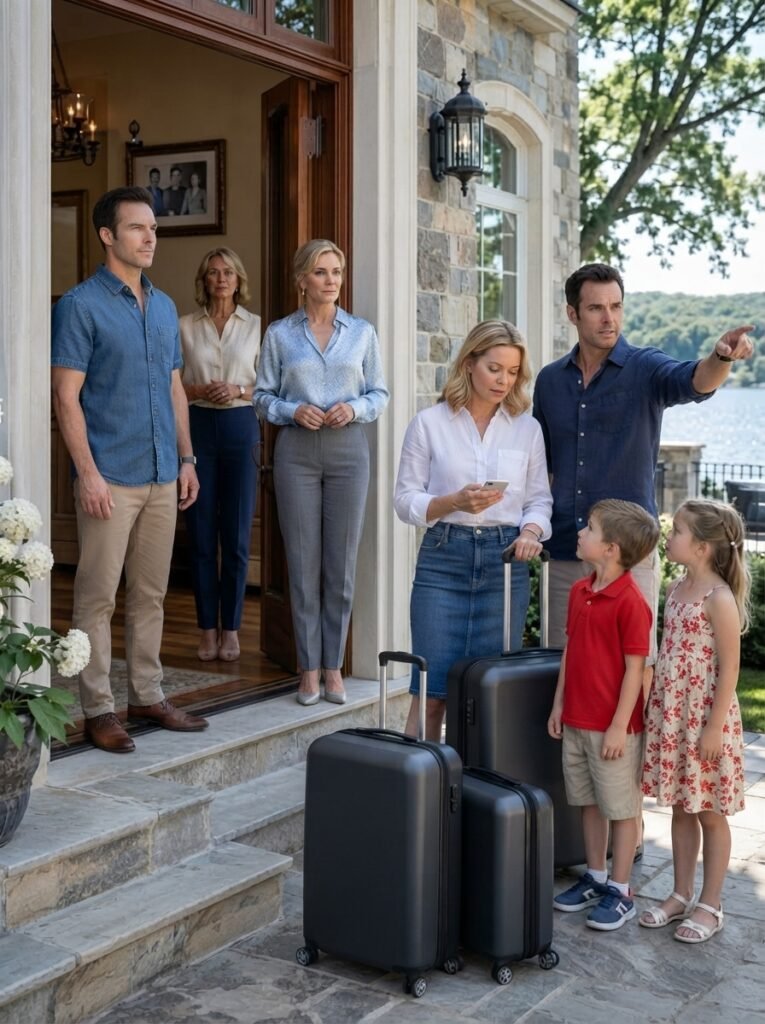
I paid for my own balcony cabin.
Then Megan called a few weeks later saying the grandchildren’s package had become expensive.
So I covered half their fares.
Then there were specialty dining upgrades.
Group transportation.
Excursion deposits.
I paid for some of those too.
Not because I was asked harshly.
Because I wanted the trip to feel special.
Because Patrick was turning forty.
Because the grandchildren were excited.
Because I still believed generosity created closeness.
The night before departure, my suitcase was already packed.
A navy bathing suit.
Three dresses.
Walking shoes.
Sunscreen.
George’s old camera.
My passport was inside my handbag.
On the kitchen island sat a straw sun hat Megan had given me.
She had laughed when she handed it over.
“You’ll need this when we’re in St. Thomas.”
I was making tea when my phone buzzed.
Patrick.
I smiled before opening it.
Then I read the message.
“Plans changed, you’re not coming on the cruise. Megan wants only her family. Please don’t make this difficult.”
For several seconds, I genuinely thought I had misunderstood.
I read it again.
Then a third time.
The words did not change.
You’re not coming.
Megan wants only her family.
Please don’t make this difficult.
Only her family.
I was Patrick’s mother.
His children called me Grandma.
I had paid for part of the trip.
Yet somehow, less than twelve hours before departure, I had been removed like an inconvenient reservation.
My first instinct was to call him.
My thumb hovered over his name.
Then another message appeared.
“We’ll explain after we get back. Can you still take care of the balance for the kids’ excursions? It’s already linked to your card.”
That was the moment everything inside me became very still.
Not broken.
Still.
There is a difference.
I stared at the screen and suddenly understood something I should have understood years earlier.
They did not feel guilty excluding me.
They only feared losing access to what I paid for.
I sat down at the kitchen table.
George’s old chair was across from me.
I could almost hear him.
Miriam, read what he wrote.
Not what you wish he meant.
So I did.
Patrick had not said he was sorry.
He had not blamed a booking mistake.
He had not called because he couldn’t bear to hear my disappointment.
He had texted because texting made it easier to discard me.
And then he asked for money.
I replied with two words.
“Enjoy yourselves.”
A moment later, Patrick sent a thumbs-up.
That tiny symbol hurt more than the original message.
No apology.
No hesitation.
No, Mom, are you okay?
Just a thumb.
As though we had settled a parking question.
I slept very little that night.
At seven the next morning, I stood behind the curtains and watched the rideshare leave Patrick’s townhouse across town on the location-sharing app we had all once used for convenience.
Megan posted a photograph from the airport less than an hour later.
She stood between her parents wearing a matching white T-shirt with blue lettering.
Patrick and the children were beside them.
Everyone was smiling.
The caption said:
“Family only. Exactly how it should be.”
I stared at those six words.
Then I closed the app.
I opened my banking portal.
The first payment I removed was the card linked to the cruise excursions.
Then Patrick’s SUV autopay.
Then the grandchildren’s private-school activity account.
Then the family cell-phone plan.
Then the streaming services.
Then the storage unit.
Then several smaller recurring charges I had nearly forgotten I was still covering.
I did not cancel anything that belonged legally to me.
I did not sabotage their accounts.
I simply removed my money from obligations that had never been mine.
By nine o’clock, every automatic payment connected to Patrick and Megan had been separated from my finances.
I sat at the kitchen table again.
And for the first time in years, I looked around the house not as a mother preserving something for her son.
But as its owner.
My phone was beside me.
I called Vivian Albright.
Vivian had been a realtor in our area for nearly three decades.
She had also been a friend of mine since before George died.
Two weeks earlier, she had brought me an unsolicited cash offer from Michael and Ruth Henderson, a local couple who restored older lake homes.
I had declined.
Patrick had nearly laughed when I mentioned it.
“You’re not actually thinking about selling the family home, are you?”
At the time, I had immediately reassured him.
Of course not.
Now Vivian answered on the second ring.
“Miriam?”
“Is the Henderson offer still available?”
Silence.
Then her tone changed.
“Yes.”
“Still cash?”
“Yes.”
“Still flexible on the furniture?”
“They increased their offer yesterday, actually.”
I looked through the glass doors toward the lake.
“How fast can we close?”
There was another pause.
“Miriam, is something wrong?”
“No.”
And that was true.
For the first time in a long time, something was right.
Vivian lowered her voice.
“The title work is already mostly prepared because they were serious. Their attorney could probably close in eight days. Maybe sooner.”
Eight days.
The cruise returned in nine.
Perfect.
Vivian arrived that afternoon with the updated offer.
I had expected myself to cry when I saw the paperwork.
I didn’t.
The house was worth more than George and I had ever imagined when we bought it.
Property values on the lake had surged.
The Hendersons’ cash offer was generous enough to fund a comfortable retirement, travel, healthcare, and whatever life I chose to build next.
I thought of how many times Patrick had spoken about the property’s value.
How often Megan had said, “You’re lucky taxes here are still manageable.”
How casually they discussed future renovations.
They had already spent an inheritance that did not exist.
Vivian placed the documents in front of me.
“Are you certain?”
I looked toward the pantry.
Inside the door were pencil marks showing Patrick’s height through childhood.
George had written the dates beside each one.
Age six.
Age nine.
Age twelve.
Age fifteen.
My throat tightened.
Then I remembered the airport photograph.
Family only.
Exactly how it should be.
“I’m certain.”
I signed.
The next few days moved fast.
Faster than grief.
Faster than doubt.
I hired an estate company.
I called movers.
I sorted fifty years of belongings into three categories.
Take.
Sell.
Leave.
I kept photographs.
George’s letters.
His watch.
My mother’s china.
The quilt my grandmother made.
Patrick’s baby album.
The grandchildren’s first drawings.
A wooden box filled with birthday cards George had saved.
Everything else became negotiable.
The Hendersons wanted much of the furniture.
The dining table.
The porch seating.
The dock equipment.
Even the old green canoe Patrick had promised for twelve years to restore.
On the third day of the cruise, my phone began buzzing.
Patrick.
“The excursion desk says your card was declined. Can you fix it?”
I saw the message while eating lunch on the back porch.
I answered calmly.
“No. You’ll need to use your own card.”
His reply arrived within seconds.
“Seriously? The kids are standing here.”
I imagined the scene.
The cruise desk.
The grandchildren excited.
Megan embarrassed.
Patrick annoyed.
For years, that mental picture would have forced me to solve the problem.
This time, it didn’t.
Half an hour later, Megan messaged.
“This is unnecessary. Whatever feelings you have about the invitation should not affect the children.”
I read it once.
Then put the phone down.
It was impressive, in a way.
She had excluded me from a vacation I helped fund, yet somehow my refusal to keep paying had become an attack on the children.
That evening, Patrick’s SUV payment attempted to process.
It failed.
The next morning, his private-school activity account requested updated billing information.
Then the phone plan sent notice that individual members would need new payment arrangements before the next cycle.
The family chat exploded.
“Mom, what are you doing?”
“You canceled the car payment?”
“Miriam, this is childish.”
“We are literally in the middle of the ocean.”
“Why are you punishing everyone?”
I replied once.
“The accounts are yours. I have simply removed my payment information.”
Patrick called.
I let it ring.
Again.
I declined.
Megan called.
Declined.
Then Patrick sent a message that erased the last of my guilt.
“We’ll deal with this when we get home.”
Not talk.
Not understand.
Deal with this.
As though I were an employee who had violated procedure.
I muted the family chat.
On Friday, I walked through Patrick’s old bedroom for the last time.
That was when I found the paint samples.
Three cards sat on the dresser.
Soft Gray.
Coastal White.
Harbor Blue.
On the back of one, Megan had written:
“Future office.”
I almost laughed.
Then I opened the closet.
Four suitcases.
Two boxes of winter clothes.
A folding crib.
Several framed prints.
And a large folder from a remodeling company.
I opened it.
Kitchen renovation.
Expanded primary suite.
Glass doors across the rear wall.
New flooring.
Updated bathrooms.
Landscape redesign.
Estimated cost: nearly two hundred thousand dollars.
Customer:
Megan Dawson.
Property owner:
Blank.
She had already hired someone to plan renovations to a house she did not own.
I photographed every page.
Not because I needed evidence.
Because I needed to remember exactly how far this had gone.
Vivian helped arrange for Patrick and Megan’s possessions to be moved to the same storage unit Megan used.
I prepaid one month.
That felt fair.
After that, the account would belong to them.
My final evening in the house was quiet.
I made tea.
Sat on the back porch.
Watched the sunset turn the lake copper.
For the first time since George died, I spoke aloud to him.
“I think you would’ve done it sooner.”
A breeze moved across the water.
I smiled.
“You always were better with boundaries.”
Closing took place the next morning.
Michael and Ruth Henderson arrived early.
Michael was an architect in his early sixties.
Quiet.
Careful.
The kind of man who examined old woodwork before discussing replacement.
Ruth taught art at a community college.
She walked through the house the week before closing and paused beside the pantry door.
When she saw Patrick’s height marks, she asked, “Would you like us to preserve these?”
The question nearly undid me.
“Yes,” I said.
She nodded.
“Then we will.”
That was how I knew I had chosen the right buyers.
At the closing table, Vivian slid the final document toward me.
Once I signed, the house was officially no longer mine.
My hand hesitated for only a second.
Then I wrote my name.
Miriam Dawson.
The money transferred that afternoon.
I had already leased a small furnished apartment in another city three hours away.
Not because I was running.
Because I wanted something new.
A walkable neighborhood.
A library nearby.
Restaurants.
A train station.
No dock maintenance.
No basement full of other people’s belongings.
No family members discussing my future property as though my death were simply part of their long-term planning.
Before leaving town, I placed one sealed envelope inside a weatherproof sleeve on the front door.
Not for the Hendersons.
For Patrick.
Vivian had arranged it with them.
The note was short.
The cruise returned the next afternoon.
I know what happened because Ruth later called to tell me, and because Patrick eventually left me seventeen voicemails describing his version.
They arrived at the house just after four.
Apparently, Patrick had planned to pick up golf clubs from the garage before going home.
Megan wanted several dresses from the guest-room closet.
The grandchildren expected to swim because they had been talking about it on the flight.
Patrick walked to the front door carrying his old house key.
It did not work.
He tried again.
Then harder.
Then the side entrance.
Then the garage keypad.
Nothing.
Megan reportedly said, “Your mother changed the locks.”
Patrick called me.
I did not answer.
Then Ruth opened the door.
Patrick apparently stared at her.
“Who are you?”
Ruth answered politely.
“Ruth Henderson.”
“Why are you in my mother’s house?”
And Ruth said the sentence I wish I had been there to hear.
“It’s our house.”
Patrick laughed.
He genuinely thought she was joking.
Megan stepped forward and demanded an explanation.
Ruth pointed to the envelope.
Patrick tore it open.
Inside was my note.
It read:
Patrick,
You told me the cruise was for family only.
I finally understood what you meant.
For years, I have paid expenses that belonged to you, stored possessions that belonged to you, and allowed you and Megan to treat my home as though my ownership were temporary.
It was not.
The house belonged to me.
I have sold it to Michael and Ruth Henderson.
Your belongings were moved to Megan’s storage unit. The first month is paid.
All future bills connected to your household are your responsibility.
Do not contact the Hendersons about the property. They are the legal owners.
I am safe.
I am healthy.
I am beginning a new chapter somewhere else.
You asked me not to make the cruise difficult.
I didn’t.
I simply stopped making your life easy at my expense.
Mom
Patrick called me eleven times in twenty minutes.
Then Megan started.
Then messages.
“YOU SOLD THE HOUSE?”
“Call me NOW.”
“How could you do this without talking to us?”
“That house was Patrick’s childhood home.”
“The children are devastated.”
“You had no right to move our belongings.”
“We were planning renovations.”
That last one made me laugh.
I finally answered Patrick that evening.
He did not say hello.
“How could you sell Dad’s house?”
I sat beside the window in my new apartment.
“It was my house.”
“You know what I mean.”
“Yes,” I said. “I finally do.”
He sounded furious.
“You made a major family decision without discussing it.”
I almost admired the irony.
“You removed me from a family vacation twelve hours before departure without discussing it.”
“That was different.”
“How?”
“Megan wanted time with her family.”
“And I wanted control over my property.”
Silence.
Then he said, “You’re doing this because of one cruise?”
“No.”
My voice stayed calm.
“I’m doing this because of ten years.”
He started to argue.
I continued.
“The cruise simply made it impossible for me to keep pretending.”
“Pretending what?”
“That you saw me as your mother instead of as financial support with a house attached.”
He inhaled sharply.
“That is ridiculous.”
“Is it?”
“Yes.”
“Then tell me why Megan had a remodeling estimate for my kitchen.”
Silence.
A longer one this time.
I continued.
“Tell me why she had labeled your old bedroom ‘future office.’ Tell me why you told me I couldn’t come on a trip I helped pay for, then immediately asked me to continue paying for the children’s excursions.”
Patrick’s anger began to crack.
“Megan was just planning ahead.”
“For my death?”
“No. Mom, come on.”
“Planning ahead for what, Patrick?”
He had no answer.
I asked one final question.
“When you called the lake house ‘the family home,’ whose family did you mean?”
His voice dropped.
“Mom…”
“Because apparently I wasn’t family enough for the cruise.”
That finally reached him.
Not completely.
But enough to make him quiet.
Megan took longer.
For the next week, she alternated between anger and negotiation.
She wanted to know whether the sale could be reversed.
It could not.
She wanted the Hendersons’ contact information.
I refused.
She threatened to consult an attorney.
I told her she was welcome to.
She said the children would never understand why Grandma had “taken away their lake house.”
I replied:
“They never owned a lake house.”
Then I stopped responding.
Something surprising happened after that.
Without my payments, Patrick and Megan had to look closely at their own finances.
The SUV was refinanced.
The storage unit was reduced.
Several subscriptions disappeared.
Megan returned to full-time work.
The grandchildren remained in their school, but some optional activities were cut.
Nothing catastrophic happened.
No one became homeless.
No one went hungry.
They simply had to live within a reality I had spent years protecting them from.
Three months passed before Patrick called again.
This time, he sounded different.
Tired.
Not angry.
“Can we talk?”
“We are talking.”
“I mean really talk.”
I waited.
He exhaled.
“I found Dad’s old toolbox.”
That surprised me.
The movers had accidentally placed it inside one of Patrick’s boxes.
Patrick continued.
“There was an envelope inside.”
My chest tightened.
I knew the envelope.
George had written one years earlier.
A note for Patrick after we bought the house.
George sometimes wrote letters when he found things difficult to say aloud.
Patrick read part of it to me.
“Your mother and I worked thirty-two years for this place. If you’re ever lucky enough to inherit it, remember that inheritance is a gift, not a debt somebody owes you.”
Patrick stopped.
His voice cracked.
“I don’t remember him writing that.”
“He never gave it to you.”
“Why?”
“I don’t know.”
Another silence.
Then Patrick said, “I think I understand why now.”
I said nothing.
He continued.
“Megan and I talked about the house like it was already ours.”
“Yes.”
“And I let you pay for too much.”
“Yes.”
“I thought because you could afford it, it didn’t matter.”
“That was part of the problem.”
He sounded ashamed.
“I was angry when you sold it.”
“I know.”
“I’m still sad.”
“So am I.”
That surprised him.
“You are?”
“Of course. Selling a house full of thirty years of memories isn’t painless.”
“Then why did you do it?”
I looked around my apartment.
The walls were brighter than the lake house.
My furniture was simpler.
George’s photograph stood beside the window.
“Because memories are not the same thing as obligations.”
Patrick started crying.
Quietly.
I had not heard my son cry since George’s funeral.
“I’m sorry, Mom.”
I did not immediately say it was okay.
Because it wasn’t.
Instead I said, “Thank you for saying that.”
We began rebuilding slowly.
Not dramatically.
No movie-style reunion.
No instant forgiveness.
Patrick visited my new city alone first.
We had lunch.
He paid.
That mattered more than it should have.
A month later, the grandchildren came.
I showed them the park near my apartment.
We went to a museum.
My granddaughter asked whether I missed the lake.
“Sometimes.”
“Do you regret selling it?”
I thought before answering.
“No.”
She nodded.
Then said, “Dad says he should have treated you better.”
Children hear everything.
“Yes,” I said gently. “Sometimes adults learn things late.”
Megan did not visit for almost six months.
When she finally did, she was polite.
Careful.
She handed me a box.
Inside were the paint samples from Patrick’s old room and the remodeling estimate.
“I should never have done that,” she said.
“No.”
“I thought we were planning for the future.”
“You were.”
She looked embarrassed.
“Just not your future.”
That sentence landed.
She lowered her eyes.
“I’m sorry.”
I accepted the apology.
I did not erase the memory.
There is a difference.
The Hendersons kept their promise.
Months later, Ruth mailed me a photograph of the pantry door.
The height marks were still there.
They had refinished the kitchen around them.
A small brass plaque now sat beside the markings.
It read:
“History belongs to everyone who respects it.”
I cried when I saw it.
Not because I wanted the house back.
Because I finally understood that selling it had not erased my life with George.
The memories had never been inside the deed.
They were mine.
The next year, I took a cruise.
Alone.
At least, that was the original plan.
I booked a balcony cabin to Alaska because George had always wanted to see glaciers.
Two weeks before departure, Patrick called.
“Would you mind if I joined you?”
I smiled.
“Just you?”
“Just me.”
“What about Megan?”
“She said this one should be ours.”
That answer mattered.
We went.
Patrick paid for his own cabin.
His own excursions.
His own airfare.
On the third evening, we stood on deck while the ship moved through cold blue water between enormous walls of ice.
Patrick rested his hands on the railing.
“Dad would have loved this.”
“Yes.”
“I wish we’d done more trips when he was alive.”
“So do I.”
He looked at me.
“Mom?”
“Yes?”
“Thank you for not cutting me out completely.”
I watched the mountains.
“You’re my son. I never wanted to lose you.”
“I acted like you would always be there no matter how I treated you.”
I turned toward him.
“That is usually when people become careless with love.”
He nodded.
Then he asked, “Do you ever think about what would’ve happened if I hadn’t sent that cruise text?”
I did.
More often than I admitted.
I might still be paying the SUV.
Still funding activities.
Still storing furniture.
Still listening while Megan talked about renovations.
Still confusing sacrifice with love.
Still assuming boundaries would destroy the family when, in reality, the absence of boundaries almost did.
“I probably would’ve kept doing what I was doing,” I said.
Patrick winced.
“I’m sorry.”
“I know.”
He smiled faintly.
“That two-word reply scared me, by the way.”
“What reply?”
“Enjoy yourselves.”
I laughed.
“It didn’t sound scary at the time.”
“It should have.”
We stood there for a while longer.
Then Patrick pulled his phone from his pocket.
“I want to show you something.”
It was a photograph Ruth had sent him.
The lake house.
The exterior was freshly painted.
The old dock had been repaired.
Flowers lined the walkway.
And beside the porch stood a small wooden sign.
The Hendersons had named the house.
George’s Landing.
I stared at the screen.
Patrick swallowed.
“I asked Ruth why.”
“What did she say?”
“She found Dad’s initials carved under the dock railing. She thought the house should keep something from the people who loved it before.”
I pressed my fingers to my lips.
For a moment, I couldn’t speak.
Then Patrick said softly, “Maybe it stayed in the family after all.”
I looked at him.
“No.”
He seemed confused.
I smiled.
“It became someone else’s home.”
That distinction had taken me years to learn.
Homes can hold families.
They do not belong to families merely because someone expects them to.
Money can help children.
It should not purchase respect.
And love can be generous without being endless surrender.
A year earlier, I had believed selling that house meant losing the final physical piece of George.
Instead, selling it returned something I had slowly given away.
My authority over my own life.
My money.
My choices.
My future.
Patrick eventually learned that too.
Not because I screamed.
Not because I threatened.
Not because I begged to be included.
I simply stopped paying for the privilege of being treated like an outsider.
And sometimes, that is the only lesson people understand.
The morning Patrick texted that I was no longer invited on his birthday cruise, he expected me to stay home quietly until they returned.
He expected the bills to keep clearing.
He expected the lake house to remain exactly where he had left it.
He expected me to wait.
Instead, nine days later, he came home from his perfect “family only” vacation, pushed his key into the lock of the house he had already imagined inheriting—
and discovered that the door belonged to someone else.
By then, so did my future.