I tucked Pam’s written demand in with the property papers, closed my field notebook in my hand, and headed inside.
Dad was still in the living room when I came through the side door.
The television was playing an old western low enough that I could hear the wheels of his chair shift across the hardwood
He looked at the papers under my arm, then toward the window facing the driveway.
“You planning to tell me how bad it is?” he asked.
I set everything on the kitchen table.
“Garage is four feet and two inches over the property line,” I said. “It also blocks the recorded easement.”
Dad nodded once.
“And the rocks?”
“Put there after I got home.”
He stared toward the darkening window.
For most of my life, Earl Pruitt had been the kind of man who would rather rebuild something than complain that it was broken.
Parkinson’s had changed what his body could do, but it had not changed that part of him.
He hated needing the ramp.
He hated the wheelchair van more.
Most of all, he hated feeling like anyone had to rearrange a life around him.
That was exactly why Pam’s words had landed the way they did.
Then maybe it’s time Earl was somewhere with proper care.
Dad had heard her say similar things before.
Not that sentence.
But enough.
“She wants me gone,” he said.
I opened the folder.
“She wants the ramp and van gone.”
“That’s the same thing.”
I didn’t argue.
Instead, I showed him the demand Pam had handed me.
He read slowly, holding the page with both hands because the tremor was worse in the evenings.
When he finished, he put it down carefully.
“She actually gave you this?”
“She pushed it into my hand.”
Dad looked at me for a long second.
Then he laughed.
It wasn’t a happy laugh.
It was the sound a man makes when somebody has finally been arrogant enough to make your job easier.
“Your mother used to say some people bring their own shovel to the hole,” he said.
I almost smiled.
Almost.
Then I pulled the deed closer.
The recorded ingress-egress easement was there in black and white.
Book 412.
Page 88.
Filed in 1986.
The language was old, plain, and stubborn.
The access had existed long before Pam owned the property next door and long before Hawthorne Ridge had an HOA president who treated violation letters like royal decrees.
More important, my field measurements showed the new structure did not merely interfere with access.
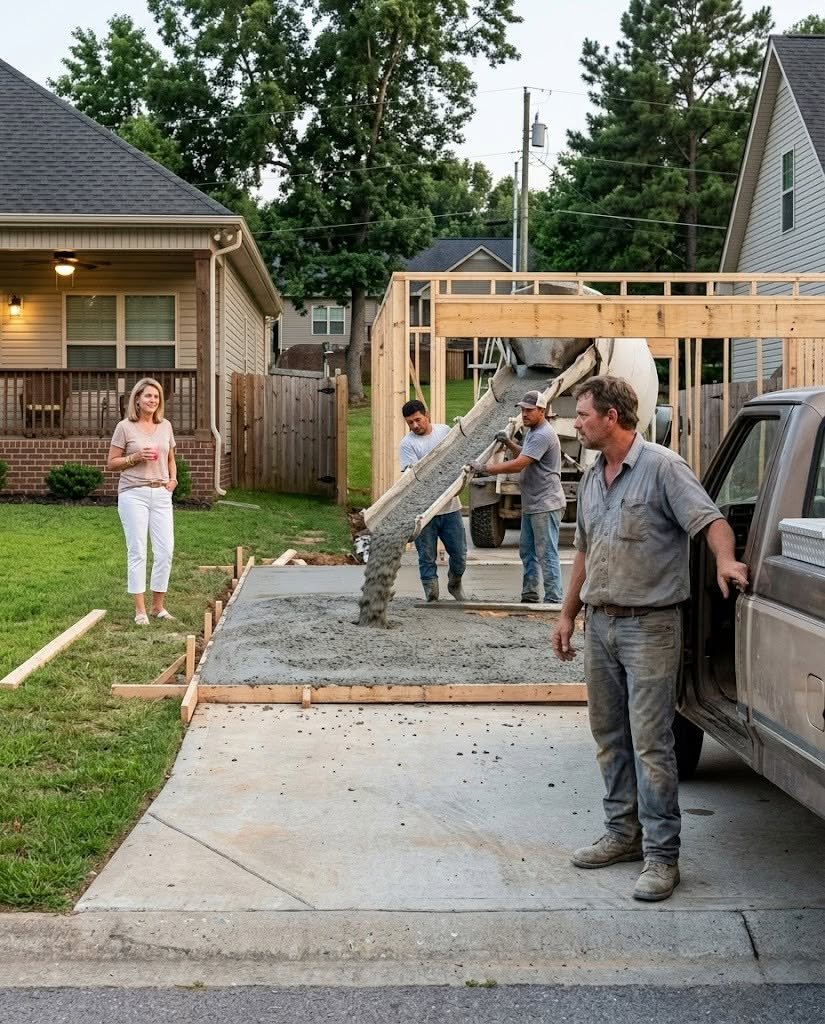
Part of the garage physically crossed onto my land.
I had checked it twice the night before.
That evening I checked it again.
Four feet.
Two inches.
Same answer.
I photographed Pam’s new boulders from multiple angles and measured the remaining clearance between the garage and fence.
Seven feet.
Dad’s van needed nine.
The next morning, I started making calls.
I didn’t call Pam.
There was nothing left to discuss with her privately.
I called a property attorney and explained the situation without adjectives.
I told him about the recorded easement.
I told him about the encroachment.
I told him about the garage frame, the fresh slab, the boulders, Dad’s wheelchair van, and Pam’s written demand tying removal of the obstruction to removal of Dad’s ramp and vehicle.
Then I sent him photographs, measurements, deed records, the plat, and copies of what I had found when I checked the construction paperwork.
No permit.
No grading approval.
No inspection request.
He called me back after reviewing the documents.
His first question was simple.
“Did you move anything?”
“No.”
“Touch the garage?”
“No.”
“Threaten her?”
“No.”
“Good.”
That one word told me more than a speech would have.
He asked whether Dad had a medical appointment scheduled.
I told him yes.
He asked whether the van could physically leave the property without crossing terrain Dad could not safely navigate.
I told him no.
Then he asked whether Pam knew that.
I looked at the paper she had handed me.
“Yes.”
There was a pause.
“Send me that demand again,” he said.
I did.
Pam spent the rest of that day behaving as if nothing could touch her.
She walked the edge of her yard while talking on her phone.
She spoke to the construction crew.
At one point, she stood beside the new framing with her hands on her hips while another load of material arrived.
I watched from my kitchen window without going outside.
Dad rolled up beside me.
“You’re making her nervous,” he said.
“I haven’t said anything.”
“Exactly.”
By afternoon, Pam finally came over.
She stopped on her side of the boulders.
“You know this could all be resolved,” she called.
I stepped onto the porch.
“How?”
“You comply.”
“With what?”
She pointed toward Dad’s ramp as though it offended her personally.
“The board has standards.”
I glanced past her at the three-car garage sitting across my driveway.
“Does the board have a standard for building on somebody else’s land?”
Her mouth tightened.
“The board approved the project.”
“That wasn’t my question.”
She shifted her weight.
Then she tried a different angle.
“You’ve always been hostile about improvements.”
I had never been hostile about improvements.
I had been hostile about an HOA letter claiming my pickup was an eyesore because it was twelve years old.
I had been hostile about a warning because Dad’s van stayed in the driveway overnight after he returned late from an appointment.
I had been hostile about Pam measuring the height of my mailbox post with a ruler while ignoring her own husband’s equipment trailer parked along the neighborhood road.
But I didn’t bring any of that up.
None of it mattered now.
The dispute had moved past personality.
It had coordinates.
It had measurements.
It had recorded property rights.
And Pam had put her demand in writing.
“I’m not discussing this with you anymore,” I said.
She gave me that same satisfied little smile.
“You’ll discuss it when the HOA starts adding fines.”
I went back inside.
That evening, the attorney called again.
The papers were moving.
Because Dad’s only usable vehicle access had been deliberately obstructed and because construction was continuing across a disputed boundary and recorded easement, he was asking the court to stop the work and restore access while the property issue was resolved.
I didn’t celebrate.
A filing wasn’t a ruling.
A strong deed wasn’t an open driveway.
Dad still had an appointment coming.
The rocks were still there.
The garage was still there.
For the next couple of days, the strangest part was how ordinary everything around the problem remained.
Coffee brewed.
Dad complained that his westerns all used the same fake town set.
I answered work emails.
A delivery truck crawled down Old Beechcroft Lane and had to reverse when Pam’s construction vehicles narrowed the turn.
Meanwhile, every time I stepped outside, there was a three-car garage where my driveway used to be.
Then Pam received notice of the legal action.
I didn’t see the delivery itself.
I knew it had happened because twenty minutes later she was at my door.
She knocked hard enough to rattle the glass.
I opened it but stayed inside.
“You sued me?” she demanded.
“I asked the court to restore access to my property.”
“You went straight to a lawyer instead of talking to the board?”
I looked over her shoulder at the boulders.
“Pam, you blocked a wheelchair van.”
Her expression sharpened.
“You’re twisting this.”
“No.”
“You could move the ramp.”
“Where?”
She hesitated.
That was the problem with measurements.
Eventually they make vague people answer specific questions.
“There are options,” she said.
“Name one that gives the van nine feet of clearance.”
She didn’t.
Instead she lowered her voice.
“If you embarrass this board publicly, don’t expect the neighborhood to forget it.”
I held her gaze.
“This stopped being about the neighborhood when your garage crossed my property line.”
She turned and walked away.
Dad had been sitting just inside the living room.
When I closed the door, he said, “She still thinks you’re arguing with her.”
“She’ll figure it out.”
The court moved faster than Pam expected.
The hearing was not dramatic.
There was no packed gallery, no shouting, no speech about justice.
There were documents.
That was enough.
My attorney laid out the recorded easement, the deed, the plat, the measurements, the photographs, and the obstruction of Dad’s only usable vehicle route.
Pam’s side leaned heavily on HOA authority and the claim that the construction had been approved as an improvement involving property beside mine.
But an HOA approval could not change the description on my deed.
It could not make seven feet become nine.
It could not move a boundary four feet and two inches simply because Pam wanted the garage where she had poured the slab.
And it could not erase the recorded access right that had been sitting in county records since 1986.
Then the written demand came up.
That changed the tone.
The paper made it difficult to pretend the boulders had been placed for landscaping or construction convenience.
Pam had tied their removal to Dad’s ramp and van.
She had documented the leverage herself.
My attorney didn’t need to call her cruel.
He just read what she had written.
The court ordered the obstruction removed and barred continued interference with the easement while the property encroachment was addressed.
The construction work stopped.
For the first time since I had returned from the Smokies, Pam could not solve the problem by issuing another HOA letter.
She had a court order to obey.
The boulders went first.
I stood beside Dad as equipment moved them away from the remaining access.
He watched from his chair near the ramp.
When the last stone was lifted clear, he looked at me.
“Nine feet?”
I took out the steel tape.
“More than nine.”
“Good.”
That was all he said.
But later that afternoon, he asked if I would drive the van down to the road and back.
He wanted to see it pass.
So I did.
Slowly.
The van rolled through the reopened space, cleared the fence, and reached Old Beechcroft Lane without touching grass or gravel.
When I backed it toward the house, Dad was still watching.
Pam was watching too.
She stood on her porch with her arms folded.
I didn’t wave.
The bigger problem remained.
Her garage was still over the line.
Stopping construction had protected the situation from getting worse, but the slab and framing didn’t become legal because the crew went home.
The boundary evidence still showed the same encroachment.
Four feet and two inches.
Pam challenged my measurements.
That part didn’t surprise me.
What surprised her was that arguing with a land surveyor about a property line is not the same thing as arguing with a neighbor about where he parks his truck.
The deed controlled.
The recorded plat mattered.
The monuments and calls in the property description mattered.
The physical measurements mattered.
Her opinion did not move any of them.
A second survey confirmed the conflict.
Pam’s garage had been placed partly on my land and across the protected access.
At that point, there was no version of the story left where the building could stay exactly as constructed.
Pam tried to make it about cost.
She complained about materials.
She complained about labor.
She complained that removing completed work would be wasteful.
I understood why she was upset about the money.
Concrete is expensive.
Framing is expensive.
Having work undone is expensive.
But none of those costs had been created by me.
I had not chosen the location.
I had not ordered the pour.
I had not told a crew to continue after the access problem was obvious.
And I had not stood on a porch saying I didn’t care whether a disabled man could get through.
Pam had made a gamble.
She had gambled that I would be intimidated by the HOA title.
She had gambled that Dad’s mobility problems would make us easier to pressure.
She had gambled that the structure would become too expensive and too inconvenient to challenge once the concrete hardened.
Most of all, she had gambled that I wouldn’t know exactly what the deed said.
That was the bet she lost.
The final order required the encroaching construction removed from my property and the easement kept clear.
There was no wrecking-ball spectacle.
There didn’t need to be.
The same kind of ordinary work that had put the garage up began taking it apart.
Lumber came down.
Fasteners were pulled.
Sections of framing disappeared from the view outside my kitchen window.
Then came the concrete work.
I stayed on my property and documented everything.
Not because I wanted souvenirs.
Because after twenty-two years surveying land, I had learned that memory is emotional and records are patient.
Dad watched part of the removal from the porch.
He had a paper coffee cup balanced in the holder on his chair.
At one point he looked at the shrinking structure and said, “That’s an expensive way to learn where the line is.”
I laughed.
That time, so did he.
Pam did not come over.
For several days she barely looked in our direction.
The HOA notices stopped too.
I don’t know whether that was embarrassment, legal advice, or simple exhaustion.
I didn’t care enough to guess.
I had never wanted to defeat an HOA.
I wanted to get my father to his van.
That was the part people seemed to miss when neighbors started whispering about what had happened.
Some treated it like a feud.
Garrett versus Pam.
Homeowner versus HOA president.
Property-line war.
But I never saw it that way.
If Pam had built six inches too close to a flower bed and fixed it when the mistake was discovered, there would have been no story.
If a contractor had misunderstood a stake and immediately stopped work, there would have been no story.
If Pam had knocked on my door and said, “We have a boundary problem; let’s sort it out,” there probably would have been no court order.
The problem was the choice she made after knowing what the obstruction did.
Dad could not simply step around it.
He could not squeeze his van through seven feet because an HOA president decided nine feet was inconvenient.
And once the boulders appeared, there was no plausible claim that his access was an accidental side effect of construction.
The obstruction had become the point.
Dad made his medical appointment.
I drove.
The van went down the same driveway it had used before Pam’s garage existed.
On the way home, we stopped for coffee.
He complained about the price.
Then he drank all of it.
That was Dad.
When we turned onto Old Beechcroft Lane, I noticed he was looking ahead toward the house.
Not at Pam’s porch.
Not at the construction debris.
At the driveway.
It was open.
A few weeks earlier, that strip of pavement had looked like something I had taken for granted my entire life.
Afterward, I understood it differently.
Access can sound like a technical word until somebody takes it away.
An easement can look like one dusty paragraph in an old deed until a wheelchair van needs to pass through the exact space it protects.
A property line can seem invisible until somebody pours concrete across it.
Pam had counted on invisibility.
She thought authority came from the title printed under her name on HOA emails.
She thought concrete made a decision permanent.
She thought inconvenience would make me negotiate away something already recorded as mine.
But boundaries do not become less real because someone ignores them.
Dad’s ramp stayed.
His van stayed.
The driveway stayed open.
And where Pam’s garage had crossed the line, the space returned to what it had been before she decided she could take it.
One afternoon, after the last of the encroaching work was gone, I walked outside with my steel tape.
Dad was on the porch behind me.
“You measuring it again?” he called.
“Habit.”
He shook his head.
I hooked the tape at the edge, walked the clearance, and looked down at the number.
Then I reeled the tape back into its case.
Dad waited.
“Well?”
I slipped it into my pocket.
“Nine feet and plenty more.”
He rolled toward the ramp.
I stepped aside.
And this time, nothing blocked his way.