The steel came down at exactly five o’clock.
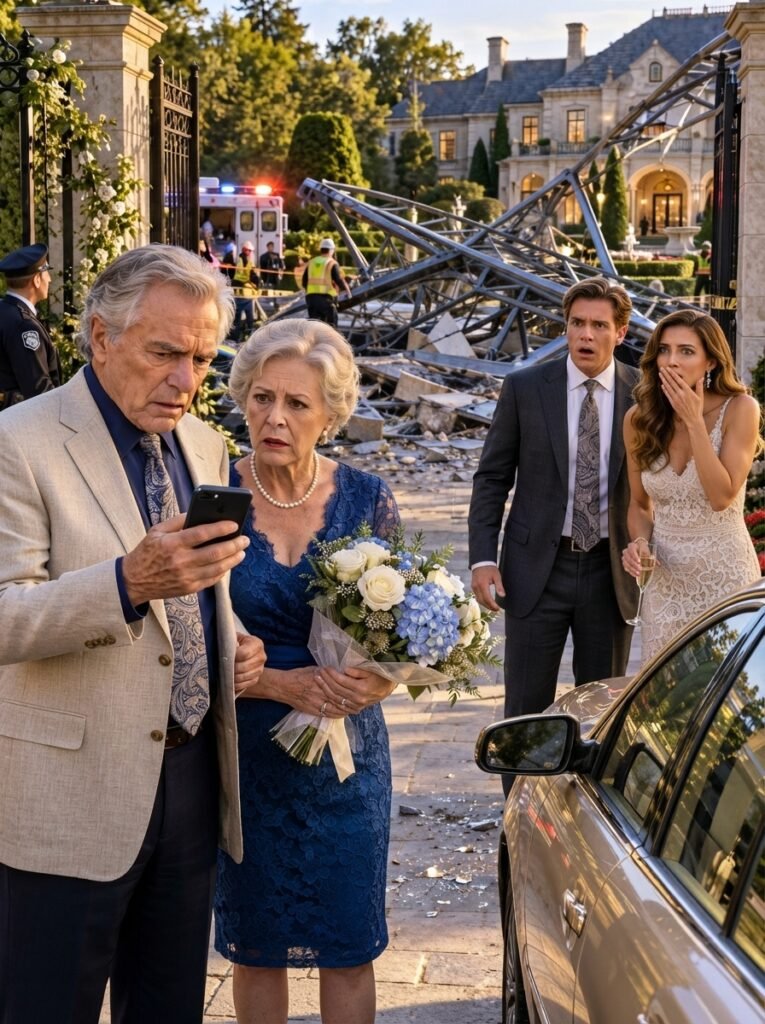
Twenty-two minutes later, when my younger son saw his mother and me step out of our sixteen-year-old Buick, he looked like a man who had just watched two dead people climb out of their graves.
His wife dropped her champagne glass.
And after thirty-one years investigating industrial disasters, I knew there was something far more frightening than the twisted wreckage blocking the entrance to their multimillion-dollar estate.
Someone had expected us to be underneath it.
My name is Walter Keene.
I was seventy-one years old that October, married to the same extraordinary woman for forty-eight years, and retired from a profession that had taught me never to believe in convenient coincidences.
I had spent seventeen years as a mechanical engineer at a manufacturing plant outside Indianapolis before moving into industrial loss investigation.
For the next thirty-one years, I examined disasters after they happened.
Collapsed warehouses.
Factory fires.
Equipment failures.
Construction accidents.
I studied photographs, interviewed witnesses, inspected damaged machinery, and examined maintenance records that companies sometimes desperately wanted to disappear.
My job wasn’t to determine who appeared guilty.
My job was to discover what had actually failed—and why.
Sometimes it was a machine.
Sometimes it was an overlooked safety procedure.
Sometimes it was a careless employee.
And sometimes, beneath all the paperwork and excuses, it was a person who had deliberately created the conditions for catastrophe.
I learned early that accidents rarely begin at the moment something breaks.
They begin days, weeks, or even years earlier, with decisions that seem harmless until the consequences arrive.
My wife, Miriam, used to tell me I was incapable of enjoying retirement.
She wasn’t entirely wrong.
I checked hotel emergency exits before unpacking our suitcases.
I inspected smoke detectors in vacation rentals.
Once, I complained to a grocery-store manager because a stack of bottled water partially blocked an emergency door.
Miriam apologized for my interruption.
Then, when we reached the parking lot, she squeezed my hand.
“You were right, Walter.”
That was our marriage.
I worried about everything.
She reminded me there were still beautiful things worth enjoying.
We raised two sons in a brick house on the outskirts of Indianapolis.
Our oldest, Adrian, was forty-six.
He worked in forensic accounting and possessed a remarkable ability to find inconsistencies that other people overlooked.
He was methodical, disciplined, and reserved.
He had inherited my suspicion of missing numbers, along with my tendency to think too much before speaking.
Our younger son, Eric, was forty-two.
Eric was different.
He had a smile that opened doors, a handshake that made strangers feel like friends, and an appetite for risk that had frightened me since he was a teenager.
At thirty-one, he founded Northline Building Supply with two trucks, a rented warehouse, and a business plan I believed was dangerously optimistic.
Seven years later, the company operated facilities in three states.
Business magazines called him a visionary.
His employees admired him.
His customers trusted him.
And despite my constant criticism, I was enormously proud of him.
I just never learned how to say it.
When Eric was fourteen and earned an A in mathematics, I asked why it wasn’t an A-plus.
When he made the varsity basketball team, I reminded him that making the roster meant nothing unless he earned a starting position.
When he landed his first major business contract, I questioned the financing instead of congratulating him.
I believed I was teaching discipline.
Adrian once told me otherwise.
“Dad, you know what Eric really wants?”
“What?”
“For you to tell him he’s done enough.”
I remember laughing.
“Life doesn’t work that way.”
Adrian looked at me for a long moment.
“Maybe that’s the problem.”
I dismissed his observation.
Years later, I would understand how much damage can be done by words a father never says.
But I would also discover something far more terrible.
One of my sons had spent years listening to lessons I never realized I was teaching.
And he had learned them in the worst possible way.
Six Weeks Before the Birthday Dinner
Eric married Vanessa Hale five years before the incident.
Vanessa was beautiful in an effortless, expensive way.
She wore tailored clothing, remembered everyone’s favorite restaurant, and could make a conversation sound intimate while revealing almost nothing about herself.
Her father had been involved in commercial real estate.
Her mother belonged to several charity boards and possessed an extraordinary talent for making insults sound like expressions of concern.
Vanessa grew up surrounded by wealth.
Or at least the appearance of it.
I never particularly liked her enthusiasm for money.
She asked questions that struck me as unnecessarily specific.
How much had we invested in Northline?
Were our preferred shares transferable?
Did our estate plan divide the company investment equally between Adrian and Eric?
Miriam thought I was being unfair.
“She’s interested in the family business,” she said.
“She’s interested in the family’s money.”
“Those aren’t always the same thing.”
Miriam had a remarkable ability to find generosity where I saw suspicious behavior.
And sometimes she was right.
During the first year of Eric’s marriage, Miriam and I invested a considerable portion of our savings in Northline’s expansion.
It wasn’t a gift.
We received properly documented nonvoting preferred shares, and the company used our capital to acquire a distribution facility near Louisville.
I reviewed the paperwork myself.
The transaction was legitimate.
Northline expanded.
Revenue increased.
Eric bought his beautiful estate outside Indianapolis, complete with landscaped gardens, a long private driveway, and a magnificent stone house that Miriam said resembled something from a magazine.
For several years, everything appeared to be going wonderfully.
Then Adrian called me on a Thursday afternoon.
“Dad, I need to ask you something about Northline.”
I was sitting in my study, reading the newspaper.
“Accounting?”
“Yes.”
“Then ask.”
He hesitated.
That alone caught my attention.
Adrian never hesitated when numbers were involved.
“Has Eric asked you for money recently?”
“No.”
“Has Vanessa?”
“No.”
“What about increasing your investment?”
I lowered the newspaper.
“Adrian, what’s wrong?”
There was a long silence.
“I found a company name where it shouldn’t have been.”
“What company?”
“Crescent Advisory.”
“Never heard of it.”
“Neither has anyone else, apparently.
Not in any meaningful operational sense.”
He explained that one of his clients had business dealings involving a Northline supplier.
During a routine review, Adrian noticed payments connected to several consulting companies.
The descriptions were vague.
The addresses belonged to virtual offices.
The ownership records disappeared behind layers of registered agents.
And some of the supposed consulting work had no supporting documentation.
“How much money are we talking about?”
I asked.
“I don’t know yet.”
“Does Eric know you’re looking?”
“No.”
“Keep it that way until you’re certain.”
“I was going to tell you the same thing.”
That irritated me.
Which meant he was probably right.
Over the following weeks, Adrian continued reviewing the financial trail.
Then, four days before Vanessa’s birthday dinner, he called again.
This time, his voice was different.
“Dad, one of Northline’s controllers contacted me.”
“Who?”
“Rachel Dominguez.”
Rachel had discovered approximately $860,000 in consulting payments made over eighteen months to entities that appeared indirectly connected to Vanessa.
Rachel had already contacted an independent attorney.
She was preserving records.
And she was frightened.
“Does Eric know?”
I asked.
“Not that I can confirm.”
“What about Vanessa?”
“We don’t know whether she understands where the money has gone.”
“That sounds like theft.”
“It might be.
But suspicious payments aren’t the same thing as proof, Dad.”
“Then find proof.”
“I’m trying.”
Adrian paused.
“There’s something else.”
“What?”
“Rachel says someone in Northline’s finance department has been asking about your preferred shares.”
My stomach tightened.
“Who?”
“She hasn’t been able to establish that.”
“Are we losing money?”
“Not yet, as far as I can tell.”
I leaned back in my chair.
“And what exactly are you telling me to do?”
“Nothing dramatic.
Keep the investment records somewhere safe.
Don’t sign anything new.
And please don’t confront Eric until we understand what’s happening.”
I stared at the family photograph above my desk.
It showed Eric at twenty-one, grinning in his college graduation gown.
Adrian stood beside him.
Miriam had both arms around our sons.
And I stood slightly apart, looking unreasonably serious.
I remembered how proud I had been that day.
How certain I was that I’d raised two decent men.
“I understand,” I said quietly.
But I didn’t.
Not even close.
Because somewhere between that conversation and Vanessa’s birthday dinner, someone began preparing a crime so carefully calculated that my entire professional experience would barely be enough to recognize it.
And the first warning arrived disguised as an ordinary invitation.
The Invitation That Became an Obsession
Vanessa called three days before her birthday.
“Walter, we’re doing something special this year.”
She sounded cheerful.
“We’d love you and Miriam to arrive at exactly five o’clock.”
“We’ll be there.”
“Five, not five-thirty.”
“I understand how clocks work, Vanessa.”
She laughed.
“And please use the west entrance.
We’re having photographs taken in the courtyard, and the main drive will be crowded with catering vehicles.”
It was a reasonable explanation.
I wrote the instruction on the calendar beside my desk.
Saturday.
Five o’clock.
West entrance.
I didn’t think about it again until the morning of the dinner.
Vanessa called at nine-fifteen.
“Just confirming you’ll be here at five.”
“Yes.”
“And the west entrance?”
“Yes.”
“Perfect.”
She hung up.
Twenty minutes later, she called again.
“One more little thing, Walter.”
I was standing in the garage, checking the tires on our newer SUV.
“What’s that?”
“Would you mind bringing the Buick instead?”
I frowned.
“Why?”
“The west driveway is narrow.
The Buick will fit better, and I don’t want your new vehicle getting scratched.”
I looked at the cars.
The Buick was sixteen years old.
Miriam loved it because the seats reminded her of the cars we owned when the boys were young.
It was reliable, but it lacked many modern safety features.
Our SUV had automatic emergency braking, collision sensors, and enough electronic warnings to make me feel as though a small committee was driving with me.
The request was strangely specific.
“Are you planning to park us in a broom closet?”
I asked.
Vanessa laughed again.
“Oh, Walter.
You’re impossible.”
Then her tone changed.
“Please.
It would mean a lot to me.”
I agreed.
But after hanging up, I stood looking at the Buick.
People who provide unnecessarily precise instructions often know something the person receiving them doesn’t.
That was a lesson from my investigation days.
I called Adrian.
“Vanessa wants us to arrive at five sharp, use the west entrance, and drive the old Buick.”
There was a pause.
“Why the Buick?”
“She says the driveway is narrow.”
“That’s strange.”
“You think so?”
“Maybe.
But don’t start imagining conspiracies because your daughter-in-law has opinions about parking.”
“I’m not imagining anything.”
“Dad, you once spent forty minutes investigating why a hotel elevator made a clicking noise.”
“And I was right about that elevator.”
Adrian sighed.
Then his voice became serious.
“Listen, Rachel found another irregularity.”
“What?”
“Some of the consulting payments appear to have financed fees connected to a large private loan.”
“How large?”
“We’re still confirming.”
“Adrian.”
“I don’t want to give you a number until I know it’s accurate.”
I didn’t like that answer.
Then he said, “Whatever happens tonight, please don’t confront Eric.”
“Why would I?”
“Because I know you.”
He was right about that too.
Upstairs, Miriam was getting dressed.
She wore a dark green dress and the pearl earrings Eric had given her after his first profitable year.
When I mentioned Vanessa’s unusual instructions, Miriam stopped fastening her necklace.
“The Buick?”
“Apparently the west driveway can’t accommodate an SUV.”
She looked at me in the mirror.
“Do you think something is wrong?”
“I think something is odd.”
“That wasn’t my question.”
Forty-eight years of marriage had given her an extraordinary ability to recognize evasive answers.
I sighed.
“I don’t know.”
Miriam turned.
“Then promise me something.”
“What?”
“If we get there and something feels wrong, we leave.”
I smiled.
“Of course.”
She kissed my cheek.
“Good.
Now stop worrying.”
We left the house at four-ten.
The drive to Eric’s estate ordinarily took thirty-five minutes.
I had already calculated that we’d arrive ten minutes early.
Miriam sat beside me, watching the October countryside roll past.
The trees were beginning to turn red and gold.
Sunlight moved through the branches, casting shifting patterns across the road.
For several minutes, neither of us spoke.
Then Miriam opened her purse.
Her expression changed.
“Oh, Walter.”
“What?”
“We forgot flowers.”
“Flowers?”
“For Vanessa.”
“It’s her birthday.
She’s probably receiving arrangements from half of Indianapolis.”
“That doesn’t mean we should arrive empty-handed.”
“We’re already halfway there.”
“Walter.”
There it was.
The tone that had settled hundreds of disagreements during our marriage.
I sighed.
“Fine.
Where?”
“There’s a florist on Meridian Road.”
“That’s out of the way.”
“Only a little.”
“It’ll make us late.”
Miriam looked at me.
Then she said something I would never forget.
“For once in your life, Walter, being late might not be the worst thing that happens.”
I assumed she was teasing me.
I turned toward the florist.
We arrived at four-thirty-eight.
Miriam spent twenty-two minutes selecting an arrangement of white roses and blue hydrangeas.
I stood beside the Buick, checking my watch.
At five o’clock, my phone rang.
Vanessa.
I declined the call because Miriam was approaching the checkout counter.
At five-oh-two, another call came.
Then a text message.
WALTER, WHERE ARE YOU?
WE AGREED ON FIVE.
I showed Miriam.
She frowned.
“Good heavens.
It’s a birthday dinner, not a military operation.”
I laughed.
But as we drove away, an uneasy feeling settled in my stomach.
I had spent my career studying situations in which timing mattered.
And Vanessa seemed unusually concerned with ours.
We reached the entrance to Eric’s private road at approximately five-twenty-two.
I saw the flashing emergency lights first.
Then the security vehicles.
Then the wreckage.
I stopped so suddenly that Miriam grabbed the dashboard.
“Dear God,” she whispered.
Ahead of us, a massive section of temporary steelwork lay twisted across the west guest drop-off lane.
Part of the unfinished pavilion had collapsed.
Thick metal beams covered the pavement.
Broken sections of decorative stone littered the driveway.
A security guard hurried toward our vehicle.
“Sir, you can’t enter here.”
“What happened?”
“Structural failure.
Nobody’s allowed through.”
“Was anyone hurt?”
“We’re still checking.”
I looked past him.
The collapsed structure covered the exact area where cars were supposed to stop before proceeding toward the courtyard.
I checked my watch.
Then I looked at the flowers resting on Miriam’s lap.
Had we arrived at five, our Buick would have been directly beneath several tons of falling steel.
I felt a coldness spread through my chest.
I got out.
Across the barricade, a site supervisor was arguing with another worker.
“Those supports were inspected yesterday,” he kept saying.
“This makes no sense.”
I looked at the steel.
Even from a distance, something about the failure bothered me.
The frame hadn’t simply folded under its own weight.
One section had separated from its supporting assembly.
The steel itself appeared relatively intact.
That suggested a problem at the connections.
I wasn’t about to make a final determination from twenty feet away.
But I knew enough to recognize a failure that required urgent scrutiny.
Then someone shouted.
“Dad!”
Eric stood near the front steps of the house.
When he saw us, his face went completely white.
For a moment, I thought he might collapse.
Vanessa stood beside him in a shimmering champagne-colored dress, holding a glass of champagne.
She looked at Miriam.
Then at me.
Then at the Buick.
The glass slipped from her fingers and shattered on the pavement.
Neither moved toward us.
Neither asked whether we’d been injured.
They stood frozen.
Watching.
And suddenly the uneasy feeling in my stomach became something much worse.
I had seen genuine surprise thousands of times.
People reacted unpredictably.
They shouted.
They cried.
They asked questions.
Sometimes they laughed from shock.
But Eric and Vanessa were not behaving like people surprised by our unexpected arrival.
They looked as though they were struggling to understand why something they had expected hadn’t happened.
My phone vibrated.
A message from Adrian.
DAD.
RACHEL FOUND ANOTHER PAYMENT.
LOOK AT THE COMPANY CONNECTED TO THE PAVILION CONTRACT.
An image followed.
It was an invoice.
At the bottom, in neat black lettering, were two words.
CRESCENT ADVISORY.
My breath caught.
The same company Adrian had been investigating.
The same company associated with the missing $860,000.
I looked up.
Vanessa was staring at my phone.
And for one terrible second, I saw raw terror cross her face.
Eric started walking toward me.
“Dad,” he said, his voice shaking.
“Before you say anything, there’s something you need to understand.”
Behind him, the site supervisor suddenly shouted.
“EVERYBODY BACK!”
A rescuer pointed toward the collapsed structure.
Something had moved beneath it.
And then I heard a faint human cry.
The Man Beneath the Steel
I turned instinctively toward the wreckage.
A young construction worker was trapped near the outer edge of the collapsed pavilion.
He was conscious.
Barely.
An emergency responder crouched beside him while another team stabilized the surrounding debris.
The worker couldn’t have been much older than twenty-five.
His left leg was pinned.
Blood stained one sleeve of his jacket.
He kept trying to say something, but the noise of the emergency vehicles drowned him out.
I stepped toward the barricade.
“Sir, stay back,” a firefighter ordered.
I stopped immediately.
The last thing rescuers needed was an uninvited retiree wandering into an unstable collapse zone.
But I could see enough.
A fractured connection plate hung from one end of a steel support.
Nearby, two attachment points were exposed.
Something was missing.
I looked at the site supervisor.
“What was supposed to connect that assembly?”
He frowned.
“Bolted steel brackets.
Why?”
“Have your people located the missing fasteners?”
His eyes moved toward the wreckage.
For the first time, his expression changed from confusion to alarm.
“They were installed yesterday.”
“Are you certain?”
“I signed off on the inspection myself.”
“Then preserve every photograph, delivery record, and inspection report.
Don’t let anyone remove anything unnecessarily.”
A police officer approached.
“Sir, who are you?”
“Walter Keene.
Retired industrial loss investigator.”
She studied me.
“Are you connected to this property?”
“My son owns it.”
She introduced herself as Detective Elena Price.
Her expression sharpened when I explained why Miriam and I were supposed to have been in the west lane at five o’clock.
“You’re saying your arrival time was specifically requested?”
“Repeatedly.”
“By whom?”
“My daughter-in-law.”
“And the entrance?”
“Same person.”
Detective Price took out a notebook.
“Would you mind staying available for a statement?”
“Not at all.”
Behind us, the rescue team began carefully lifting a section of steel.
The injured worker cried out.
Miriam gripped my arm.
“Walter, please.”
I turned toward her.
Her face was pale.
She was looking at the place where the Buick should have been.
“Let’s go somewhere safe,” she whispered.
Before I could answer, my phone rang.
Adrian.
I stepped aside.
“Adrian.”
“Dad, thank God.
Are you both okay?”
“Yes.”
“You’re sure?”
“There’s been a collapse at Eric’s house.”
“I know.
Rachel called me.”
“How?”
“Someone at Northline contacted her about the contractor.”
I looked at the wreckage.
“Adrian, what exactly have you found?”
He inhaled sharply.
“The consulting payments are connected to financing arrangements.
Rachel has uncovered documents indicating that Northline may have taken on approximately fourteen million dollars in obligations.”
I felt as if the ground had shifted.
“Fourteen million?”
“Yes.”
“Does Eric know?”
“He must know at least part of it.
But there’s something else.”
“Go on.”
His voice became almost inaudible.
“Dad, someone submitted insurance documents covering you and Mom.”
I went still.
“What kind of insurance?”
“Life insurance.
The paperwork appears to have been issued about three months ago.”
“That’s impossible.”
“Some of the documents are dated and bear signatures purporting to be yours.”
“We haven’t applied for any life insurance.”
“I know.”
“How much?”
“Millions.”
I gripped the phone.
“Who owns the policy?”
“We’re still verifying the ownership arrangements.”
“Who’s the beneficiary?”
Adrian didn’t answer.
“Adrian.”
His breathing sounded uneven.
“Dad, please listen carefully.
I don’t know if these documents are authentic.
They may have been manufactured to implicate someone.”
“Who?”
Another silence.
Then my oldest son whispered:
“Me.”
For several seconds, I couldn’t speak.
“What?”
“The beneficiary designation names me, Dad.
I swear I didn’t authorize it.
Someone put my name there.”
I stared at the ruined pavilion.
At the ambulance.
At Eric and Vanessa standing outside their beautiful home.
“Why would someone do that?”
“I don’t know.”
For the first time in my life, Adrian sounded frightened.
Then he said something that made the situation even more disturbing.
“Dad, if someone tried to kill you and Mom today, they’re going to want the police to believe I arranged it.”
I closed my eyes.
He was right.
Or at least, his explanation was possible.
And I was suddenly facing the kind of question I had spent my career trying to answer without prejudice.
Was the evidence pointing toward the guilty person—or toward the person someone wanted us to blame?
I told Adrian not to contact anyone at Northline until the police had secured the records.
He agreed.
When I hung up, Miriam was watching me.
“What did he say?”
I looked at her.
For the first time in forty-eight years, I couldn’t bring myself to tell my wife everything.
“Something very bad is happening,” I whispered.
She squeezed my hand.
“I know.”
There was something unusual about the way she said it.
Not fear.
Not confusion.
Almost as if she had been expecting those words.
Before I could question her, Detective Price approached.
“Mr.
Keene, we need to speak with you and your family separately.”
She glanced toward the mansion.
“We’ve secured the construction area.
We also need to establish who authorized the guest lane to remain open during an active installation.”
“Why?”
“Because the supervisor says he ordered that lane closed at noon.”
My heart began pounding.
“And?”
“Someone overrode his instruction.”
“Who?”
“We’re checking.”
I looked toward the estate.
Eric stood beside the front steps.
Vanessa had disappeared.
Then Detective Price added one more detail.
“The young worker we pulled from the wreckage is conscious.
He says somebody delivered replacement hardware to the site late yesterday.”
“Who?”
“He doesn’t know.
But he says the delivery was accompanied by instructions not to document the change until after the weekend.”
I felt cold.
That was no longer the language of an ordinary construction accident.
It was the language of concealment.
And somewhere inside the beautiful house ahead of us, someone knew exactly why those instructions had been given.
The Warning My Wife Had Hidden
We spent the next two hours giving statements.
Detective Price was thorough.
She asked about our departure time, the route we’d taken, Vanessa’s calls, and why we’d brought the Buick.
I answered everything.
Then she asked Miriam why we’d stopped for flowers.
My wife looked down at the bouquet resting beside her chair.
“Because I wanted to be late,” she said.
I turned.
“What?”
Miriam’s eyes filled with tears.
“Walter, there’s something I haven’t told you.”
My stomach dropped.
She opened her purse and removed her phone.
“At four-twenty-six, while you were checking the garage door, I received a message.”
She handed me the screen.
It came from an unfamiliar number.
The message contained only two sentences.
PLEASE DON’T LET DAD REACH THE WEST ENTRANCE AT FIVE.
I CAN’T EXPLAIN RIGHT NOW.
I stared at the words.
“Who sent this?”
“I don’t know.”
“Why didn’t you show me?”
“Because I knew what you’d do.”
I looked at her.
“You’d have called Eric immediately.
You’d have confronted him.
And if someone was threatening him, I didn’t know whether that would make things worse.”
She wiped her cheeks.
“I thought it might be a cruel prank.
But I couldn’t ignore it.”
“Why flowers?”
“Because I needed an excuse to delay us without making you suspicious.”
I looked at the arrangement.
White roses.
Blue hydrangeas.
Miriam had spent twenty-two minutes selecting flowers that I now realized she hadn’t particularly cared about.
“Why didn’t we simply go home?”
“I considered it.
But I also thought Eric might need us.
Once five had passed, I wanted to see whether everyone was all right.”
Her voice broke.
“I didn’t know anything was going to collapse, Walter.”
I put my arms around her.
For forty-eight years, I’d been the one who inspected equipment, anticipated danger, and insisted that preparation saved lives.
Yet when it mattered most, my wife had trusted a warning she couldn’t explain.
She had saved us by doing the one thing I almost never allowed myself to do: changing the plan.
Detective Price asked permission to document the message.
Miriam agreed.
The detective studied the screen.
“Does either of your sons usually call Mr.
Keene ‘Dad’?”
“Both,” Miriam said.
“Could this have come from Eric?”
“I don’t know.”
“Adrian?”
“Possibly.”
Price wrote something down.
Then she asked a question that made my skin prickle.
“Mr.
Keene, who knew your wife would insist on stopping for flowers?”
“Nobody.”
Miriam shook her head.
“Not even Walter.
I invented the excuse after receiving the message.”
The detective nodded slowly.
“So whoever sent this warning knew about the scheduled arrival, but your delay wasn’t part of the original arrangement.”
“That’s correct.”
Price closed her notebook.
“Then we need to find out who was trying to save you.”
She stood.
“And who was trying to make certain you arrived on time.”
The First Confession
At eight-thirty that evening, Vanessa asked to speak with the detective.
Not with Eric.
Not with me.
With Detective Price.
I was sitting in a guest room with Miriam when a uniformed officer came upstairs.
“Mr.
Keene, your daughter-in-law has provided information concerning the construction contract.
Detective Price would like you to clarify one financial matter.”
I followed him downstairs.
Vanessa sat at the dining-room table.
Her beautiful birthday dress was wrinkled.
Mascara had dried beneath her eyes.
The woman who normally seemed perfectly assembled looked as though she’d aged ten years in a single afternoon.
She didn’t look at me.
Detective Price placed a folder on the table.
“Mrs.
Keene has acknowledged approving several payments to Crescent Advisory.”
I felt my jaw tighten.
“How much?”
Vanessa whispered, “About a hundred and forty thousand dollars that I knew about.”
“What for?”
She swallowed.
“My mother’s finances were collapsing.
After my father died, we discovered he’d borrowed against almost everything he owned.”
I said nothing.
“Eric offered to help, but I couldn’t stand the thought of everyone knowing my family was broke.”
“So you took money from his company?”
Her eyes filled.
“Adrian suggested a consulting arrangement.”
The room became very still.
“Adrian?”
I repeated.
She nodded.
“He said Northline needed marketing and corporate-development services.
He told me my experience organizing events and working with commercial-property contacts would be useful.”
“Did you do the work?”
“Some of it.”
“All of it?”
She looked away.
“No.”
I clenched my fists beneath the table.
Vanessa began crying.
“I signed invoices I shouldn’t have signed.
I know that.
I was embarrassed, and I was stupid, and I thought I’d pay everything back.”
“What happened to the rest of the money?”
“I didn’t know there was more until Rachel contacted me.”
“Then why didn’t you tell Eric?”
“Because Adrian told me he could make sure Eric went to prison.”
I stared at her.
She reached into her handbag and removed several printed messages.
“Adrian said Eric had signed documents pledging company assets to secure a private loan.
He said the paperwork contained representations Eric couldn’t support.”
“And?”
“He told me that if I exposed Crescent, the lenders would call the loan and Northline would collapse.”
“Did you believe him?”
“Yes.”
Her voice cracked.
“Eric had spent eleven years building that company.
Hundreds of people depend on it.”
Detective Price leaned forward.
“Vanessa, tell Mr.
Keene why you repeatedly insisted that he arrive at five o’clock.”
Vanessa covered her face.
“Because Adrian told me to.”
My heart began pounding.
“What?”
“He said it was important for the family photographs.
He said he’d arranged a surprise presentation for the company anniversary and needed everyone in place before the other guests arrived.”
“Did he tell you to ask for the Buick?”
She nodded.
“Why?”
“He said the west entrance would be crowded and your old car would be easier to park.”
I felt something inside me fracture.
“Vanessa, you’ve been married to Eric for five years.
You know I don’t like being told what to do.
Why didn’t you ask Adrian to make those requests himself?”
“Because he said you’d be more likely to cooperate if the instructions came from me.”
She wiped her eyes.
“And because I was afraid of him.”
“Did you know the pavilion was going to collapse?”
“No.”
“Look at me.”
She did.
“Did you know?”
Her voice rose.
“I knew something was wrong, Walter, but I didn’t know anyone was going to die!”
Detective Price asked her to explain.
At approximately four-forty-five, Adrian had called Vanessa.
He asked whether we’d arrived.
She told him we hadn’t.
He became angry.
Vanessa said she’d never heard him speak that way before.
“He told me everything depended on the schedule.”
“What exactly did he say?”
Price asked.
Vanessa hesitated.
Then she repeated the sentence.
“If they miss the window, we lose our only chance.”
I felt sick.
“What window?”
“He wouldn’t tell me.”
She began shaking.
“I called you at five.
When you didn’t answer, I called again.
I wanted to know where you were.”
“Why didn’t you warn us?”
“I was trying to understand what was happening.”
She looked at the shattered patio doors, beyond which the cleanup crews were still working.
“Then the pavilion fell.”
Her voice dropped to a whisper.
“I thought you were underneath it.”
“Is that why you dropped your glass when you saw us?”
Vanessa nodded.
“I was relieved.
Then I looked at Eric, and he looked so terrified that I realized something worse might be happening.”
She covered her mouth.
“Adrian called again after the collapse.
He asked whether you and Miriam had arrived.”
I leaned forward.
“What did you tell him?”
“That you were alive.”
“And?”
“He didn’t say anything for several seconds.”
Vanessa looked directly at me.
“Then he told me not to speak to the police without a lawyer.”
I sat back.
For six weeks, Adrian had been helping me investigate suspicious payments.
He had warned me about financial irregularities.
He had called immediately after the collapse.
He had even volunteered the shocking information that his own name appeared as an insurance beneficiary.
Everything he had done made him look like the person trying to protect us.
Yet now Vanessa was telling me he had been giving the instructions.
I wanted to believe she was lying.
I wanted to believe she was trying to protect herself.
But a professional investigator learns to distinguish what he hopes is true from what the evidence actually supports.
And Vanessa had just handed the detective the first evidence that pointed toward someone I had never truly considered.
My oldest son.
The Son Who Couldn’t Look at Me
Eric found me shortly after ten.
He was standing in the darkened kitchen, holding a mug of coffee he hadn’t touched.
“Dad.”
I stopped in the doorway.
“Did you know about the fourteen-million-dollar loan?”
He closed his eyes.
“Some of it.”
“How much is ‘some’?”
“I knew about a financing facility.
Adrian helped arrange it.”
“Did you sign the agreement?”
“Yes.”
“Did you understand it?”
He looked ashamed.
“Not completely.”
I stared at him.
A familiar anger rose inside me.
“You’re the chief executive of a company with facilities in three states, and you’re telling me you signed a major loan agreement without understanding it?”
“I trusted Adrian.”
“That’s not an answer.”
Eric slammed the mug onto the counter.
“I KNOW!”
The sound echoed through the kitchen.
Then his shoulders collapsed.
“I know, Dad.”
He sat down.
“I was trying to keep the company alive.”
Northline had suffered a difficult year.
Two major customers had delayed payments.
Inventory costs had risen.
A planned expansion consumed more cash than expected.
Adrian offered to arrange bridge financing through a private lender.
“He said it would give us breathing room,” Eric whispered.
“He said I was a good businessman, but I needed someone who understood complicated financial structures.”
“Did he tell you the loan was fourteen million?”
“The facility had that limit.
But he said most of it wouldn’t be drawn unless we needed it.”
“Was it?”
Eric nodded miserably.
“That’s what Rachel discovered.”
I sat opposite him.
“Where did the money go?”
“I thought it went to suppliers, acquisition deposits, and refinancing older obligations.”
“And now?”
“Now I don’t know.”
I studied his face.
“Did you send your mother a message this afternoon?”
Eric’s eyes lifted.
“What message?”
“Four-twenty-six.
From an unfamiliar number.”
The color drained from his face.
I watched the answer appear before he spoke.
“Yes.”
My throat tightened.
“Why?”
He rubbed his hands together.
“At four-fifteen, I overheard Adrian arguing with a construction contractor on the phone.”
“What did he say?”
“He kept asking whether the west lane would be clear at five.”
Eric swallowed.
“The contractor told him everything was ready.”
“What did you think that meant?”
“At first?
Something about the presentation Vanessa was arranging.”
“And then?”
“Adrian said, ‘They have to be under it when it releases.’”
The kitchen seemed to tilt.
I heard my own breathing.
“Under what?”
“I didn’t know.”
“Then why didn’t you call me?”
“I tried.”
I took out my phone.
There was a missed call from Eric at four-twenty-three.
I hadn’t heard it.
He had then used an unregistered company phone to message Miriam because he feared Adrian could access his business communications.
“I sent Mom the warning,” he whispered.
“I knew she’d find a way to make you late.”
“Why didn’t you call the police?”
His eyes filled.
“I should have.”
“That’s not what I asked.”
He stared at the table.
“Because I was afraid I was misunderstanding something.
Because Adrian had been telling me for months that if I exposed the financing arrangements, people would lose their jobs.
Because I thought if I could keep you away, I’d have time to figure it out.”
His voice broke.
“Because I was a coward.”
I looked at my younger son.
The boy whose ambition I had constantly criticized.
The man whose success I’d so rarely praised.
And I realized how easily fear had been dressed up as loyalty.
“You should have called the police,” I said.
“I know.”
“You should have warned me directly.”
“I know.”
I leaned forward.
“But you sent that message.”
He nodded.
“And your mother listened.”
Eric covered his face.
“I saw the pavilion fall.
I thought I’d been too late.”
When he looked up again, his eyes were red.
“Then you got out of the Buick, and I couldn’t move.
I thought I was looking at a miracle.”
I reached across the table.
For the first time in longer than I could remember, I held my younger son’s hand.
“Eric, listen carefully.”
He stared at me.
“Whatever mistakes you’ve made, whatever money you’ve lost, whatever legal consequences follow, we will face the truth.”
“Dad—”
“But you do not get to hide behind fear anymore.
Not from me.
Not from the police.
Not from yourself.”
Tears rolled down his cheeks.
“I understand.”
I squeezed his hand.
Then I asked the question I’d been avoiding.
“Do you believe your brother tried to kill us?”
Eric closed his eyes.
And whispered:
“I believe Adrian knew exactly where you were supposed to be at five o’clock.”
The Fourteen-Million-Dollar Lie
The following morning, Detective Price called and asked Miriam and me to come to the police station.
She wasn’t alone.
Rachel Dominguez was there with her attorney.
Rachel was thirty-eight, with dark hair pulled tightly behind her head and the tired eyes of someone who hadn’t slept properly in days.
She stood when we entered.
“Mr. and Mrs.
Keene, I’m sorry.”
I shook my head.
“You have nothing to apologize for.”
Her eyes filled.
“I found the discrepancies months ago.
I should have acted sooner.”
“Tell me what you found.”
Her attorney opened a thick folder.
Northline’s private financing arrangement was considerably more complicated than Eric had understood.
A lender had committed a facility of approximately fourteen million dollars, supposedly secured by inventory, receivables, equipment, and certain ownership interests.
But someone had submitted documents that falsely represented our preferred shares as available collateral.
Other records showed unusual transfers connected to the loan proceeds.
A portion of the money had moved through acquisition accounts.
Some had gone toward legitimate company obligations.
But several million dollars had been transferred to entities without any clear business purpose.
“Who controlled those entities?”
I asked.
Rachel looked at Detective Price.
The detective nodded.
“One of them was called Kestrel Holdings.”
“Who owns it?”
“On paper, a private trust.”
“Controlled by whom?”
Rachel pushed a document toward me.
At the bottom was a signature.
I recognized it immediately.
Adrian Keene.
My oldest son.
The boy who once helped his classmates with mathematics.
The teenager who carefully saved every dollar from his first summer job.
The adult who had spent six weeks warning me about suspicious financial transactions.
I stared at the signature.
“Could it have been forged?”
“That’s what we’re investigating,” Rachel answered.
She opened another file.
“This document has a notarized certification.
We’ve independently verified that Adrian attended the signing.”
I felt something crack inside my chest.
But there was more.
Northline’s original investment agreement gave Miriam and me limited protective rights.
Although our preferred shares carried no ordinary voting power, certain major transactions—including sales of significant business assets and changes affecting our investment priority—required our consent.
I remembered negotiating those provisions years earlier.
I’d wanted to protect our retirement savings without interfering in Eric’s daily management.
Rachel placed another document before me.
“Someone submitted an amendment supposedly transferring those protective rights to an entity controlled by Adrian.”
I studied the signatures.
Mine appeared at the bottom.
So did Miriam’s.
Neither was genuine.
“These are forged,” I said.
Rachel nodded.
“We believe so.”
Then she explained the insurance documents.
The supposed multimillion-dollar life policies had been submitted using questionable identity and consent records.
The beneficiary designation identified Adrian through a trust arrangement.
The documents had also been used to support representations made to the lender.
Detective Price was careful.
“We don’t yet know whether the insurer would have honored any claim.
There are serious questions about the validity of the applications.
But the documents establish something important.”
“What?”
“Someone was making financial plans based on your deaths.”
My hands began trembling.
Rachel continued.
“There’s another problem.
Your estate documents name Adrian as executor.”
I closed my eyes.
Of course they did.
Miriam and I had chosen our oldest son years earlier because he was responsible, careful, and knowledgeable about financial matters.
If we died, he would be the person responsible for administering our estate, subject to the courts and applicable safeguards.
Under the fraudulent documents, he could attempt to gain control over decisions involving our Northline investment while creditors fought over the company’s assets.
And if the company collapsed under its hidden debt, assets could be purchased through entities connected to whoever controlled that debt.
I looked at Rachel.
“You’re telling me someone planned to bankrupt Eric’s company, purchase its assets cheaply, and benefit from insurance arrangements connected to our deaths?”
“That’s one possible interpretation of the records.”
I swallowed.
“And my older son appears in the middle of it.”
Rachel didn’t answer.
She didn’t need to.
I stared at the documents until the numbers blurred.
Then something occurred to me.
“Why did Adrian tell me about Crescent Advisory six weeks ago?”
Detective Price leaned back.
“That’s an important question.”
“He started this investigation.
He brought me the concerns.
He warned me about Vanessa.”
Rachel looked uncomfortable.
“Mr.
Keene, Adrian didn’t discover Crescent Advisory by accident.”
“What do you mean?”
She opened her laptop.
“The company name appeared in records he was authorized to review.
But the particular irregularity he described to you was not where he claimed to have found it.”
My pulse quickened.
“He misrepresented the source?”
“Yes.”
“Why?”
Rachel took a breath.
“Because the trail he showed you had been arranged to point toward Vanessa.”
I remembered every conversation.
Every warning.
Every carefully timed pause.
Every occasion when Adrian had advised me not to confront Eric.
And suddenly, the pattern became visible.
Adrian hadn’t necessarily been investigating the fraud.
He might have been managing what I discovered about it.
He had directed my attention toward Vanessa.
He had made Eric appear financially incompetent.
He had positioned himself as the only person capable of protecting the family.
And when the supposed insurance beneficiary information emerged, he’d immediately volunteered that his own name appeared.
At the time, I thought that was proof of honesty.
Now I understood another possibility.
By revealing damaging information first, Adrian could make it appear that someone else was framing him.
I had seen the same tactic during industrial investigations.
People sometimes disclosed small, carefully selected pieces of incriminating information to gain credibility while concealing the truth.
I looked at Detective Price.
“He’s been controlling the story.”
She nodded.
“That is what the evidence increasingly suggests.”
My stomach turned.
Then Miriam spoke.
“There’s something else.”
Everyone looked at her.
She folded her hands.
“Three weeks ago, Adrian came to our house.”
I turned.
“What?”
“You were in Chicago visiting your old colleague.”
I remembered the trip.
“He brought paperwork,” she continued.
“He said there were some routine adjustments needed for Northline’s refinancing.”
Rachel sat forward.
“What paperwork?”
“An amendment concerning our investment.”
“Did you sign it?”
“No.”
“Why not?”
Miriam gave a small, sad smile.
“Because Walter has spent forty-eight years teaching me never to sign a financial document I don’t understand.”
I almost laughed.
Almost.
“What did Adrian do?”
Detective Price asked.
“He told me I was being difficult.
Then he apologized.”
Miriam’s voice trembled.
“He said we’d discuss it when Walter returned.”
“Did he come back?”
“No.”
She stared at the table.
“But two days later, Vanessa called and asked whether we’d ever considered transferring our investment entirely to Eric.”
My blood ran cold.
“Why didn’t you tell me?”
“Because I thought they were having a family disagreement about financing.
I didn’t want to accuse either son without understanding it.”
Detective Price looked at Rachel.
“When was the supposed amendment executed?”
Rachel checked the date.
“Three weeks ago.
The day after Mrs.
Keene says she refused to sign.”
The room fell silent.
Someone had forged our signatures almost immediately after Miriam refused.
And for the first time, I began to understand why both of us had been ordered to arrive at the estate at precisely five o’clock.
Our deaths would remove the two people most capable of challenging the fraudulent transfer.
I had spent my professional life searching for a single failed component.
Now the components were financial documents, family relationships, and a steel pavilion.
And they were beginning to fit together.
The Evidence That Changed Everything
Two days later, the investigation took another devastating turn.
The injured construction worker survived.
His name was Caleb Morris.
He was twenty-six, recently married, and expecting his first child.
His left leg required surgery, but doctors believed he would eventually recover.
Detective Price interviewed him at the hospital.
Caleb remembered receiving instructions to keep certain delivery records off the ordinary site log until after Vanessa’s birthday event.
He had objected.
His supervisor had assured him the paperwork would be reconciled after the weekend.
Caleb also remembered a visitor arriving the previous afternoon.
A man in an expensive dark coat.
The visitor had inspected the west pavilion and spoken privately with a subcontractor responsible for the temporary structure.
At first, Caleb couldn’t remember the man’s name.
Then Detective Price showed him photographs.
He immediately recognized Adrian.
My son.
Caleb said Adrian had been unusually interested in the guest drop-off lane.
He had asked exactly where a vehicle would stop.
He had asked how long guests would ordinarily remain beneath the unfinished overhead framework.
And he’d insisted that the west entrance remain accessible for the birthday event.
The subcontractor, a man named Grant Sloane, had since disappeared.
But he hadn’t disappeared far enough.
Investigators located him at a motel in southern Indiana.
His phone contained messages concerning unauthorized changes to the temporary steelwork.
The messages were not a complete explanation of the collapse.
That would require engineering examination.
But they showed something profoundly disturbing.
Grant had been paid through a company linked to Crescent Advisory.
And Adrian had been communicating with him before the birthday dinner.
Rachel’s attorney provided an additional piece of evidence.
A payment schedule.
The contractor had received an unusually large advance shortly before the collapse.
The account funding that payment traced back through entities associated with Kestrel Holdings.
My son was connected to the suspicious financing.
The shell-company payments.
The insurance documents.
And now the contractor responsible for the collapsed pavilion.
I wanted to reject it.
I wanted some missing piece of information to appear and explain everything.
But after three decades examining industrial disasters, I knew that evidence didn’t become less meaningful simply because it implicated someone you loved.
That evening, I sat alone in my study.
On the wall above my desk hung the photograph of our family at Eric’s college graduation.
Adrian stood beside his brother, smiling politely.
Eric had one arm around Miriam.
I stood on the other side, looking proud but serious.
I remembered an evening when Adrian was nine years old.
He had spent weeks building a model bridge for a school competition.
He worked with wooden sticks, glue, and string, carefully calculating how much weight the bridge might support.
He won first prize.
When he showed me the trophy, I inspected his project.
“Your connections are weak,” I told him.
His smile faded.
“But I won, Dad.”
“I know.
I’m saying you could make it stronger.”
He stood quietly for a moment.
Then he carried his trophy upstairs.
I never understood why Miriam was angry with me afterward.
Now, sitting beneath that photograph, I remembered something else.
Three years later, Adrian won a regional mathematics competition.
I wasn’t there.
I’d been called away to investigate a factory explosion.
I told him we’d celebrate when I returned.
When I finally came home, he was asleep.
The trophy sat on the kitchen counter.
I meant to congratulate him the following morning.
I forgot.
I had no memory of telling my older son how proud I was of him.
That realization hurt more than I expected.
But another truth followed it.
A father’s failures might explain a child’s wounds.
They do not excuse what that child chooses to do with them.
Whatever mistakes I’d made, I had never taught Adrian that money mattered more than human life.
At least, that was what I wanted to believe.
My phone rang.
Adrian.
I stared at his name.
Then answered.
“Hello, son.”
“Dad, I need to see you.”
“Why?”
“Because someone’s trying to destroy our family.”
I looked at the photograph.
“Yes,” I said quietly.
“I believe someone is.”
He exhaled.
“Vanessa has been talking to the police.
She’s blaming me.”
“She has mentioned your involvement.”
“Dad, you know me.”
I closed my eyes.
“I thought I did.”
There was a long silence.
Then Adrian spoke in a voice so cold I barely recognized it.
“Everything I have done has been to protect this family from Eric’s mistakes.”
My heart began pounding.
“What have you done, Adrian?”
He hesitated.
Then his familiar, reassuring tone returned.
“Come to the old distribution warehouse tomorrow.
I’ll explain everything.
Bring the original preferred-share documents.
Once you see the whole picture, you’ll understand.”
He gave me an address.
It was the first warehouse Eric had rented when he started Northline.
The place where Miriam and I had celebrated his first profitable year with pizza eaten from cardboard boxes.
A place associated with our family’s happiest memories.
“I’ll think about it,” I said.
“Dad, please.”
“Good night, Adrian.”
I hung up.
Then I called Detective Price.
The Last Conversation With My Oldest Son
I didn’t go to the warehouse alone.
Detective Price had already warned me that confronting Adrian could be dangerous.
She arranged a controlled meeting, with officers nearby and additional safeguards in place.
Miriam insisted on coming.
“No,” I told her.
She crossed her arms.
“Walter Keene, that young man is my son too.”
“Miriam—”
“I carried him for nine months.
I stayed up with him when he was sick.
I sat through every school performance you missed because you were working.”
Her eyes filled.
“And if he’s responsible for this, I have questions of my own.”
I couldn’t argue with that.
The warehouse looked smaller than I remembered.
Its faded loading doors faced a cracked parking lot.
Weeds pushed through the pavement.
The enormous business Eric had built began here, in a place hardly anyone passing on the highway would notice.
Adrian stood near the office entrance.
He wore a gray coat and carried a leather briefcase.
When he saw Miriam, his expression tightened.
“Mom?
I thought Dad was coming alone.”
“Families don’t always do what you expect,” she said.
He gave a strained smile.
“Come inside.”
The warehouse smelled of old lumber and dust.
I remembered Eric unloading his first truck here.
I remembered Adrian helping him reconcile invoices late into the night.
Back then, I had believed my sons would always protect each other.
Adrian led us into the little office.
He placed several documents on the desk.
“I can save Northline,” he said.
I remained standing.
“From what?”
“From Eric.”
“Eric built Northline.”
“And he’s been driving it into the ground.”
“He made mistakes.”
“Millions of dollars’ worth.”
“Then he must answer for them.”
Adrian gave a bitter laugh.
“There’s the Walter Keene I know.”
I studied him.
“What does that mean?”
“It means you never change.”
He began pacing.
“Eric gets praised for taking risks.
Eric gets called brilliant when things go well.
When he makes a mistake, everyone rushes to help.”
“That’s not true.”
“Isn’t it?”
He stopped.
“I spent my entire life doing things correctly, Dad.
Perfect grades.
Good schools.
A respectable career.
No scandals.
No expensive failures.”
His voice rose.
“And what did I get?”
I said nothing.
“More work.
More responsibility.
More expectations.”
He pointed toward the warehouse.
“Eric starts a company with two trucks, and you invest your retirement savings.”
“You know why we did that.”
“Because you believed in him.”
“Because we believed in the business.”
Adrian shook his head.
“You believed he could become something extraordinary.”
He swallowed.
“You never believed that about me.”
Miriam stepped forward.
“Adrian, that’s not true.”
He looked at her.
“Mom, you spent my entire childhood making excuses for him.”
Her face went pale.
“I spent your childhood loving you.”
He looked away.
I took a breath.
“Adrian, I wasn’t the father you deserved.”
That stopped him.
“I should have told you I was proud of you.
I should have celebrated your achievements.
I should have been there when you needed me.”
His eyes flickered.
For a moment, I saw the nine-year-old boy holding a model bridge.
Then the bitterness returned.
“Too late, Dad.”
I nodded.
“Maybe.”
I stepped closer.
“But I need you to answer something.”
“What?”
“Why did you arrange the financing through Kestrel Holdings?”
He froze.
“What are you talking about?”
“Why did Northline money move through Crescent Advisory?”
“Dad, those companies are connected to Vanessa.”
“Some of the initial transactions were.
But the money moved farther than that.”
He said nothing.
I continued.
“And why did someone submit insurance documents using forged signatures from your mother and me?”
Adrian stared at me.
“Someone is framing me.”
“Who?”
“Vanessa.
Maybe Eric.”
“Why would Vanessa put your name on the insurance?”
“To make me look guilty.”
I nodded slowly.
“Then why did you tell her to have us arrive at exactly five?”
His jaw tightened.
“I didn’t.”
“Why did you tell her to request the Buick?”
“She’s lying.”
“Why did you instruct the construction contractor to leave the west lane open?”
“I didn’t.”
“Why did Grant Sloane receive money through an entity connected to Kestrel?”
Adrian’s expression changed.
Only slightly.
But I’d spent thirty-one years interviewing people who were trying to hide catastrophic mistakes.
I recognized the moment an explanation became difficult to maintain.
He sat down.
“You don’t understand how badly Eric damaged the company.”
“Then explain it.”
“He was going to lose everything.”
“So you stole from him?”
“I was reorganizing the financing.”
“Without telling him?”
“He wouldn’t have understood.”
“Did you forge our signatures?”
Adrian looked at Miriam.
“Mom, tell him he’s being ridiculous.”
She stood perfectly still.
“Answer your father.”
His face hardened.
Then he said something that changed everything.
“You should have signed the amendment when I brought it to the house.”
Miriam inhaled sharply.
I looked at him.
“Why?”
“Because it would have solved the problem.”
“How?”
“I could have taken control of the restructuring.”
“You could have taken control of Eric’s company.”
He said nothing.
I stepped closer.
“That was always the plan, wasn’t it?”
Adrian looked away.
“You needed us to surrender our protective rights.”
Silence.
“And when your mother refused, you found another way.”
His expression twisted.
“I was trying to save something that belonged to this family.”
“No,” I whispered.
“You were trying to take it.”
For several seconds, nobody moved.
Then Adrian reached into his briefcase.
He removed another set of papers.
“There’s still a way to fix this.”
I looked down.
A proposed transfer agreement.
The same protective rights.
The same ownership interests.
And a space for my signature.
“If you sign,” Adrian said, “I can restructure the debt.
I can keep the company out of receivership.
I can protect the employees.”
I stared at him.
“And if I don’t?”
His voice became quiet.
“Then Eric may lose everything.”
Miriam moved beside me.
“Walter, don’t.”
I wasn’t going to.
I pushed the document away.
“No.”
Adrian closed his eyes.
Then he laughed.
It was a horrible sound.
Exhausted.
Bitter.
Almost relieved.
“You always did love saying that word.”
I shook my head.
“Not when it mattered.”
I looked at him.
“Adrian, tell me what was supposed to happen at five o’clock.”
He looked up.
For the first time, the practiced expression disappeared from his face.
“You wouldn’t understand.”
“Try me.”
His eyes filled.
“Everything was supposed to become simple.”
My blood turned cold.
“What does that mean?”
He stood abruptly.
“The financing would have been protected.
The estate would have been administered.
The debt could have been settled.
Northline could have been reorganized without Eric fighting every decision.”
Miriam covered her mouth.
“And us?” she whispered.
Adrian stared at her.
His silence was unbearable.
I took a step toward him.
“Did you expect your mother and me to die?”
He looked at the floor.
Then he said:
“I wasn’t supposed to have to do it that way.”
Miriam made a small, broken sound.
I felt as though someone had driven a steel beam through my chest.
“Adrian.”
He looked up.
I had one final question.
“Did you know people would be beneath that pavilion when it collapsed?”
His expression changed again.
And in a moment of terrible clarity, I understood that he had already answered.
I stepped back.
The office door opened.
Detective Price entered with two officers.
“Adrian Keene, we need you to come with us.”
He stared at her.
Then at Miriam.
Then at me.
“You called the police?”
I couldn’t speak.
Miriam answered.
“We gave you a chance to tell the truth.”
Adrian laughed bitterly.
“You chose Eric.”
I looked at my oldest son.
“No.”
My voice trembled.
“I chose not to let you kill anyone else.”
The officers took him into custody.
He didn’t resist.
As he passed me, he stopped.
For one brief moment, he looked like the boy who had waited for me to congratulate him on his trophy.
“Dad?”
I looked at him.
“Yes?”
“Was I ever enough?”
My eyes filled.
“Oh, Adrian.”
I stepped closer.
“You were enough the day you were born.”
His face crumpled.
For one moment, I thought he might reach for me.
Instead, he lowered his head.
And the officers led him away.
The Second Plan
I believed the worst was over.
I was wrong.
During the following investigation, detectives uncovered something even more disturbing than the attempted murder.
Adrian had prepared two different financial strategies.
One depended on our deaths.
The other depended on our survival.
That was the part I hadn’t anticipated.
According to the recovered records and statements from people involved, the first plan would have allowed Adrian to attempt control over our estate interests and the Northline restructuring after the supposed accident.
The insurance documents, forged investment amendments, and hidden loan arrangements had all been positioned to support that strategy.
But he had prepared an alternative.
If Miriam and I survived, or if the collapse didn’t happen as intended, Adrian would use the financial evidence to convince us that Eric and Vanessa were responsible for a dangerous fraud.
He would present himself as the honest accountant who had uncovered everything.
He would urge us to protect our investment by transferring control of our protective rights to him.
And with that consent, he hoped to force the company into a restructuring favorable to his own hidden financial interests.
If we died, he intended to benefit from administering what we left behind.
If we lived, he intended to make us willingly surrender it.
His calls warning me about Crescent Advisory were not simply expressions of concern.
They were also part of a story he had been constructing.
A story in which Vanessa was dishonest, Eric was incompetent, and Adrian was the only trustworthy person left.
When the collapse failed to kill us, he immediately encouraged me to focus on Crescent Advisory.
He sent me the pavilion-related invoice himself.
He volunteered the insurance information before anyone else could reveal it.
He even acknowledged that his name appeared as beneficiary.
At the time, I had interpreted those actions as courage.
In reality, they were consistent with an effort to control my interpretation of the evidence before independent investigators reached their own conclusions.
And then another detail emerged.
The contractor, Grant Sloane, eventually cooperated with investigators.
His account, supported by recovered communications, connected Adrian to unauthorized changes to the temporary pavilion.
Grant claimed he’d initially been told the work was part of a controlled demolition or replacement operation that would occur with the area cleared.
But messages recovered from his phone contradicted important parts of that explanation.
Investigators believed he knew people might be endangered.
The collapse was not a harmless construction mishap.
Nor was it simply an attempt to frighten us.
It had been arranged to occur while guests were expected to occupy the west drop-off lane.
The situation was even worse than I had feared.
And there was one final discovery.
Adrian had obtained information about our estate documents several months earlier.
He knew he was named executor.
He knew our preferred shares carried protective rights.
He knew Miriam had refused to sign the transfer amendment.
And according to one recovered planning document, he had identified a problem with the proposed takeover in a single sentence.
“Both original owners must be removed from the decision process.”
I stared at those words for a long time.
Both original owners.
Not Mom and Dad.
Not Walter and Miriam.
Not the people who raised him.
Just obstacles.
For thirty-one years, I had investigated the language people used when they wanted to make terrible things sound ordinary.
Workers became labor units.
Injured employees became claims.
Fatal accidents became unfortunate incidents.
And my own son had reduced his parents to a financial inconvenience.
That was when I finally understood how thoroughly he had separated ambition from conscience.
He hadn’t merely wanted money.
He had convinced himself that taking control of everything would prove he was the son who deserved it.
And in trying to win the approval he thought I’d withheld, he had almost destroyed the people who loved him.
What Remained of Our Family
The months following the collapse were brutal.
The investigation expanded.
Financial records were preserved.
Independent auditors were appointed to examine Northline’s transactions.
The lender’s claims were reviewed.
Insurance companies questioned the authenticity of the applications and beneficiary documents.
The construction contractor faced criminal proceedings.
Adrian faced serious charges connected to the alleged attempt on our lives and the financial scheme.
The criminal cases took time, as such cases do.
I learned more about legal procedure than I’d ever expected to know in retirement.
But justice was no longer something I could control by carefully inspecting damaged equipment.
There were attorneys.
Hearings.
Witnesses.
Document reviews.
And long days when Miriam and I could do nothing except wait for the truth to be established.
Eric cooperated fully with investigators.
He acknowledged signing financing documents without adequate review.
He accepted responsibility for serious failures of management and oversight.
He stepped away from Northline’s leadership while independent professionals assessed the company’s finances and obligations.
Vanessa admitted her involvement in the improper consulting arrangements.
She retained counsel and cooperated with investigators.
Her marriage to Eric nearly ended.
For a while, they lived separately.
Neither pretended the damage could be erased by an apology.
But eventually, they began counseling.
They talked about money, secrecy, pride, and the terrible cost of trying to appear successful at any price.
Miriam and I didn’t interfere.
For once, I understood that being a father didn’t mean fixing every problem.
It meant loving my children while allowing them to face the consequences of their own choices.
Northline survived.
Not without losses.
Not without painful changes.
Several operations were reorganized, and outside management helped negotiate a path forward.
But the business was not destroyed.
Employees kept their jobs, and the company began rebuilding its finances under stronger oversight.
The most important thing Eric learned was that a business could survive a difficult year.
What it could not survive indefinitely was dishonesty.
As for Caleb Morris, the young worker injured beneath the pavilion, Miriam and I visited him during his recovery.
We didn’t arrive with speeches.
We brought dinner.
We helped coordinate assistance through appropriate channels and made sure his family knew we cared about what had happened to him.
Several months later, he sent us a photograph.
He stood outside his home, leaning on a cane.
Beside him was his wife.
In her arms was their newborn daughter.
On the back of the photograph, Caleb had written:
“Thank you for caring about a stranger when your own family was falling apart.”
I placed that photograph beside the graduation picture in my study.
I kept both.
One reminded me how complicated love could become.
The other reminded me why doing the right thing still mattered.
The Truth About the Flowers
Almost a year after the collapse, Miriam and I returned to the florist on Meridian Road.
It was a bright October afternoon.
The leaves had turned the same beautiful colors they wore on the day of Vanessa’s birthday dinner.
Miriam stood among the flowers, studying the arrangements.
I watched her quietly.
For months, I had been trying to understand how close we’d come to dying.
If we’d left home two minutes earlier.
If we’d taken the SUV.
If I’d insisted that flowers were unnecessary.
If Miriam had ignored the anonymous warning.
If Eric hadn’t found the courage to send it.
There were hundreds of tiny decisions that could have changed everything.
I had spent my career calculating risk.
But some things were too complicated to reduce to a diagram.
Miriam selected white roses and blue hydrangeas.
The same flowers.
The same arrangement.
I smiled.
“You’re becoming predictable.”
She looked at me.
“You’re becoming sentimental.”
“Occupational hazard.”
She laughed.
Then her expression softened.
“Walter, there’s something I’ve wanted to ask you.”
“Anything.”
“Do you blame yourself for Adrian?”
The question hit harder than I expected.
I considered giving her a reassuring answer.
Something simple.
Something that would make both of us feel better.
Instead, I told the truth.
“I blame myself for things I should have done differently.”
She nodded.
“I do too.”
“I should have praised him more.”
“Yes.”
“I should have made him feel loved without making him earn it.”
“Yes.”
I swallowed.
“But I didn’t tell him to steal from his brother.”
“No.”
“I didn’t tell him to forge our signatures.”
“No.”
“And I never taught him that someone else’s life was disposable.”
Miriam took my hand.
“Then don’t carry responsibility for choices that weren’t yours.”
I looked away.
For months, I had wondered whether being a different father might have prevented everything.
Perhaps it would have changed something.
Perhaps it wouldn’t.
There was no way to know.
But Miriam was right about one thing.
Regret wasn’t the same as guilt.
And love wasn’t the same as forgiveness without accountability.
Adrian had made choices.
Terrible choices.
And those choices had consequences.
I could grieve the son I thought I knew without pretending he was innocent.
We stood together in silence.
Then the florist approached.
“Same arrangement as last year?”
I looked at her.
“You remember us?”
She smiled gently.
“Of course.”
She glanced at Miriam.
“Your wife was terribly upset that day.”
I turned.
“Upset?”
The florist nodded.
“She kept checking her phone.
She asked whether there was somewhere she could sit for a few minutes.”
Miriam looked uncomfortable.
“Miriam?”
She sighed.
“I didn’t tell you everything about that afternoon.”
My heart tightened.
“What do you mean?”
She glanced at the florist, who tactfully moved toward another customer.
Then Miriam turned back to me.
“When I received Eric’s message, I didn’t know what to do.
I was frightened.”
“I know.”
“No, Walter.
You don’t.”
Her eyes filled.
“I thought something terrible was going to happen to you.”
I took her hand.
“So you delayed us.”
“Yes.
But that’s not the whole story.”
She opened her purse.
Inside was a small folded piece of paper.
Its edges were worn.
She handed it to me.
It was a receipt from the florist.
On the back, in Miriam’s handwriting, were three sentences.
Don’t let Walter arrive before five-twenty.
Keep him somewhere safe.
If necessary, make him angry with me.
I stared at the words.
Miriam wiped her eyes.
“I wrote that while you were standing outside.”
“Why?”
“Because I knew you’d never forgive yourself if Eric was in danger and you hadn’t tried to help.”
She swallowed.
“And I knew you’d rush straight into whatever was happening.”
I couldn’t speak.
She continued.
“I wasn’t worried about being late for a birthday dinner.
I was worried about losing you.”
I folded the receipt carefully.
Then I pulled her into my arms.
For forty-eight years, I’d been proud of protecting my family.
I’d made a career out of spotting danger.
I’d checked fire exits, inspected stairways, and examined every document I was asked to sign.
But on the day someone tried to destroy us, I had almost followed instructions straight into a death trap.
And my wife had saved me with a simple act of defiance.
She had refused to be punctual.
We stayed there for a long time.
Then Miriam whispered something against my shoulder.
“You know what frightened me most?”
“What?”
“That if we died, our sons would spend the rest of their lives blaming each other.”
I closed my eyes.
“One of them already had enough blame to carry.”
“I know.”
Her voice broke.
“But I still love him.”
I kissed the top of her head.
“So do I.”
And that was the hardest truth of all.
You can love someone without protecting them from the consequences of what they’ve done.
The Last Thing I Never Expected
Two years after the collapse, I received a letter from Adrian.
By then, the criminal proceedings had established his responsibility for the central scheme, and he was serving a substantial prison sentence.
I’d received occasional messages through his attorney.
Most were practical.
Requests concerning old records.
Questions about personal belongings.
This one was different.
It was handwritten.
I recognized the careful, precise lettering immediately.
Miriam sat beside me as I opened it.
The letter began:
Dad,
I have spent a long time thinking about the question I asked you at the warehouse.
Was I ever enough?
I used to believe the answer could be measured.
Better grades.
Better jobs.
More money.
More respect.
I spent my whole life competing against Eric because I thought there was only enough pride in you for one son.
When I discovered how vulnerable Northline was, I told myself that taking control of it would finally prove I was the one who understood how to succeed.
Every dishonest decision made the next one easier.
Eventually, I stopped seeing people.
I saw problems.
And then I started treating people as problems.
I stopped reading.
My hands were shaking.
Miriam placed her hand over mine.
I continued.
I could tell you I never wanted anyone to die.
But that would be another lie.
There was a point when I knew exactly what I was allowing to happen.
I had chances to stop it.
I chose not to.
And I will live with that for the rest of my life.
Tears blurred the page.
Then I reached the final paragraph.
There is something else I need you to know.
For years, I thought Eric was the lucky son because you believed in his dreams.
But when everything collapsed, I finally understood something I should have understood long ago.
He was lucky because he could still admit when he was afraid.
I couldn’t.
I was so determined to prove I was stronger than everyone else that I became the weakest person in the family.
I’m not asking you to forgive me.
I’m asking you to believe that, for the first time in my life, I’m trying to become someone who deserves the love you offered me before I knew how to recognize it.
Your son,
Adrian.
I lowered the letter.
Miriam was crying.
So was I.
For several minutes, we didn’t speak.
Then I reached for my desk drawer.
Inside was an old photograph.
Adrian, nine years old.
Holding his model bridge.
Smiling proudly.
I’d kept it for decades without understanding why the expression on his face made me feel so sad.
Beside the photograph was a small wooden trophy.
Miriam had found it in a box of Adrian’s childhood belongings.
I picked it up.
The engraved plate read:
FIRST PLACE — REGIONAL ENGINEERING COMPETITION.
I turned the trophy over.
On the bottom, written in a child’s uneven handwriting, were seven words.
“Maybe Dad will be proud of me.”
My heart broke.
Not because those words explained his crimes.
They didn’t.
Not because they erased what he had done.
They couldn’t.
But because I finally understood how long my son had been carrying a question I should have answered when he was nine years old.
I took out a sheet of paper.
And I wrote him a letter.
I told him I loved him.
I told him I was proud of the good things he’d done before he allowed ambition and resentment to destroy his judgment.
I told him I would never excuse his crimes.
I told him accountability was part of becoming a better man.
And then I wrote the sentence I’d failed to say often enough when he was young.
“Adrian, you never had to defeat your brother to earn a place in my heart.”
Miriam read the letter.
She nodded.
Then she helped me fold it into an envelope.
Outside, the afternoon sun fell across our garden.
Blue hydrangeas bloomed beneath the kitchen window.
White roses climbed the fence.
And I thought about the extraordinary chain of events that had brought us to that quiet moment.
A birthday invitation.
A private road.
A carefully planned arrival time.
A section of steel that should never have fallen.
A frightened son’s anonymous warning.
A mother’s decision to trust her instincts.
And twenty-two minutes spent choosing flowers.
I had once believed that the most important thing an investigator could do was establish exactly where a structure had failed.
But after everything that happened, I understood something else.
Sometimes the most important question isn’t what caused the collapse.
It’s what remains standing afterward.
Our family had been damaged in ways that would never completely disappear.
Trust had been broken.
Lives had been endangered.
A son had gone to prison.
Another had lost the business reputation he’d spent years building.
There were wounds no apology could erase.
But Miriam and I were alive.
Eric was rebuilding his life.
Vanessa was learning that honesty mattered more than appearances.
Caleb Morris was raising his daughter.
And somewhere behind prison walls, Adrian was finally confronting the person he’d become.
I didn’t know whether our family would ever be whole again.
Perhaps that was no longer the right goal.
Perhaps the goal was to build something better from what survived.
Something more honest.
Something less dependent on pride.
Something strong enough to withstand the truth.
That evening, Miriam asked whether I wanted to take a drive.
“Where?”
I asked.
“Anywhere.”
“Should we take the SUV?”
She smiled.
“No.
Let’s take the Buick.”
I laughed.
Then she added, “And Walter?”
“Yes?”
“Don’t worry about being on time.”
I looked at the woman who had loved me for nearly half a century.
The woman who had quietly refused to let our family die.
And I smiled.
“For you, Miriam, I’ll be twenty-two minutes late for the rest of my life.”
Because in the end, the greatest mystery of my career wasn’t the collapsed pavilion or the stolen millions.
It was how I’d spent so many years searching for danger in the world while overlooking the quiet courage sitting beside me.
The steel had fallen at five o’clock.
The truth had taken years to uncover.
And the woman I’d loved for forty-eight years had saved our lives with a bouquet of flowers.