That evening, I left through a hospital exit reserved for patients requiring additional privacy, and the twins and I moved into a secure apartment I’d quietly leased two months earlier, under a business name Julian had never heard of.
Waiting for us there was my attorney, Audrey Chen, a neonatal nurse hired to help manage the boys’ care during those first critical nights, and two thick binders of evidence I’d assembled with the same discipline I brought to every audit I’d ever conducted.
I was a forensic accountant. During my pregnancy, I discovered Julian had been diverting business funds into hidden accounts, small enough individually to avoid immediate scrutiny but substantial enough, cumulatively, to fund an entire second life. The money paid for hotels, jewelry, private trips, a condominium for Sienna, and a credit card issued entirely in her name.
I never confronted him. I documented everything.
“He believed you’d never find any of this,” Audrey said, reviewing the binders spread across the apartment’s dining table. “The account structure is sophisticated enough that a casual review would have missed it entirely. It took someone with your specific training to trace it properly.”
“I’ve spent twelve years learning to follow money that people work very hard to hide,” I said. “Julian underestimated exactly how much that expertise would matter once he decided to hide something from me personally.”
Audrey believed, based on the financial patterns she’d reviewed, that Julian had been quietly draining marital assets in preparation for filing divorce on his own terms, positioning himself to claim the twins as symbols of the Vance family legacy while leaving me with comparatively little to contest it with.
“The custody offer wasn’t really about the boys,” Audrey said. “It was about closing off your ability to investigate the accounts. He needed your signature on that waiver clause far more than he needed the actual custody arrangement.”
“I know,” I said. “That’s exactly why I signed it.”
Audrey looked up sharply. “You understand that clause significantly limits your ability to pursue those financial claims independently.”
“It limits my ability to pursue them,” I said, “but it doesn’t limit yours, or the court’s, once fraud and concealment are established independently of anything I personally waived. Julian handed me exactly what I needed, voluntarily, in front of twenty witnesses and a security camera. He just doesn’t know it yet.”
We spent the following hours preparing emergency filings — requests for sole custody, protective orders, account freezes, and a formal request for forensic investigation into the Vance family real estate holdings. We had everything ready except the final piece: proof that Julian intended to follow through on removing the twins from my care by force.
Eleanor had already provided that proof herself, in the hospital room, in front of the same camera.
At 2:18 that morning, Audrey filed everything. Before sunrise, a judge had approved every request.
At exactly nine the next morning, Eleanor Vance arrived at my old apartment, exactly as she’d promised, dressed as though collecting the twins was a formality rather than the seizure of two newborns from their mother.
She wasn’t greeted by an empty apartment or a grieving daughter-in-law.
She was greeted by a process server.
“Mrs. Vance,” the server said, “I have documents for you regarding an active protective order and custody proceeding.”
Eleanor’s confusion was evident even through the brief video call Audrey later showed me, captured by the building’s lobby security system at my request. She read through the first page, her expression shifting from confusion to something closer to panic as she reached the section outlining the emergency custody order granting me sole physical and legal custody of Leo and Oliver, effective immediately.
She called Julian before she’d even finished reading.
I wasn’t present for that call, but Audrey obtained the phone records during discovery, and the transcript that later emerged painted a clear picture of two people realizing, in real time, exactly how thoroughly they’d been outmaneuvered.
“She signed the papers,” Eleanor said, according to the records. “How does she have custody? How does she have a protective order?”
“I don’t know,” Julian said. “This doesn’t make sense. She signed everything. She agreed to all of it.”
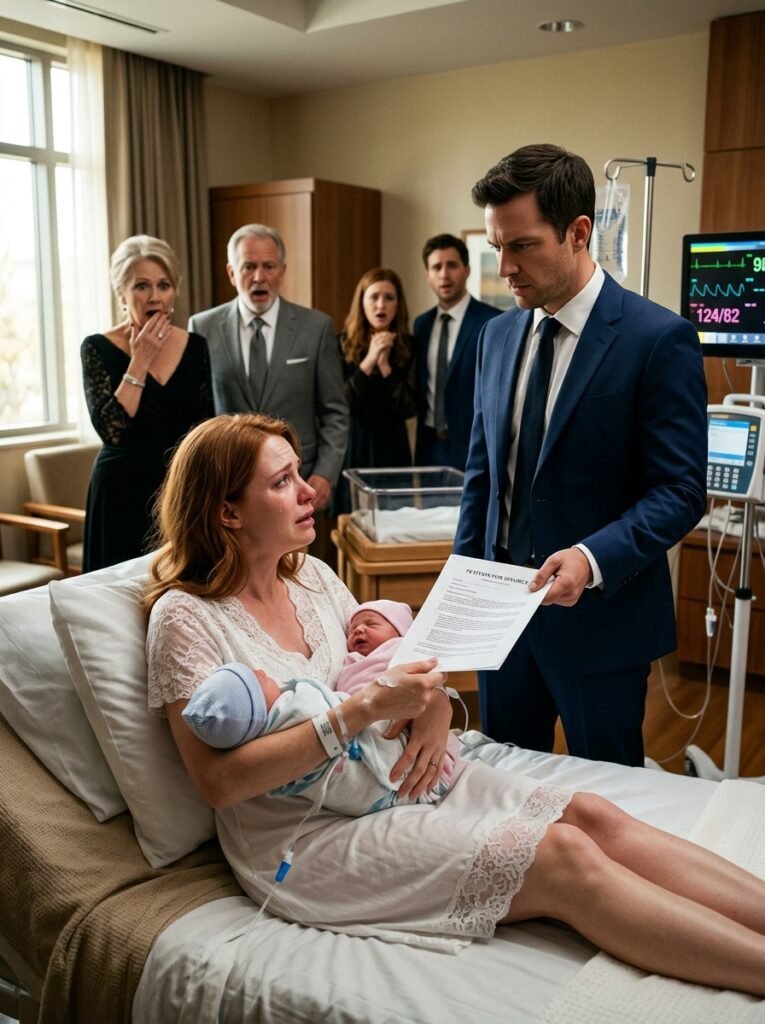
What neither of them understood, not yet, was that a custody agreement obtained through coercion, documented pressure, and a threat to seize newborns by force the following morning held almost no weight in court, regardless of any signature attached to it. My attorney had built the emergency filing specifically around Eleanor’s recorded threat, the twenty-witness pressure campaign, and the hospital security footage showing Julian’s team surrounding a recovering postpartum patient in a wheelchair.
The court didn’t see a signed agreement. It saw coercion.
Julian’s attorney contacted Audrey later that afternoon, attempting to negotiate, only to learn that the forensic investigation into the Vance real estate accounts had already been formally requested as part of the same filing, triggered directly by the waiver clause Julian himself had inserted into the custody documents.
“He built the trap himself,” Audrey told me that evening, reviewing the day’s developments. “The waiver clause only makes sense if there’s something worth waiving rights to investigate. He essentially confirmed, in writing, that those accounts contained something he needed to hide.”
The forensic investigation moved quickly once formally authorized, given that I’d already assembled most of the underlying documentation over the preceding six months. Within three weeks, auditors had traced over $380,000 in diverted funds from the Vance family real estate company, funneled through a series of shell transactions designed to obscure their ultimate destination.
The condominium purchased for Sienna. The credit card issued in her name, with charges averaging nearly $12,000 monthly. Two international trips billed as “business development” that corresponded exactly with dates I’d documented Julian and Sienna traveling together, based on flight confirmations I’d quietly saved from a shared email account he’d forgotten I still had access to.
Julian’s father, who served as CFO of the family company, was implicated as well, having approved several of the questionable transfers without adequate documentation, either through negligence or deliberate accommodation of his son’s activities.
“This goes well beyond a custody dispute now,” Audrey told me, as the investigation’s scope expanded. “You’re looking at potential criminal referral for fraud, depending on how the district attorney’s office chooses to proceed once our findings are formally submitted.”
Julian requested a meeting through his attorney, hoping to negotiate a settlement that would resolve both the custody matter and the financial investigation quietly, before either reached a courtroom.
I agreed to the meeting, though not for the reasons he likely hoped.
“You need to understand something,” I told him, sitting across a conference table from a man I’d once believed I would spend my life with. “This isn’t about revenge, Julian. I don’t need it to be. The evidence speaks for itself. I’m here because I want you to understand exactly what you built, piece by piece, over the last year, and exactly why none of it worked the way you expected.”
“I didn’t think you’d fight this hard,” he admitted quietly. “I thought, given everything, given the money, you’d just take it and go.”
“You thought that because you never actually knew who you married,” I said. “You built an entire plan around a version of me that existed only in your imagination, someone who’d fold under pressure from twenty relatives and a folder full of legal paperwork. I’ve spent twelve years being the person who finds exactly what powerful people try to hide. I was never going to fold, Julian. I was simply waiting for you to hand me the last piece I needed.”
The custody matter concluded eight months later, with the court affirming my sole legal and physical custody of Leo and Oliver, citing both the coercive circumstances surrounding the original agreement and Julian’s demonstrated pattern of financial misconduct as directly relevant to his fitness as a co-parent during that period.
The financial investigation resulted in a settlement requiring Julian and his father to repay the diverted funds in full, alongside significant penalties, though criminal charges were ultimately avoided through a negotiated agreement that included independent financial oversight of the family company for the following five years.
Sienna disappeared from Julian’s life within months of the investigation’s findings becoming public, taking with her, I later learned, considerably less than she’d apparently expected when she first slipped her arm through his in that hospital room.
I still work as a forensic accountant, though I’ve shifted my practice toward cases involving financial abuse within family and custody disputes, work I discovered I found more meaningful than any audit I’d conducted before Leo and Oliver were born.
They’re two years old now, sturdy and curious, utterly unaware of the hospital room where twenty relatives once watched their father try to buy their mother’s silence for $150,000. I plan to tell them the full story eventually, when they’re old enough to understand it properly — not as a story about revenge, but as a story about the particular kind of strength that doesn’t announce itself in the moment, the kind that simply reads every clause carefully, signs without flinching, and waits patiently for the truth to finish doing the rest of the work on its own.