My husband left for his mother’s house when our son was five days old and told me from the driveway, “You’ve got the easy part.” I said it was fine. I fed the baby. Three hours later his mother listed our crib online with the caption “never used, son needs cash,” and neither of them knows who messaged her first to buy it, or what I am going to say when she opens the door.
My name is Jenna. I am twenty-eight. Isaac was tiny, five days old, breathing in shallow, rhythmic puffs against my chest as the front door clicked shut. My mother died when I was nineteen and my father is in Texas and does not call, so the only family I have in this state is the one that just drove away in a silver pickup truck. Colton had packed a small duffel bag with three shirts and a pair of gym shorts. His mother had called him twice that morning before he even got out of bed, her voice loud enough to bleed through the receiver about how overwhelmed he looked, how pale he was, how the stress of a newborn was too much for a young man starting his career in logistics.
“My mom thinks I need a break, Jenna. A week. She’s right.”
“She usually is.”
“You don’t need me for the feeding part anyway.”
“I don’t,” I said.
I endured “you’ve got the easy part.” I endured his mother telling the nurses at the hospital that I was “young and dramatic” when I asked them to check Isaac’s heel-prick bandage again because it looked loose.
I endured her taking the car seat out of my car “to clean it” and putting it in hers under the guise of maternal expertise. I endured my husband saying, to her, on the phone, in my hearing, “She’ll figure it out. They always do.”
The listing had a photograph. Our crib, sitting right there in her garage. The crib my husband and I put together at midnight in March, arguing over the screws while the radio played low in the dark. The one Isaac had slept in for five nights. She had taken it while I was at the pediatrician Tuesday. I came home holding the plastic diaper bag over my elbow, carrying the folder with Isaac’s newborn checkup notes, and walked straight into the nursery. The room smelled like fresh paint and pine shavings from the bookshelf Colton built in February. But the corner where the white wooden crib stood was empty. In its place sat a portable mesh bassinet, still folded half out of its plastic wrap, and a piece of lined notebook paper torn from a legal pad. “This is fine for now. Crib’s at Mom’s for safekeeping.”
Now it was for sale. Two hundred dollars. “Son needs cash.”
I did not call him. I did not call her. I made a new account with a photograph of an orange sunset over a lake and the name Ashley and I messaged the seller. “Is this still available? Can pick up tonight.”
“Yes!! 7 pm ok?”
“Perfect. Cash?”
“Cash is great hon.”
At 6:40 I put Isaac in the bassinet in his car seat, because the good car seat was bolted into her car under the prepositions of cleanliness, and strapped him into the backseat of my sedan. The engine turned over with a familiar rattle. I drove forty blocks north through the housing developments where the streetlights were just beginning to flicker on against the pale blue evening, the tires hissing slightly against the damp asphalt.
My husband’s truck was parked in the driveway of his mother’s split-level house, right behind the empty space where her Honda usually sat. There was also a car I did not know. Red. Out-of-state plate, Florida or maybe Georgia. I parked three houses down under the boughs of a heavy oak tree and cut the ignition. Isaac slept.
At 6:58 the front door opened with a sharp click of the latch and my husband came out with a woman. Not his mother. Younger than me, wearing a yellow cardigan and dark denim, her hair pulled back in a high ponytail. Laughing about something he said, a light, easy sound that carried across the quiet lawn. She got into the red car. He leaned in the window with his forearm braced against the glass, talking to her for a long time, his head tilted down, his shoulder brushing the door frame.
The red car left. He went back inside.
At 7:00 I got out with the baby carrier hooked over my forearm, walked up the paved path, and pressed the doorbell button. His mother opened the door with a practiced host’s smile that fell off her face like a plate sliding off a greasy counter.
“Jenna.”
“I’m Ashley,” I said, looking right into her widened eyes. “I’m here for the crib.”
“What, “
“Two hundred.
Cash.” I pulled two crisp one-hundred-dollar bills from my pocket and held them out flat against my palm. “I’d like to see it first.”
Behind her, in the lighted kitchen, my husband called out, his voice sharp and familiar. “Mom, who is it?”
“It’s your wife.”
Nothing. A heavy, frozen pause. Then a chair scraping against linoleum tiles. He came down the short hallway into the entryway. He looked at the baby carrier in my arms. He looked at the money in my hand.
“What are you doing here.”
“Buying my son’s crib from your mother. She said you need cash.”
“That’s not, Mom, what did you do?”
“I was helping. You said you were short.”
“For what, Colton?” I said. “What are you short for?”
He did not answer. He stared at the floorboards near my left shoe.
“Was that Ashley?” I said. “The girl in the red car? Because I picked the name at random and your mother didn’t blink.”
His mother’s mouth opened and closed like a fish stranded on a dock.
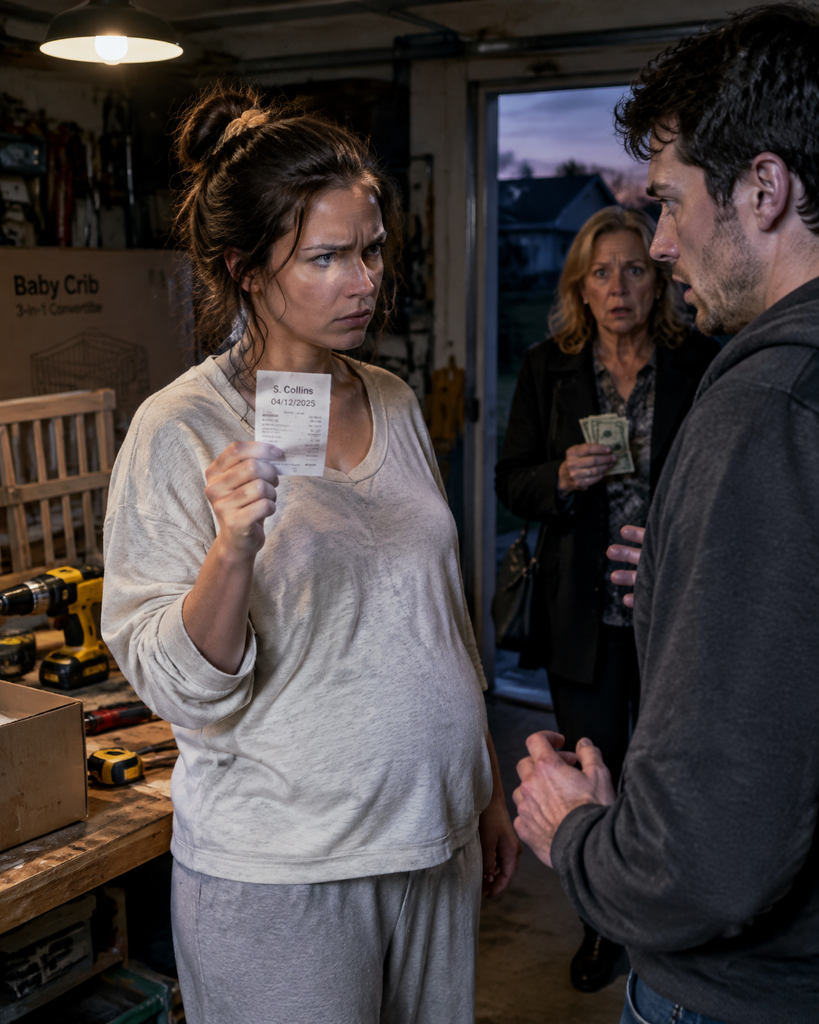
I walked past both of them without waiting for an invitation, stepping down into the cool, concrete-floored garage. The crib was there, disassembled, packed neatly back into the cardboard box it came from, with all the metal screws and washers collected in a sandwich bag taped to the side with yellow masking tape. She had done that carefully. She had wanted it to look professional for whoever bought it.
On the wooden workbench right next to it was a second box. A brand-new car seat box, still sealed with factory tape. A white store receipt was taped across the top flap. The receipt had yesterday’s date printed in purple ink and a name that was not mine and not his mother’s.
I reached out, my fingers trembling slightly against the crisp paper, and peeled the receipt away from the cardboard.
“Who’s Brianna?”
Silence from the doorway behind me.
“Colton. Who’s Brianna, and why did you buy her a car seat yesterday, on our card, while I was at the pediatrician with your son?”
His mother hurried into the garage behind us, her hands fluttering near her chest. “Jenna, it’s not what, “
“I’m asking him.”
Colton looked up, his face pale under the fluorescent glare. He swallowed hard. “She’s a friend.”
“Friends with a baby?”
“She’s pregnant.”
I pulled the receipt completely free and slid it into the side pocket of the diaper bag where Isaac was still sleeping. I reached out and pressed the two hundred dollars into my mother-in-law’s unresisting hand, folding her old fingers over the paper bills until her fist closed around them.
“That’s for the crib,” I said, my voice remarkably steady in my own ears. “I’ll be back with the car seat you took out of my car, and then I’m going to want you to explain, in front of your son, why the woman on this receipt is listed as the emergency contact on Isaac’s pediatrician form, which I saw for the first time this afternoon, in your handwriting, because you signed him up before he was born, and the reason you gave the office was that I was too unstable to handle medical decisions alone.”
Colton took half a step forward, his hands raised in a placating gesture. “Jenna, don’t make this bigger than it is, let’s talk inside.”
“There is nothing to talk about inside,” I said, turning my back on him and lifting the carrier handles. “You can pack the rest of your bags tonight, or I can put them on the porch. Either way, my locks are changing before midnight.”
His mother started to cry, real, wet tears of self-pity, but I did not look back at either of them as I walked out to my car.