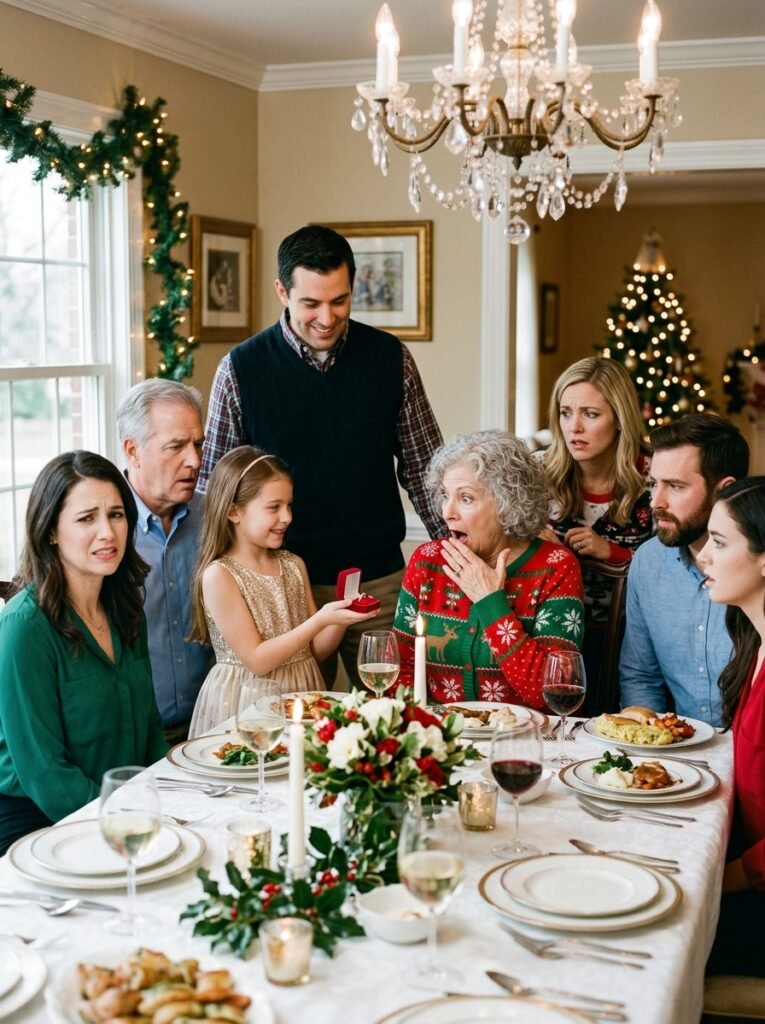
Zia moved one pace nearer and extended her hand toward the velvet case still in Lorraine’s grip.
Lorraine jerked it toward her chest.
That reaction told me more than the scream had.
Whatever Travis had put inside, Lorraine understood it immediately.
The rest of us didn’t.
From where I stood, all I could see was a small brass key resting against the red velvet lining and a folded square of white paper tucked beneath it.
One of Travis’s uncles leaned sideways for a better look.
Lorraine snapped the lid shut.
“No.”
Travis stayed behind Zia, close enough that she could reach for his hand if she wanted, but he didn’t touch her or move her out of the way.
Zia looked up at Lorraine.
“You opened it.”
Her voice was still calm.
Lorraine stared at Travis instead.
“You wouldn’t.”
“I already did.”
That was when I recognized the key.
For years, it had hung from Travis’s key ring beside our house key and the little plastic grocery-store tag he never remembered to replace.
It was the spare key to Lorraine’s house.
He’d had it long before I met him.
It was the key he used when she needed someone to bring groceries inside, check something while she was away, or arrive early on Christmas morning to help move chairs before everyone else showed up.
Now it was sitting in a jewelry box in her hand.
He had given it to Zia to return.
Lorraine opened the lid again, this time slowly, and pulled out the folded paper.
I watched her eyes move across the few lines Travis had written.
Then she looked at Zia.
Not me.
Not her son.
Zia.
“What does this mean?” Lorraine demanded.
Travis answered before our daughter had to.
“It means I told Zia that if you deliberately excluded her again, she could give you your key back.”
Lorraine laughed once, sharp and unbelieving.
“You put that decision on a seven-year-old?”
“No,” Travis said. “I put the decision on you.”
The room tightened around those words.
He nodded toward the place card still sitting in front of Zia’s empty chair.
“You knew exactly what you were doing.”
Lorraine glanced at the card.
Guest.
One word in careful handwriting.
It looked even uglier now than it had ten minutes earlier.
“I had extra people this morning,” Lorraine said. “I was trying to keep track of seating.”
Travis pointed toward the rest of the table.
Every other card had a name.
His aunt’s name.
His uncle’s name.
Every cousin.
Every in-law.
Even the cousin who had arrived late and hadn’t confirmed until the night before had a handwritten card with his actual name on it.
Only Zia was Guest.
Lorraine’s explanation didn’t survive its own evidence.
She shifted quickly.
“Well, she is your wife’s daughter.”
Travis’s jaw tightened.
“She is my daughter.”
“You know what I mean.”
“I do.”
That landed harder than shouting would have.
Because we all knew what Lorraine meant.
For three years, she had built a tiny fence around Zia and pretended each piece was too small to matter.
She introduced the biological grandchildren as her grandkids and Zia as mine.
She bought matching pajamas and somehow forgot Zia’s size.
She framed school pictures from the cousins but left Zia’s in the envelope.
She corrected people when they called Zia her granddaughter.
She always had a reason.
A misunderstanding.
A technicality.
A habit.
A joke.
Christmas morning had removed the disguise.
The iPads were not the problem.
The cash was not the problem.
Even that cheap vanilla candle wasn’t the real problem.
The tag was.
To Travis’s Girl.
And when one written insult somehow failed to make the point clearly enough, Lorraine had written another one the next morning.
Guest.
Travis looked at Zia.
“Do you want to stay?”
I felt every adult at that table go still in a different way.
Some looked uncomfortable.
Some looked embarrassed.
One aunt pressed her lips together and stared at her plate.
But Travis wasn’t asking them.
He wasn’t asking me either.
Zia studied Lorraine for several seconds.
Then she shook her head.
“No.”
“All right.”
That was it.
No victory speech.
No demand for an apology.
Travis reached for Zia’s little purse from the back of her chair while I picked up her coat.
Lorraine stepped around the table.
“You are not walking out of my house over a place card.”
Travis stopped.
“We’re walking out because you’ve spent three years telling my daughter she is temporary.”
“She isn’t your daughter.”
The sentence came so quickly that Lorraine didn’t have time to dress it up.
Nobody needed an explanation after that.
Zia looked at Travis.
I hated that she had heard it.
I hated even more that part of me was relieved Lorraine had finally said the thing plainly, because there was no polite version left for anyone to defend.
Travis crouched until he was eye level with Zia.
“Do you remember what I told you last night?”
She nodded.
“Say it back to me.”
Her eyes were wet now, but her voice held.
“You’re my dad.”
“What else?”
“No tag gets to decide that.”
“Exactly.”
Lorraine made an impatient sound.
“This is ridiculous.”
Zia turned toward her.
Then she did something I will remember longer than the scream, the key, or the place card.
She picked up the cheap candle from the sideboard where someone had moved it after breakfast.
She held it against her gold dress with both hands.
“Thank you for my candle,” she said.
Lorraine blinked.
The politeness almost made it worse.
Zia wasn’t throwing the gift back.
She wasn’t demanding an iPad.
She wasn’t asking why the cousins got more.
She was showing every adult in that room that this had never been about price.
Then she looked at the place card marked Guest.
“I don’t want that.”
Travis picked up the card.
He folded it once and placed it beside Lorraine’s red box.
“You can keep both.”
Lorraine’s face hardened.
“If you leave now, don’t expect me to chase after you.”
Travis took Zia’s coat from me and helped her into it.
“I’m not asking you to chase us.”
He zipped the front carefully so it wouldn’t catch the fabric of her dress.
“I’m asking you to stop hurting a child because you resent how our family was formed.”
Lorraine looked around for support.
For years, that had worked.
Someone usually rescued her from consequences by translating whatever she had done into something smaller.
She’s old-fashioned.
She didn’t mean it like that.
You know how she is.
Why ruin Christmas?
This time, the excuses had nowhere comfortable to land.
One of Travis’s sisters finally spoke.
“Mom, the card was cruel.”
Lorraine turned toward her so fast the napkin rings rattled when her hip bumped the table.
“You stay out of this.”
“I have stayed out of it.”
His sister looked at Zia.
“That’s the problem.”
Another relative quietly picked up the Guest card, unfolded it, and stared at the handwriting.
No one applauded.
No one needed to.
The mood had shifted from family spectacle to something far more uncomfortable: recognition.
Lorraine felt it too.
She changed tactics again.
She looked at me.
“You’re really going to let him cut off his mother because your daughter is sensitive?”
There it was.
My daughter.
Still mine when Lorraine needed distance.
I stepped beside Travis.
“I’m going home with my husband and our daughter.”
Lorraine’s eyes narrowed.
“You knew about this box?”
“No.”
That surprised her.
It had surprised me too.
I looked at Travis.
“I found out last night.”
“And you allowed it?”
I thought about Zia sitting on the guest-room bed in her wrinkled gold dress, asking whether she was only Dad’s girl.
I thought about Travis answering without hesitation.
Always.
“I allowed my daughter to say she’d had enough.”
Lorraine turned back to Travis.
“So what now? I’m banned from your house?”
He took a breath before answering.
The anger was there, but he kept it from doing the talking for him.
“For now, we’re leaving.”
“That isn’t what I asked.”
“I know.”
He put one hand on Zia’s shoulder.
“When you can treat all three of us as one family, we can talk about what contact looks like.”
“All three of you.”
“Yes.”
“And if I don’t accept that?”
Travis looked down at the brass key in the red box.
“Then you already have your answer.”
Lorraine gripped the box so tightly that the velvet edge pressed into her palm.
For the first time since we had arrived, she had nothing to hand Zia, label Zia, or assign Zia.
The decision was no longer hers.
We left before brunch was served.
Outside, the morning was bright and cold enough to sting my nose.
Zia’s dress flashed gold beneath her open coat as she crossed the driveway between us, still carrying the ridiculous vanilla candle.
Travis opened the back door of the SUV for her.
She climbed in, buckled herself, then looked through the open door at him.
“Are you mad at me?”
The question hit him harder than anything Lorraine had said.
He leaned his forearm against the top of the door frame.
“No.”
“Grandma is.”
“Grandma is responsible for Grandma’s feelings.”
Zia thought about that.
“Did I make you lose your mom?”
Travis closed his eyes for a second.
Then he climbed halfway into the back seat so she could see his face clearly.
“No, sweetheart. You didn’t make me lose anybody.”
He pointed gently toward the house.
“My mom made a choice about how she was going to treat you. I made a choice about what I was going to allow around my kid.”
Zia looked at the candle in her lap.
“And the key?”
“I’d carried that key a long time.”
“Do you want it back?”
“No.”
That answer came easily.
She nodded and ran her thumb over the crooked bow on the candle bag.
“Okay.”
We drove home without Christmas music.
Not because anyone declared the holiday ruined, but because all three of us were tired and nobody reached for the radio.
Halfway home, Zia fell asleep against the window with the candle tucked beside her.
Travis drove with both hands on the wheel.
I watched him for several miles before I spoke.
“How long had you been planning the box?”
He kept his eyes on the road.
“Planning isn’t the word.”
“Preparing?”
He nodded.
“After the last family dinner.”
I remembered it immediately.
Lorraine had taken a group picture of the grandchildren and asked Zia to hold everyone’s coats while she did it.
When Travis told his mother to include her, Lorraine had acted confused.
“Oh, I thought you meant the grandkids.”
Zia had pretended not to hear.
Travis had not.
“I kept thinking I could handle it adult to adult,” he said. “Then I realized Mom was counting on Zia being too polite to object.”
“So you gave Zia the choice.”
“I gave her a stop button.”
He glanced at me briefly.
“I never wanted her responsible for fixing my relationship with Mom. I wanted her to know she didn’t have to keep sitting there while someone erased her.”
That distinction mattered.
Especially later.
Because Lorraine told the family a different version almost immediately.
By that evening, two relatives had texted Travis asking why he had forced a child to choose whether her grandmother could remain in the family.
He answered both the same way.
He didn’t argue about the candle.
He didn’t argue about money.
He sent a picture of the place card.
Guest.
Then he wrote that Zia had chosen to leave a house where she had been deliberately singled out, and her parents had chosen to leave with her.
One relative replied within minutes.
The other did not.
Lorraine called three times that night.
Travis didn’t answer until Zia was asleep.
I sat beside him at the kitchen table while the cheap candle rested on the counter between a bowl of fruit and a stack of unopened mail.
He put the call on speaker only after telling Lorraine I was there.
She started with anger.
“You embarrassed me in front of my entire family.”
Travis rubbed his forehead.
“Mom, Zia is seven.”
“You gave her a weapon.”
“I gave her your house key.”
“You know what that key meant.”
“Yes.”
“She doesn’t.”
That was the first thing Lorraine said that made Travis hesitate.
Because there was some truth inside it.
A seven-year-old did not understand decades of family history packed into a brass key.
She didn’t know how many times Travis had let himself into that house as a teenager, how often he had arrived early for holidays, or how automatic it had once felt to belong there.
But she understood what the box meant to her.
Stop.
Enough.
I want to go home.
Travis answered carefully.
“She understood the part she needed to understand.”
Lorraine lowered her voice.
“And if I apologize?”
It was the first time she had used the word.
Travis looked at me.
“For what?” he asked.
Lorraine went quiet.
“For today.”
“What about today?”
“You know what.”
“No. Say it.”
She resisted for several seconds.
Then came the familiar escape hatch.
“I’m sorry everyone took the place card the wrong way.”
Travis leaned back in his chair.
“That isn’t an apology to Zia.”
“I am trying.”
“Then try without blaming everyone else for understanding exactly what you wrote.”
Lorraine hung up.
We did not call back.
The next several days were quieter than I expected.
There were messages, but Travis handled them without turning our house into a command center for family drama.
He didn’t read every opinion aloud.
He didn’t ask Zia whether Grandma should be forgiven.
That choice had never belonged on a child’s shoulders.
Zia had made the only decision Travis had promised her she could make: whether she wanted to remain in a room where she was being treated as less than the other children.
The adult consequences belonged to us.
A week later, a plain envelope arrived in our mailbox addressed to Zia by name.
Not Travis’s Girl.
Not Guest.
Zia.
I set it on the kitchen counter and waited until Travis came home before we decided what to do with it.
Inside was a short note from Lorraine.
There was no cash.
No expensive replacement gift.
No attempt to match the cousins’ iPads.
That surprised me.
The note said she was sorry for treating Zia as if she were separate from the family and for putting that message in writing twice.
She said the candle tag had been cruel.
She said the place card had been cruel too.
Most importantly, she did not add but.
Travis read the note twice.
Then he asked Zia whether she wanted to hear it.
She did.
When he finished, she sat at the kitchen table swinging one foot beneath the chair.
“Do we have to go back?”
“No,” he said.
“Do I have to answer?”
“No.”
“Can I think about it?”
“Absolutely.”
So she did.
There was no magical reunion the following weekend.
No family photograph where everyone squeezed together and pretended Christmas had somehow repaired itself.
Trust did not return because Lorraine finally found the correct words on a piece of paper.
But something important had changed.
The old arrangement was gone.
Lorraine could no longer treat Zia as optional while expecting Travis to remain fully available as her son.
She could no longer separate his marriage from his fatherhood whenever it was convenient.
Being close to Travis meant respecting the child he called his daughter.
Months later, contact resumed slowly and on different terms.
Short visits came before holidays.
We left when we planned to leave.
Zia was never required to hug anyone.
Nobody corrected her relationship to Travis.
And the first time Lorraine introduced the children together again, she included Zia without adding an explanation after her name.
I noticed.
Travis noticed.
Zia was busy looking for her shoes and may not have noticed at all.
That was probably the healthiest part.
The red velvet box never came back.
Neither did Lorraine’s spare key.
Travis’s key ring still has the small empty space where that brass key used to hang.
Every once in a while, I notice it when he drops his keys into the bowl by our front door after work.
The cheap vanilla candle lasted longer than anyone expected.
We lit it at home one evening while Zia colored at the kitchen table, not because it had become sentimental, but because she liked the smell.
The crooked gift tag was gone.
Zia had thrown that away herself.
A few minutes later, Travis came in carrying groceries, kicked off his shoes, and asked Zia whether she had finished the drawing she had been working on.
She held it up for him to see.
“Dad, look.”
He put the grocery bags down and went straight to her.
There was no pause.
No correction.
No label.
Just Dad.