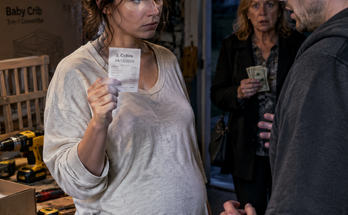
My Husband Offered Me $250,000 to Walk Away From Our Newborn Twins—His Entire Family Watched Me Sign, Never Knowing I Had Spent Six Months Preparing for That Moment
The Offer in the Hospital Room
Three days after giving birth to twin boys, Maren Whitfield was sitting in a wheelchair inside the discharge room at Briarwood Medical Center in Raleigh, North Carolina.
Every movement pulled against the fresh incision beneath her loose blue dress. Her body felt exhausted, and she had barely slept since the delivery. Still, when she looked down at the two babies resting in her arms, the discomfort seemed to fade.
Hudson slept against her left side, wrapped in a pale gray blanket. His brother, Callum, rested against her right arm, his tiny fingers curled around the edge of his blanket.
A nurse had just finished explaining Maren’s recovery instructions when the door opened without warning.
Her husband, Preston Callahan, entered first.
He wore a dark tailored suit and carried a thick leather folder under one arm. Behind him walked Sloane Mercer, the woman Maren had discovered he was seeing during the final months of her pregnancy.
Sloane wore a cream-colored dress and polished heels, as though she were attending a celebration rather than standing in a hospital room with a recovering mother and two newborn babies.
Then came Preston’s parents, Richard and Marilyn Callahan, followed by his two sisters, several cousins, an uncle, and family friends Maren had met only a few times.
More than twenty people entered the room.
Some carried coffee cups. A few whispered to one another. Others avoided looking at Maren entirely.
Not one person asked about the twins.
Not one of them stepped forward to see whether Maren needed help.
They formed a half-circle around her chair while Preston placed the folder on the small table beside the window.
“I’m offering you two hundred and fifty thousand dollars,” he said. “You sign the divorce agreement, give me primary custody of the boys, and leave tonight.”
For several seconds, Maren thought she had misunderstood him.
She looked at Preston, then at Sloane, who stood beside him with one hand resting lightly on his arm.
“You want me to give you our sons?” Maren asked quietly.
“They need stability,” Preston replied. “My family can provide that. You will have enough money to begin again somewhere else.”
Marilyn folded her arms.
“The boys belong with the Callahan family,” she added. “They need our name, our resources, and a secure future. This arrangement is better for everyone.”
Maren looked down at Hudson and Callum.
They were only three days old.
Preston was talking about them as though they were assets being divided during a business meeting.
She opened the folder.
Inside was a private agreement promising her $250,000 in exchange for surrendering primary custody. Another section limited her ability to request financial records connected to Preston’s companies. A third clause attempted to prevent her from making future claims against marital property.
It was not a generous settlement.
It was an attempt to purchase her silence.
Sloane took out her phone and held it near her waist. Maren suspected she was recording, hoping to capture tears, anger, or humiliation.
But Maren did not raise her voice.
She read every page carefully.
Then she looked at Preston.
“Are you completely certain this is what you want?”
He gave a small, confident smile.
“I have never been more certain.”
Maren glanced toward the security camera near the ceiling. She noticed the nurse still standing beside the door and the hospital social worker who had entered after hearing the commotion.
Then she picked up the pen.
“Do not make this more difficult than it needs to be,” Preston said. “Sign it, take the money, and let all of us move forward.”
Maren signed every page.
A visible wave of relief passed through the room.
Preston closed the folder and handed it to his attorney.
Sloane smiled.
Marilyn stepped closer to Maren’s wheelchair.
“We will come for the babies tomorrow morning,” she said.
Maren kissed each of her sons on the forehead.
She did not argue.
She did not beg.
And she did not tell them that she had spent the previous six months preparing for the exact moment when Preston would finally reveal his true intentions in front of witnesses.
The Plan No One Knew About
Maren did not return to the Callahan family home that evening.
With approval from her doctor, she left the hospital through a private exit and traveled with the twins to a furnished apartment in a quiet neighborhood outside Raleigh.
Waiting inside were a neonatal nurse and Maren’s attorney, Camille Harper.
Two large folders rested on the dining table.
Camille helped Maren settle into a chair before examining the agreement Preston had brought to the hospital.
“This document does not automatically transfer custody,” Camille explained. “A private agreement involving newborn children must still be reviewed by a court. A judge will consider what is best for Hudson and Callum, not what Preston’s family wants.”
Maren released a breath she had been holding for hours.
“I knew he would try something,” she said. “I did not expect him to bring his entire family.”
“That may become one of his biggest mistakes,” Camille replied.
Maren had worked for nearly eight years as a forensic accountant. Her job was to review complicated financial records, identify unusual transactions, and reconstruct money trails people believed were hidden.
During the sixth month of her pregnancy, she had noticed irregular transfers involving one of Preston’s property development companies.
At first, the amounts were small.
Then she found payments to a consulting company that had no employees, no physical office, and no clear business purpose. Money passed through that company before appearing in accounts controlled by Preston’s cousin.
There were also hotel bills, jewelry purchases, luxury trips, and payments for a condominium in Atlanta.
The condominium was occupied by Sloane.
Maren had not confronted Preston.
Instead, she quietly documented everything she was legally permitted to review as a spouse and joint owner of several marital assets.
When she first met Camille, she brought copies of bank statements, company reports, contracts, property records, and payment schedules.
After studying them, Camille had delivered a difficult warning.
“This is not only about another relationship,” she had said. “Preston appears to be moving marital property before filing for divorce. He may be trying to make you believe there is much less money than there actually is.”
Maren had also shared her concern that Preston and his mother planned to seek custody of the babies.
Together, they prepared a strategy.
They secured temporary housing, arranged medical care for the twins, organized the financial evidence, and drafted emergency legal filings that could be submitted as soon as Preston made his move.
What they had needed was proof of his intent.
Preston had provided it himself in the hospital.
The social worker documented that Maren had been surrounded by more than twenty people while recovering from major surgery. The nurse recorded that the confrontation was unexpected and that Maren appeared physically exhausted.
Camille had already requested preservation of the hospital security footage, visitor logs, and staff reports.
At 2:24 the next morning, she filed for temporary primary custody, financial protection orders, and restrictions preventing either parent from removing the twins from North Carolina without court approval.
She also submitted a request for a detailed examination of Preston’s business transactions.
“Now we let the evidence speak,” Camille said.
Maren looked toward the two bassinets near the window.
Hudson and Callum were sleeping peacefully.
For the first time since Preston had entered the hospital room, she felt that she could breathe.
The Celebration That Ended Before Breakfast
While Maren rested beside her sons, Preston was celebrating at the Callahan estate.
He opened an expensive bottle of champagne and told his parents that the matter was finished.
“She signed everything,” he said. “There will be no custody battle and no financial investigation.”
Marilyn praised him for handling the situation quickly. Sloane began discussing how they would decorate the nursery.
At 7:16 the next morning, Preston received a call from his attorney.
His confident expression disappeared within seconds.
“What do you mean she filed?” he demanded.
His attorney spoke carefully.
“The agreement from the hospital has not been approved by a court. Maren filed an emergency petition during the night. The court granted temporary protections, and your accounts connected to the disputed companies are now subject to review.”
“She signed the papers.”
“She signed under circumstances that may appear highly coercive. She was recovering from surgery, holding two newborns, and surrounded by your family. The hospital has video.”
Preston walked away from the others.
“Tell me this can be fixed.”
“It may become much more serious than a custody disagreement. Her attorney submitted financial records suggesting concealed marital assets.”
Before Preston could respond, someone knocked on the front door.
A court representative delivered a thick packet bearing Maren’s name.
Inside were copies of transfers, corporate filings, property records, and requests for a forensic audit.
Preston reached the final page and understood what Maren’s signature had truly accomplished.
She had not signed because she was defeated.
She had allowed him to create the clearest evidence possible of what he intended to do.
The Video That Changed the Room
The first hearing took place twelve days later.
Maren still moved carefully, but she entered the courthouse with her shoulders straight. The twins remained at home with her sister and a licensed nurse.
Preston arrived with two attorneys, his parents, and Sloane.
Marilyn approached Maren in the hallway.
“You can still stop this,” she whispered. “Take the money and prevent your sons from growing up surrounded by conflict.”
Maren met her eyes.
“The conflict began when your family entered my hospital room and treated my children like property.”
A court officer asked everyone to enter.
The judge began by explaining that a private contract could not decide custody on its own. The safety, stability, and emotional well-being of the twins would be the court’s priority.
Then Camille requested permission to show the hospital recording.
The image was not perfectly clear, but it showed everything that mattered.
Maren sat in a wheelchair with one newborn in each arm.
Preston stood over her with the folder.
Sloane remained beside him.
His relatives formed a wall around Maren’s chair.
The audio captured Preston’s words.
“Take the money, sign the agreement, and give me the boys.”
It also captured Marilyn saying:
“We will come for the babies tomorrow morning.”
The courtroom became completely silent.
Preston’s attorney attempted to explain.
“My client was trying to avoid a prolonged and emotionally difficult dispute.”
The judge looked directly at him.
“Your client brought more than twenty people and another woman into the hospital room of a mother recovering from childbirth. He offered money in exchange for custody of two three-day-old infants. Is that your definition of avoiding emotional distress?”
The attorney lowered his voice.
“Mrs. Whitfield signed the agreement.”
Camille stood.
“She signed without independent counsel present, while medically vulnerable, and under intense family pressure. More importantly, the agreement contained financial clauses intended to shield transactions Mr. Callahan had not disclosed.”
She placed the first folder on the table.
For nearly an hour, Camille traced the movement of money through Preston’s companies.
Funds had left a real estate partnership and entered a consulting firm with no active staff. From there, the money moved into accounts connected to Preston’s cousin. Some of it paid for Sloane’s apartment, furniture, vehicle, and travel.
Preston leaned toward his attorneys and whispered urgently.
The judge instructed him to remain quiet.
Sloane removed her sunglasses.
“He told me those companies belonged entirely to him,” she said suddenly.
Preston turned toward her.
“Do not say another word.”
The judge immediately warned him not to pressure anyone in the courtroom.
Sloane’s face lost its confidence. She requested time to speak with her own attorney.
Only then did she seem to understand that she had not been brought into the Callahan family as a future wife.
She had been placed in the middle of a financial investigation.
The Money He Used Against Her
Camille opened the second folder.
“Your Honor, the amount offered to Maren was not chosen randomly,” she said.
Two weeks before the twins were born, Preston had transferred exactly $250,000 from a joint marital account into a newly created company.
He then prepared documents designed to make the funds appear to belong solely to him.
That same amount became the settlement he offered Maren in exchange for leaving her children.
In simple terms, Preston had tried to buy Maren’s cooperation using money that partly belonged to her.
The judge studied the documents.
“Mr. Callahan, can you explain this transfer?”
Preston stood.
“It was an internal restructuring.”
His attorney quietly told him to sit down.
Preston continued speaking.
First, he claimed the new company was part of the family business. Then he called it independent. A moment later, he described the transfer as a loan, although no loan agreement, repayment schedule, or interest terms existed.
Each answer created another contradiction.
Richard Callahan closed his eyes.
Marilyn stared at Sloane as though she were responsible for the entire situation.
At the end of the hearing, the judge granted Maren temporary primary custody. Preston’s visits would take place under professional supervision while the case remained under review.
The financial restrictions stayed in place.
A full audit was ordered.
Preston was forbidden from selling major assets or removing the twins from the state. Any necessary communication with Maren had to go through attorneys or approved channels.
It was not the final ruling, but the message was unmistakable.
Preston did not leave court as the victorious father he had imagined himself to be.
He left with his finances under examination and his conduct in the hospital preserved as court evidence.
The Truth in the Hallway
Preston caught up with Maren outside the courtroom.
Camille remained close beside her.
“Maren, wait,” he said.
He looked older than he had two weeks earlier. His suit was wrinkled, and his eyes were tired.
“How long did you know about Sloane?”
“Since before you knew we were having twins.”
His expression changed.
“And you said nothing?”
“I needed to understand how far you were willing to go.”
“You set me up.”
Maren shook her head.
“I gave you space to make your own choices. You chose to move money. You chose to hide property. You chose to bring Sloane into my hospital room. You chose to surround me with your relatives. And you chose to put a price on our sons.”
“I was trying to protect them.”
“A protective father does not pressure a recovering mother to surrender her babies while she is still sitting in a hospital wheelchair.”
Marilyn approached them.
“This woman is destroying our family,” she said sharply.
For the first time, Richard disagreed with his wife.
“No, Marilyn. We allowed Preston to destroy it.”
Everyone turned toward him.
His voice was quiet but steady.
“I knew he was seeing someone else. I knew this plan was wrong. I still went to the hospital because you said the boys had to stay with us.”
Marilyn stared at him.
“We were protecting the Callahan name.”
“A name is not worth anything when the people carrying it forget how to behave with decency.”
Marilyn walked away without another word.
Sloane left through a different exit with the attorney she had hired that morning.
Preston remained alone in the hallway.
Maren felt no satisfaction.
Justice did not always feel like victory.
Sometimes it simply felt like closing a door that had remained open for too long.
What the Audit Revealed
Over the following months, the financial examination uncovered additional transactions.
Preston had concealed property, altered internal reports, and moved company funds through relatives’ accounts. Two cousins agreed to cooperate with investigators rather than risk deeper involvement.
Sloane provided messages, receipts, and emails.
In one message, Preston had written:
“Maren will be exhausted after the delivery. She will sign whatever we place in front of her.”
When Camille showed Maren the message, she had to look away.
It was not the discovery of another relationship that hurt most.
It was seeing how carefully Preston had planned to use her weakest physical moment against her.
At the final custody hearing, the judge reviewed the entire pattern: the hospital confrontation, the money offered in exchange for the children, the concealed property, the misleading financial documents, and Preston’s failure to consider the emotional and medical needs of the newborns.
The private agreement was declared invalid.
Maren received primary custody.
Preston was ordered to provide child support based on his actual income rather than the reduced amount he had reported. His visits remained supervised until he completed parenting education and demonstrated that he could place the twins’ needs ahead of family pride.
Maren did not ask the court to remove him permanently from their sons’ lives.
Hudson and Callum were not responsible for the choices their father had made.
But she would never allow Preston to use them as trophies, bargaining tools, or symbols of ownership.
The First Supervised Visit
The twins were almost four months old when Preston attended his first supervised visit.
He arrived without a suit, without his parents, and without attorneys.
Hudson began crying soon after Preston sat down.
Preston tried to lift him but did not support the baby’s head correctly. The supervisor gently showed him what to do.
For several minutes, Preston simply held his son and stared at him.
Then tears filled his eyes.
“I lost everything,” he said quietly when the visit ended.
Maren looked at him.
“No. You lost the belief that everything belonged to you. That is not the same thing.”
He lowered his gaze.
“Will you ever forgive me?”
“Forgiveness is not the question. The question is whether Hudson and Callum will one day be able to trust you.”
For the first time, Preston seemed to understand that being a father did not mean having control.
It meant becoming someone his children could feel safe with.
One Year Later
Hudson and Callum celebrated their first birthday in the backyard of Maren’s new home.
They sat side by side in small wooden chairs, covering their hands and faces with birthday cake while Maren’s sister took photographs.
After the guests left, Maren carried the boys upstairs and placed them in their cribs.
Her sister stood in the doorway.
“Do you ever regret signing those papers?”
Maren looked at her sleeping sons.
“No,” she said. “Signing was not surrender. It allowed Preston to show everyone who he was when he believed I had no strength left.”
People often asked how she had remained calm in the hospital.
The truth was that she had not felt calm.
She had been frightened, exhausted, and deeply hurt. Part of her had wanted to scream. Another part had wanted to disappear beneath the blankets and pretend none of it was happening.
But her years of following financial trails had taught her something important.
People who hide the truth almost always leave evidence behind.
And people who believe they hold all the power often become careless.
Preston believed strength meant entering a hospital room with a large family, an expensive folder, another woman, and enough money to buy silence.
He mistook Maren’s exhaustion for weakness.
He mistook her silence for obedience.
And he mistook her signature for defeat.
He had been wrong about all three.
That night, Maren sat between the twins’ cribs and remembered Marilyn promising that the family would return for the babies the following morning.
No one had taken them.
They were not with Maren because she had more money, a famous name, or a powerful family standing behind her.
They were with her because she had prepared carefully, trusted the evidence, and refused to let fear make decisions for her.
Preston had tried to place a price on her role in their sons’ lives.
In the end, the money purchased nothing.
It only revealed how little he had understood about love, parenthood, and the quiet strength of a mother who had already decided that her children would never become anyone’s bargaining tool.
Sometimes silence is not a sign of surrender but the careful decision of someone who understands that the truth becomes far more powerful when it is supported by patience, preparation, and undeniable evidence.
A person who truly loves their children will never use money, family influence, social status, or emotional pressure to separate them from the parent who has cared for them with devotion.
Real strength does not always appear through raised voices or dramatic confrontations, because it can also be found in the quiet courage to think clearly while everyone around you expects you to fall apart.
When someone mistakes your kindness for weakness, allow their own choices to reveal their character instead of exhausting yourself by trying to convince people who have already chosen not to listen.
Wealth may purchase comfort, property, and influence, but it cannot purchase trust, erase selfish decisions, or replace the genuine bond created by daily love and responsibility.
Children should never become prizes in an adult conflict, because their hearts deserve protection, stability, patience, and the freedom to love without being pulled between prideful adults.
Preparing for a difficult moment does not make a person cold or calculating; sometimes preparation is the most responsible way to protect yourself and the people who depend on you.
A powerful family name means very little when the people carrying it forget compassion, honesty, accountability, and the basic dignity every human being deserves.
Justice may not immediately remove every painful memory, but it can create the boundaries needed to prevent past pain from controlling the future.
The greatest victory was not that Maren defeated Preston in court, but that she protected her sons without teaching them to hate their father or allowing his choices to define the lives they would build.