One year.
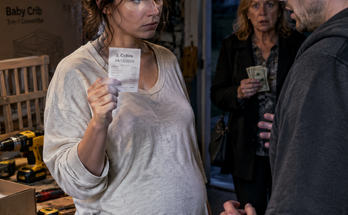
She stood in the kitchen doorway with a dish towel in her hands and let the number sink in. One year ago today, in a hospital room that smelled of antiseptic and warm blankets, she had pushed two babies into the world, and the only person she had wanted beside her had been three months in the ground.
Daniel had never met them.
That was the sentence that lived in her chest, the one she carried everywhere, the way other people carried keys. Daniel never met them. She said it to herself in the shower. She said it at three in the morning, rocking a screaming infant with one arm and warming a bottle with the other. She said it when Noah laughed, because he laughed exactly the way his father had, head thrown back, all gums and delight. She said it when Ella frowned at a spoonful of mashed peas, one eyebrow lifted in a perfect, infuriating copy of the face Daniel used to make when he thought she was wrong and was too polite to say so.
One year. Two babies. One empty chair.
She pressed the towel to her mouth and breathed through it, slow and careful, the way the grief counselor had taught her. In, hold, out. The smell of vanilla cake drifted from the oven. In the next room, someone had turned on a children’s song, and a small voice, Noah’s, was babbling along to a tune it did not know.
She was going to get through this day. She had decided that. She would smile for the photographs and cut the cake and sing the song, and she would not fall apart in front of her babies, because they deserved a mother who could look at their first birthday and see them, not the shape of what was missing.
The doorbell rang.
Hannah jumped, then laughed at herself, a short, breathy sound with no humor in it. Everyone she loved had already arrived. Her sister was in the living room with a camera. Her friend Priya had taken over the cake. Only one person was missing, and she had promised to come early.
She went to the door and opened it.
Margaret stood on the porch.
Daniel’s mother was a small woman, and grief had made her smaller. In the year since the funeral, her shoulders had curled inward, her silver hair had thinned, her wedding ring had begun to slide on a finger that no longer held it snugly. But today she stood very straight. Her chin was lifted. She wore the navy dress she had worn to the funeral, and in her arms, held tight against her body as if it might escape, was a large cardboard box tied with plain brown string.
Hannah’s smile faltered.
She had known Margaret for eight years. She knew how the older woman looked when she was happy, when she was tired, when she was pretending. She had never, not once, seen her look the way she looked now.
She looked like someone who had come to deliver a verdict.
Part Two: The Warning
“Margaret?” Hannah said. “Is everything all right?”
“May I come in?”
The words were polite, formal almost, and they landed in the doorway like a dropped glass. Hannah stepped back without thinking, and Margaret moved past her into the hall. She did not take off her coat. She did not look toward the sound of the party. Her eyes went to the stairs, the quiet stairs, the ones that led up to the room where the twins’ cribs stood side by side.
“Is there somewhere private?” she asked.
A cold thread slid down Hannah’s spine.
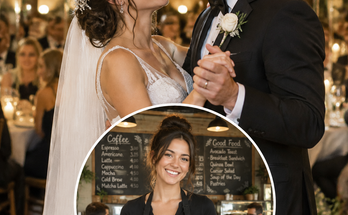
She led her into the dining room, the one nobody used, the one with the good table and the stiff chairs and the framed wedding photograph on the sideboard. She had not been able to look at that photograph for months. Daniel grinned out of it, sunburnt and happy, one arm wrapped around her waist, wind catching his tie. He looked like a man who thought he had all the time in the world.
Margaret set the box on the table.
It made a soft, heavy sound. Not the sound of something empty. Hannah stared at it. The brown string. The creased lid. The faint, familiar smell of old paper and cedar that drifted from it, and something under that, something warm and human, something that made her stomach clench before her mind could name it.
Daniel’s study, she thought. That smell is Daniel’s study.
“Where did you get this?” Her voice came out thin.
“He gave it to me.”
“When?”
“Two weeks before he died.”
The words hit like a slap. Hannah actually took a step backward, her hand finding the back of a chair. Two weeks before. She did a quick, frantic calculation. Two weeks before the accident. Before the phone call from the hospital, before the doctor’s gentle, devastating face. Daniel had been alive then. Daniel had been kissing her goodnight and complaining about the traffic and rubbing her swollen belly, whispering silly names to the babies.
And all that time, he had been handing his mother a box.
“He made me promise,” Margaret said. Her voice trembled at the edges but did not break. “He made me swear on my life that I would not give it to you until they turned one. Not a day sooner. Not a day later.”
“Why didn’t you tell me?”
“Because I promised.”
“Margaret.” Hannah heard her own voice climb. “He died. He died, and you had this, and you just sat on it for a year?”
Margaret flinched. It was a small movement, but Hannah saw it, and she saw what lay beneath it: a year of keeping a secret like a stone in her mouth. A year of looking at her daughter-in-law across Sunday dinners, holding the knowledge, saying nothing. Hannah felt her anger falter. She had been so wrapped up in her own grief that she had never once asked what it had cost the woman who had lost her only son.
And now that woman stood in front of her, pale as paper, hands knotted together, and said the sentence that changed the temperature of the room.
“Before you open this,” Margaret said quietly, “sit down.”
Hannah didn’t move.
“Please, dear.”
“What is in it?”
“Sit down, Hannah.”
She sat. The chair was hard and cold beneath her. Her heart had begun a heavy, uneven pounding, and she became aware of the party in the next room as if through water: someone laughing, a toddler squealing, the muffled thump of a balloon bumping a wall.
Margaret drew a long breath.
“Your husband said you might hate him,” she said, “for what’s inside.”
Part Three: Everything She Imagined
The room went very still.
Hannah had read once that fear has a sound. Not a scream, but a high, thin whine, like a wire pulled tight. She heard it now, vibrating behind her ears. Hate him. The words circled and circled, and every circle brought a new image, each one worse than the last.
She thought of debt. Daniel had always been careful with money, but careful men have secrets. A hidden account. A loan. A mountain of unpaid bills that would come down on her and the babies like an avalanche. She thought of the mortgage, of the nursery she had painted herself, pale green, because they hadn’t known the babies’ sexes until the day they were born.
She thought of another woman.
The thought came sharp and ugly and unwelcome, and she hated herself for it even as it unfolded. A drawer of letters. A photograph she wasn’t meant to see. A second life, folded neatly into a cardboard box and given to his mother for safekeeping, to be revealed on a day when Hannah would be too raw to refuse. Her whole body went cold. Her fingers dug into her thighs.
No. Not Daniel. Not him.
But grief makes a liar of memory, and she began, helplessly, to search for evidence. The late nights at the office. The phone he turned face-down on the table. The strange, distant look he’d worn in those last weeks, a look she had put down to nerves about fatherhood. Was it nerves? Or was it guilt?
She was breathing too fast. Her vision had started to tunnel at the edges.
And then, worse than any of it, came the thought she could not push away: What if I am about to lose him a second time?
Because that was the real terror, wasn’t it? Not the money, not even the betrayal. It was the idea that the Daniel she had mourned for twelve months, the good man, the gentle man, the husband who had read bedtime stories to her belly, might turn out to be someone else. That she would open this lid and the memory she had built her whole broken life around would crumble to dust in her hands. That she would have to grieve not just the man, but the story of the man.
She looked up. Margaret was watching her with eyes full of tears that had not yet fallen.
“Do you know what’s in it?” Hannah whispered.
“I have never looked.”
“Never?”
“It wasn’t mine to open.” Margaret’s hand lifted, trembling, and hovered over the lid without touching it. “I only know what he told me. He sat in my kitchen and he held my hands and he said, ‘Mom, she might hate me for this. But I have to do it.’ And I said, ‘Do what, Danny?’ And he wouldn’t tell me.” Her voice cracked. “He just kissed my forehead and said, ‘Give it to her when they’re one. She’ll understand then.'”
Outside, the party had gone strangely quiet, as though the whole house were listening.
Hannah stared at the box. The string. The knot, tied in the particular lazy bow that Daniel always used, the one that never held, the one she used to tease him about. Her eyes burned.
“I don’t think I can,” she said.
“I know.”
“What if it’s something that breaks everything?”
“It might be.” Margaret did not lie to her. That, Hannah would think later, was the kindest thing she did all day. “I can’t promise it isn’t. All I can tell you is that my son was the most honest man I ever knew, and he did not do cruel things. If he thought it might hurt you, it is because he believed the hurt was worth it.”
Hannah closed her eyes.
She thought of Daniel’s hands. Big, careful hands that could fix a faucet or fold a paper crane or cradle her face as though it were made of glass. She thought of his voice in the dark, low and teasing: Whatever happens, Han, I’ve got you.
She opened her eyes.
She reached for the string.
Part Four: The Box
The knot came loose almost on its own.
Of course it did. Daniel had never tied one that held. The brown string slithered off the box and pooled on the table like something shed, and Hannah felt a ridiculous, wild urge to laugh. She pressed her lips together. Her heart was a fist against her ribs.
She lifted the lid.
For one suspended second she saw nothing but paper, a drift of cream-colored envelopes packed tightly together, and her mind, braced for catastrophe, did not understand what it was looking at. She stared, waiting for the blow.
The top envelope bore her husband’s handwriting.
One line, in the blocky, slanted print she knew better than her own: For Noah and Ella. Open on your 1st birthday.
The air left her lungs.
Beneath it was another, and another. She lifted them with shaking fingers and the box seemed to open like a flower. Envelopes, dozens of them, each labeled. For Noah, age 2. For Ella, age 2. Age 5. Age 10. First day of school. First heartbreak. The labels went on and on, down through the years, When you graduate. When you leave home. When you fall in love. When you become a parent yourself.
Her vision blurred. She wiped her eyes with the back of her hand.
Beneath the envelopes lay photographs, dozens of them, loose and slightly curled at the corners. She recognized them with a lurch. Their first apartment, with its crooked kitchen. A picnic by the lake where he had proposed. Her, young and furious, on the day they brought home their awful secondhand couch. Her, laughing, hair wild, caught mid-sentence in some long-forgotten argument. Dozens of ordinary afternoons he had somehow stolen and saved.
On the back of each, in the same careful print: a date, a place, and a few words. The day your mother told me she’d marry me, then took it back, then said yes again. This is where I fell in love with her, though she’ll tell you it was me who tripped.
Hannah put her hand over her mouth.
Under the photographs were small things, wrapped carefully in tissue. A worn leather watch. A brass key. A tiny, hand-carved wooden bird, its wings slightly uneven, as though made by someone learning as he went. She turned it over and found a note taped to its belly: Made this myself. I know it’s terrible. I wanted you to have something from my hands.
A broken, wet sound escaped her.
She had not cried like this in months. She had cried in the hospital and at the funeral and in the long, blank weeks after, but somewhere along the way the tears had dried into a gray numbness, and she had mistaken that numbness for strength. Now it cracked. It cracked all at once, from the top down, and the grief that came pouring through was not the raw, bleeding kind she remembered. It was something deeper and stranger. It was grief with love in it. Grief that had a pulse.
“Oh, Danny,” she whispered. “Oh, you idiot. You idiot.“
Margaret had come around the table. Her hands were on Hannah’s shoulders, trembling, and Hannah turned and pressed her face into the older woman’s navy dress and felt thin arms close around her. They stood like that for a long time, the two of them, a widow and a mother who had both lost the same man, rocking slightly, saying nothing.
At last Hannah drew back. Her face was wet and swollen.
“Why did he think I’d hate him?”
Margaret shook her head. “Read it,” she said gently. “There’s one more. Right at the bottom. I think it’s for you.”
Hannah dug beneath the tissue, beneath the stacks, to the very floor of the box. Her fingers closed on a final envelope, thicker than the rest, sealed with a strip of tape.
Han, it said.
Only that. Only her name.
She unfolded the letter, and her husband’s voice came up off the page.
Part Five: What the Letter Said
Han,
If you’re reading this, then Mom kept her promise and I’m not there, and I am so sorry. I want to say that first, before anything else. I’m sorry I’m not there.
I’m writing this at the kitchen table at 1 a.m. while you sleep. You look like a beached whale and you’ve never been more beautiful. I keep thinking about the doctor’s appointment last week. He told us both babies are perfectly healthy and I had to go sit in the car for twenty minutes because I couldn’t stop smiling like an idiot.
But I’ll tell you why I’m writing this, and why I asked Mom to hold on to it.
My dad died when I was nine. You know that. What you don’t know is that I spent twenty years being angry at him for leaving. Not because he died. Because he left me nothing. No letter, no voice, no sentence in his handwriting. Just a closet full of suits and a silence where he used to be. I never got to hear what he wanted for me. I never got to know what he would have said.
I don’t plan on dying, Han. I want to be clear about that. I plan on being the most embarrassing father in the history of fatherhood. But I got scared. I got scared in the middle of the night, thinking about everything that could happen, and I realized I could not bear the thought of my kids having what I had. So I started writing. Just in case.
Here’s the part where you might hate me.
I did this behind your back. I knew you’d say it was morbid. I knew you’d tell me to stop, that nothing was going to happen, that we’d have a thousand years together. And you’d be right to say it. But I couldn’t stop. I needed to do it for me, and for them. If I’m gone, I want them to have more than a photograph. I want them to know I loved them before they were even born.
And I’m afraid that when you read this, it’ll hurt. That it’ll rip the scab right off. That you’ll be handed a box of the man you lost, on the very day you least want to remember. If that happens, I’m sorry. I’m so sorry. I know that giving you this isn’t going to make the pain go away. Nothing I could write would. I’m not trying to take the pain away.
I’m trying to give you something to carry it with.
Read these to them, Han. Read them slowly, and read them on the right days. Tell them about the picnic and the terrible couch and the time you made me eat that disastrous soufflé. Tell them their father was clumsy and sentimental and hopelessly in love with their mother. Let them know me, even a little.
And Han, please hear this part. Please. You are not allowed to disappear into this. You are going to be tired, and sad, and angry, and you’re going to have every right. But you are going to keep living. You are going to laugh at their ridiculous first words and cry at their graduations and fall in love again one day, and I want you to. I mean it. The love I wrote in those letters isn’t meant to hold you in the past. It’s meant to be a hand on your back, pushing you forward.
I love you more than I know how to say. You made me a better man, and I’m leaving you with the two best things we ever made.
Whatever happens, I’ve got you.
Yours,
Danny
Hannah read the last line three times. Then she folded the page against her chest and wept until she had no breath left.
She did not hate him. She could not have hated him if she tried. She understood, finally, the strange, awful shape of his fear, and she understood the wisdom beneath it. He had known that the gift would hurt. He had given it anyway, because some kinds of love are worth the ache.
When the tears finally slowed, she looked up. Margaret was sitting beside her, her own face shining and wet, one hand holding Hannah’s.
“He was right,” Hannah said hoarsely. “It does hurt.”
“Yes.”
“But it doesn’t feel like drowning anymore.”
Margaret smiled, a small, trembling, ancient smile. “My dear,” she said, “sometimes the kindest gift isn’t the one that makes the pain disappear. It’s the one that helps you carry the love forward.”
Hannah nodded slowly. Through the door, faint and bright, she heard the sound of her son’s laugh, head thrown back, exactly like his father’s. She heard her daughter squeal. She heard the muffled thump of a balloon against the ceiling, and for the first time all day it did not sound cruel.
She wiped her face. She tucked the final letter carefully back into its envelope, and took the little wooden bird from its tissue and closed it in her palm. It was warm from her hand. Slightly crooked. Perfectly imperfect.
“Come on,” she said, standing, drawing a long, shaky breath. “They’re waiting.”
She opened the dining room door, and the noise and light of the party rushed in, and she walked toward her children with the box in her arms and her husband’s love in her chest, and she did not walk alone.