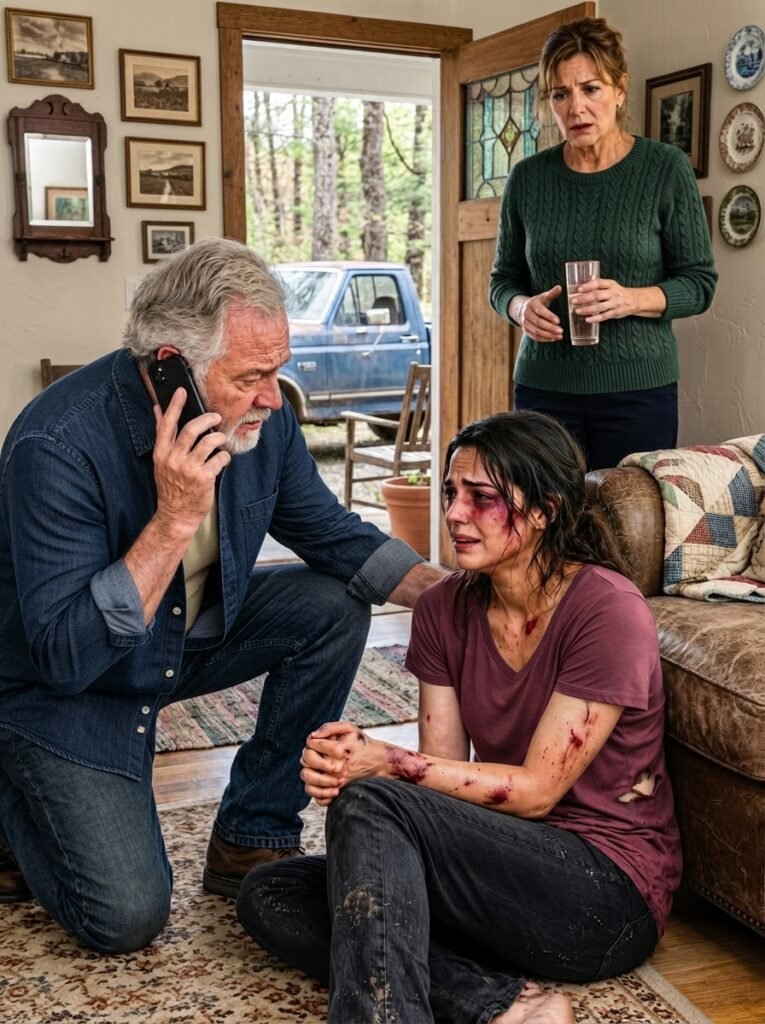
I looked at her.
“I’m remembering accurately.”
For the first time, she hesitated.
Maybe something in my voice bothered her.
Maybe she finally realized that I wasn’t there to argue.
At 8:06 p.m., according to my call log, I contacted emergency services.
I gave the dispatcher Emily’s condition.
The address.
Michael’s full name.
The make of his car.
And the direction Jessica claimed he had driven.
I requested medical assistance and law enforcement.
Nothing more.
When the dispatcher asked my relationship to the victim, I said, “I’m her father and the reporting party.”
I did not give a title.
I did not give my history.
I had been retired for years.
Tonight I wasn’t a chief.
I was a father.
Jessica laughed softly after I ended the call.
“You actually think they’re going to treat this like some kind of major investigation because you took photographs?”
I looked down at Emily.
“I think they’re going to do their jobs.”
The first patrol officer arrived minutes later with two paramedics.
Another officer pulled in behind him.
I stepped back immediately.
That mattered.
I wanted no one later claiming I had influenced the first response.
A paramedic knelt beside Emily.
“Ma’am, can you tell me your name?”
“Emily.”
“Do you know where you are?”
“My house.”
“Can you tell me what hurts?”
Emily swallowed.
“My ribs. My face. My shoulder.”
Jessica moved closer.
“She falls sometimes.”
The paramedic didn’t react.
A female patrol officer raised one hand.
“Ma’am, I’m going to ask you to stay over here.”
Jessica stared at her.
“I live here half the week.”
“That doesn’t change my request.”
Jessica’s expression hardened.
Emily winced when the paramedic gently examined her ribs.
Jessica started again.
“She gets emotional.”
No one responded.
“She exaggerates when she and Michael argue.”
Still nothing.
“She was throwing things.”
The female officer wrote that down.
Then she separated everyone.
Exactly as she should have.
I gave my statement in the dining room.
I showed the officer the photographs I had taken.
I showed him the call from Emily.
He recorded the timestamps.
He asked whether I had moved anything.
“Only my daughter enough to cover her with my coat.”
“Did you see Michael here?”
“No.”
“Did you hear what happened before arriving?”
“I heard part of it over the phone.”
I repeated Emily’s words exactly.
Then the scream.
Then the impact.
Then silence.
No conclusions.
No embellishment.
Facts.
Across the room, Jessica was speaking rapidly to the second officer.
Her hands moved more than before.
She looked irritated now instead of bored.
That was when headlights washed across the curtains.
Another vehicle pulled behind the patrol cars.
The younger officer beside me glanced toward the window.
His posture changed.
His partner stopped writing.
Jessica noticed.
Her mouth tightened into a faint smile, as though she believed someone important had finally arrived to restore order in her favor.
The front door opened.
A man in a dark raincoat entered.
Detective Aaron Cole.
I had not seen him in almost three years.
He had been twenty-six when I first promoted him into investigations.
He was older now.
Gray at his temples.
More tired around the eyes.
But he still walked into a room the same way.
First the people.
Then the exits.
Then the details.
He looked at the overturned table.
The paramedics.
Jessica.
Emily.
Then he saw me kneeling beside my daughter.
His face changed.
“Chief.”
The entire room went silent.
Jessica’s smile disappeared.
The younger patrol officer looked from Cole to me.
Then back again.
I stood.
“Aaron.”
Jessica stared.
“Chief?”
Detective Cole’s eyes stayed on Emily.
“You didn’t tell dispatch who you were.”
“Because it didn’t matter.”
He looked at me.
“It matters to me.”
“No.”
I lowered my voice.
“It cannot matter tonight.”
He understood immediately.
I watched him make the mental adjustment.
Former supervisor.
Victim’s father.
Potential witness.
Conflict risk.
I had trained him too well to pretend those things didn’t exist.
“You’re right,” he said.
Then he turned to the patrol sergeant.
“Notify Captain Ruiz. Tell him who the reporting party is. I want everything documented. Body cameras stay on. Evidence procedures by the book. If command wants another lead investigator, I’ll step aside.”
That was exactly what I wanted to hear.
Jessica looked between us.
“So he used to be your boss?”
Nobody answered her.
Her face changed again.
Not fear yet.
Calculation.
I knew that expression too.
Detective Cole crouched near Emily.
“Emily, you remember me?”
She nodded faintly.
“I think so.”
“I’m Aaron. Your father and I worked together years ago.”
Emily looked toward me.
Cole continued.
“But tonight I’m here for you. Not for him. Understand?”
“Yes.”
“Do you feel safe answering questions with your father nearby?”
Emily looked at me.
Then shook her head.
“No.”
For a fraction of a second, it hurt.
Then I realized what she meant.
She didn’t want to say certain things in front of me.
Shame does strange things to victims.
They often protect the people who love them from the truth.
I stood immediately.
“I’ll be outside.”
Emily tightened her grip on my hand.
“Dad.”
I stopped.
“Don’t leave.”
“I’ll be right outside the door.”
“You promise?”
“I promise.”
I walked onto the porch.
Rain blew beneath the roofline.
For the first time since the phone call, my hands began to shake.
Not when I saw Emily.
Not when Jessica lied.
Not when Cole called me Chief.
Now.
Because I finally had nothing to do.
I had spent thirty-four years responding to other people’s worst nights.
I knew how to secure scenes.
How to interview witnesses.
How to testify.
How to stay calm when someone was bleeding ten feet away.
None of that prepared me to stand on a porch while another detective asked my daughter how many times her husband had hurt her.
Ten minutes later, Captain Elena Ruiz arrived personally.
She had never worked under me.
That was useful.
She shook my hand once.
“Mr. Carter.”
Not Chief.
I appreciated that more than she knew.
“We’re transferring investigative lead to Detective Monroe,” Ruiz said. “Cole can assist because he was first investigative arrival, but Monroe will make charging recommendations.”
“Good.”
“And because of your former position, every interview involving you will be recorded.”
“Good.”
She studied me.
“You understand why.”
“I’d be concerned if you didn’t.”
The paramedics brought Emily out on a stretcher shortly afterward.
She looked smaller beneath the blanket.
I walked beside her.
“Dad?”
“I’m here.”
“They’re going to say I started it.”
“Then they’ll say it.”
“Jessica saw everything.”
I looked toward the house.
Jessica was now speaking with Detective Monroe.
“What did she see?”
Emily’s eyes filled.
“She watched.”
That sentence was worse than almost anything else she could have told me.
“She watched him?”
Emily nodded.
“And afterward she told me to stop making him angry.”
My jaw tightened.
The ambulance doors opened.
Before they loaded her inside, Emily whispered one more thing.
“Dad, Michael said nobody would believe me because his mother would tell them I was crazy.”
I squeezed her hand.
“You don’t have to prove everything tonight.”
“But—”
“You tell the truth. That’s enough.”
The ambulance left.
I followed in my pickup after officers finished my preliminary statement.
Jessica remained at the house.
Michael was still missing.
For twenty-three minutes.
Then his car was spotted six miles away.
An officer attempted a traffic stop.
Michael pulled into a gas station.
According to the body-camera footage I later saw, he stepped from his vehicle looking annoyed rather than frightened.
He demanded to know why he was being detained.
Then he learned Emily had been taken to the hospital.
His first question wasn’t whether she was alive.
It wasn’t whether she was badly injured.
It was:
“What did she tell you?”
That sentence eventually appeared in the probable-cause affidavit.
At the hospital, doctors found extensive bruising along Emily’s ribs and shoulder, swelling to her face, and injuries consistent with being struck and falling against furniture.
Thankfully, there were no life-threatening internal injuries.
I sat beside her bed just after midnight.
She stared at the ceiling.
“I should have left six months ago.”
“No.”
She looked at me.
“I knew.”
“You suspected things would get worse. That’s different.”
“I kept making excuses.”
“That’s what fear teaches people to do.”
Her eyes filled.
“I lied to you.”
“You survived the way you thought you had to.”
She turned her face away.
For several seconds, neither of us spoke.
Then she said quietly, “It wasn’t the first time.”
I already knew that.
But hearing it almost stopped my heart.
“How long?”
“About eleven months.”
I closed my eyes.
Emily continued before I could speak.
“The first time he grabbed me.”
Her voice trembled.
“Then he shoved me during an argument. After that, he apologized for two days. Flowers. Dinner. He cried.”
The cycle.
I knew every word before she said it.
“He promised it would never happen again.”
Emily gave a hollow laugh.
“I believed him.”
“You wanted to believe him.”
“The next time was worse.”
I reached for her hand.
She let me hold it.
“Jessica knew.”
That part I had not known.
Emily looked directly at me.
“She knew almost from the beginning.”
I felt something cold settle inside me.
“How?”
“She walked in once after Michael pushed me into a cabinet.”
Emily swallowed.
“I thought she was going to help me.”
Instead, Jessica had closed the door.
Then she told Emily marriage was complicated.
That Michael had always had a temper.
That provoking him would only make things worse.
And then came the sentence Emily would remember for the rest of her life.
“You chose him. Learn how to manage him.”
I stared at the hospital floor.
There are moments when anger is so complete it becomes quiet.
This was one of them.
The next morning, Detective Monroe arrived.
She was in her early forties, direct, careful, and unimpressed by titles.
Exactly the kind of investigator I wanted.
She asked Emily whether she had saved any messages.
Emily hesitated.
Then she nodded.
Michael had deleted messages from her phone more than once.
So, three months earlier, Emily had quietly turned on cloud backup.
She gave Monroe access.
There were hundreds of messages.
Most were ordinary.
Dinner.
Bills.
Appointments.
Then the tone changed.
Stop embarrassing me.
You know what happens when you push me.
Tell your father you’re sick.
If you mention this to anyone, we’re done.
Mom agrees you’re unstable.
And finally, sent only four days before the attack:
Try calling your father again and see what happens.
Detective Monroe’s expression did not change.
But I saw the muscles tighten around her jaw.
There was more.
Emily had taken photographs of earlier bruises.
Not for police.
Not originally.
For herself.
She said she had started wondering whether she was losing her mind because Michael and Jessica constantly told her events had not happened the way she remembered.
So she documented them.
Dates.
Pictures.
Short notes.
March 11 — Michael grabbed right arm after dinner.
April 2 — pushed against bathroom door.
May 19 — Jessica said not to tell Dad.
July 7 — Michael broke phone.
August 14 — threatened to ruin Dad’s reputation if I leave.
The investigation widened.
Then the house began telling its own story.
A neighbor’s doorbell camera showed Michael leaving at 7:58 p.m.
Not calmly.
He backed out so fast he nearly clipped a parked car.
Emily had called me at 7:46.
Emergency services were contacted at 8:06.
Jessica told officers Michael had left long before Emily “fell.”
The video proved otherwise.
Even worse for Jessica, another camera captured her arriving at 7:31.
She had been inside during the entire incident.
Then officers found something else.
The living room had a voice-controlled smart speaker.
Jessica apparently forgot that.
Some devices retained recent voice-command history.
At 7:52, someone had commanded:
“Turn the music louder.”
The voice was Michael’s.
At 7:56:
“Volume ten.”
Then, shortly afterward:
“Stop.”
The commands did not capture the assault itself.
But they helped establish timing.
Why increase the music volume during a supposed ordinary argument?
Then came the broken glass.
One shard contained a small smear of blood.
Emily’s.
Another piece had been kicked partly beneath the kitchen cabinet.
Photographs from my arrival showed it before anyone had time to rearrange the scene.
Jessica’s description of Emily simply “tripping near the sofa” became harder to defend by the hour.
Michael was arrested before noon.
Domestic assault.
Witness intimidation allegations.
And additional charges under review based on the prior incidents.
Jessica was not arrested immediately.
That bothered Emily.
It bothered me too.
But investigations are not revenge.
They move according to evidence.
Two days later, that evidence arrived.
Detective Monroe called while I was sitting beside Emily in my guest room.
Emily had refused to return to the house.
I didn’t ask her to.
I had already changed the locks at my place, installed additional cameras, and put fresh sheets in the bedroom she used as a teenager.
Monroe asked us to come to the station.
When we arrived, she placed a printed photograph on the interview-room table.
It showed Jessica holding Emily’s phone.
Timestamp: 8:01 p.m.
The image came from a camera positioned near the rear hallway.
Michael had installed the camera himself months earlier after complaining about package theft.
Jessica had told police she never touched Emily’s phone.
The camera showed otherwise.
“What was she doing?” Emily asked.
Monroe slid another document toward us.
“Forensic extraction shows several messages were deleted between 7:59 and 8:03.”
Emily stared at her.
“Jessica deleted them?”
“We believe she attempted to.”
The cloud backup had preserved copies.
One deleted exchange had happened only minutes before Michael attacked Emily.
Michael: Tell him you’re not coming Sunday.
Emily: Stop telling me when I can see my father.
Michael: I’m warning you.
Emily: I already called him earlier. I’m done hiding this.
Michael: Then you made your choice.
Three minutes later, Emily called me.
That was why she had said:
He hurt me again.
She had finally decided to tell me.
Michael realized it.
And everything exploded.
Jessica had not merely watched the aftermath.
Evidence suggested she had actively tried to remove messages after Michael left.
Detective Monroe was careful with her words.
“We cannot prove every action until the digital analysis is complete. But we have enough to seek charges related to evidence tampering.”
Emily covered her mouth.
I expected relief.
Instead, she started crying.
“She’s going to hate me.”
I looked at my daughter.
After everything, some part of her still feared disappointing the woman who had protected her abuser.
That was the deepest damage.
Not the bruises.
The training.
The months of being taught that everybody else’s comfort mattered more than her safety.
I moved my chair closer.
“Emily.”
She looked at me.
“You are not responsible for what happens to someone because they chose to hide a crime.”
“But Michael—”
“Made his choices.”
“And Jessica—”
“Made hers.”
She wiped her face.
“What if people say I’m destroying the family?”
I thought about that.
Then I answered carefully.
“Truth doesn’t destroy a healthy family. It exposes what was already destroying it.”
The preliminary hearing happened five weeks later.
By then, the swelling on Emily’s face was gone.
The fear wasn’t.
She sat beside the prosecutor wearing a dark blue blouse and kept twisting a tissue between her fingers.
Michael entered wearing a suit.
For a moment, he looked like the man I first met years ago.
Polite.
Clean-cut.
Confident.
He glanced at Emily.
She immediately lowered her eyes.
I leaned closer.
“You don’t have to look away.”
She breathed in.
Then raised her head.
Michael looked away first.
Jessica sat behind the defense table.
Her face remained expressionless.
Until the prosecution played the patrol body-camera footage.
Jessica’s own words filled the courtroom.
“She falls.”
“She gets emotional.”
“She exaggerates.”
Then the prosecutor displayed the medical photographs.
The room became silent.
Next came the timestamped images from Emily’s cloud backup.
Then Michael’s messages.
Then the neighbor’s doorbell video.
Then Jessica’s image holding Emily’s phone.
Jessica’s attorney leaned toward her.
For the first time since the night of the attack, I saw genuine fear cross her face.
But the moment that changed everything came when the prosecutor called Emily.
She walked toward the witness stand slowly.
Michael watched her.
So did Jessica.
Emily was sworn in.
The prosecutor began with simple questions.
Her name.
Her marriage.
The house.
Then:
“Did your husband strike you on the evening of October 18?”
Emily’s hands trembled.
“Yes.”
“Was that the first time?”
“No.”
Michael shifted in his chair.
The prosecutor waited.
“How many times had he physically hurt you before that evening?”
Emily looked toward Michael.
Then toward Jessica.
Finally she looked at me.
I didn’t nod.
I didn’t smile.
I didn’t tell her what to do.
This was her voice.
Not mine.
Emily turned back toward the prosecutor.
“I stopped counting.”
A sound moved through the courtroom.
The judge immediately called for silence.
Emily continued.
“He told me nobody would believe me.”
Her voice grew steadier.
“He said people respected him.”
She glanced toward Jessica.
“And his mother kept telling me everything was my fault.”
Jessica’s face tightened.
Emily took another breath.
“But that night I called my father.”
The prosecutor asked, “Why?”
“Because I finally understood that if I kept protecting Michael, eventually there might not be enough of me left to protect.”
I closed my eyes for one second.
That sentence stayed with me.
After the hearing, Michael remained in custody pending further proceedings.
Jessica was formally charged in connection with evidence tampering and making false statements during the investigation.
Months followed.
Lawyers.
Statements.
Hearings.
Continuances.
Nothing happened as quickly as television teaches people to expect.
Justice is usually paperwork before it is a verdict.
But Emily kept going.
She began therapy.
She filed for divorce.
She changed her phone number.
At first she slept with the hallway light on.
Some nights she woke from dreams and called me from the guest room even though I was twenty feet away.
“Dad?”
“I’m here.”
That became our routine.
Two words.
Nothing more.
I’m here.
The criminal case ended almost nine months after the phone call that changed everything.
Michael accepted a plea that included felony domestic assault and witness intimidation after the prosecution prepared to introduce the full digital record and evidence of the earlier abuse.
Jessica entered a separate plea on evidence-related charges.
Neither outcome erased what happened.
No sentence could return eleven months of Emily’s life.
But there was a record now.
A legal one.
Something neither Michael nor Jessica could rewrite by saying Emily was too emotional.
The divorce was finalized several weeks later.
On the courthouse steps, Emily stood in sunlight holding a thin folder containing the final decree.
She stared at it for a long time.
“How do you feel?” I asked.
She gave a strange little laugh.
“I thought I’d feel happy.”
“And?”
“I feel tired.”
“That’s allowed.”
She looked toward the street.
“Do you know what scares me?”
“What?”
“I don’t know who I am without constantly trying to stop him from getting angry.”
That hurt more than she probably realized.
I put my hands in my jacket pockets.
“Then maybe you get to find out.”
She looked at me.
“What if I don’t like who I am?”
“Then change.”
“What if I’m weak?”
“You called me.”
Emily’s eyes filled.
“You think that makes me strong?”
“No.”
I smiled slightly.
“I think surviving long enough to make that call means you never stopped fighting.”
Almost a year after the attack, Emily moved into a small house fifteen minutes from mine.
Nothing fancy.
Two bedrooms.
A narrow kitchen.
A porch that needed repainting.
She loved it immediately.
The first night, I helped assemble a bookshelf in her living room.
My old pickup sat outside under a clear autumn sky.
The same battered truck Jessica had seen that night.
The same truck Michael once mocked at a family dinner.
“You were a police chief and you still drive that thing?” he’d laughed.
I had shrugged.
“Starts every morning.”
That was enough for me.
Emily carried two mugs of coffee into the living room.
She looked different.
Not because the bruises were gone.
Because she moved differently.
No longer listening for somebody else’s footsteps.
No longer checking the time before deciding what to say.
No longer asking permission with her eyes.
She handed me a mug.
“You know something?”
“What?”
“I used to think the reason you didn’t tell them who you were that night was because you wanted to surprise them.”
I laughed.
“No.”
“Then why didn’t you?”
I looked around her little house.
A photograph of us sat on the mantel.
Emily was nine in the picture.
Missing one front tooth.
Sitting on my shoulders at a county fair.
“Because being Chief wasn’t what mattered.”
She sat across from me.
“But it changed everything when Detective Cole recognized you.”
“It changed Jessica’s expression.”
Emily smiled.
“That was pretty satisfying.”
I smiled too.
“Maybe.”
Then I became serious.
“But it didn’t create the evidence. It didn’t create your injuries. It didn’t create Michael’s messages. It didn’t make the neighbor’s camera record him leaving. And it didn’t make Jessica delete those texts.”
Emily listened quietly.
“If I had been a plumber, a mechanic, a teacher, or an unemployed old man driving the same pickup, you still deserved the exact same investigation.”
She looked down at her coffee.
“I know.”
“That title belonged to my career.”
I pointed gently toward her.
“What happened afterward belonged to you.”
Emily’s eyes watered.
For once, she didn’t look ashamed of the tears.
That evening, before I left, she walked me to my truck.
The porch light reflected across the hood.
I climbed behind the wheel.
Emily rested one hand on the open window.
“Dad?”
“Yeah?”
“Thank you for coming.”
I looked at her.
There were a thousand things I could have said.
That she never had to thank me.
That I wished I had seen everything sooner.
That I would have driven across the country if she had called from a thousand miles away.
Instead, I said the simplest thing.
“You called.”
Emily nodded.
“And you came.”
“Every time.”
She stepped back.
I started the engine.
The old truck coughed once, then settled into its familiar rumble.
Halfway down the driveway, I looked in the mirror.
Emily was still standing beneath the porch light.
But she wasn’t watching me leave because she was afraid of being alone.
She was simply waving goodbye.
There is a difference.
People still occasionally tell the story as though the dramatic moment was when Detective Cole entered that living room and called me “Chief.”
It makes a good story.
The retired police chief.
The shocked mother-in-law.
The abuser who didn’t realize whose daughter he had hurt.
But those people misunderstand what happened.
My old badge didn’t save Emily.
Evidence mattered.
Good officers mattered.
Doctors mattered.
Detectives who refused to cut corners mattered.
A neighbor’s camera mattered.
A cloud backup mattered.
And consequences mattered.
But none of those things would have started moving if Emily had never made that call.
“Dad, please hurry—he hurt me again.”
She thought those words were an admission of weakness.
They weren’t.
They were the moment she stopped protecting the people who were hurting her.
The moment she chose herself.
And the moment Michael and Jessica finally lost the one thing they had depended on most.
Her silence.