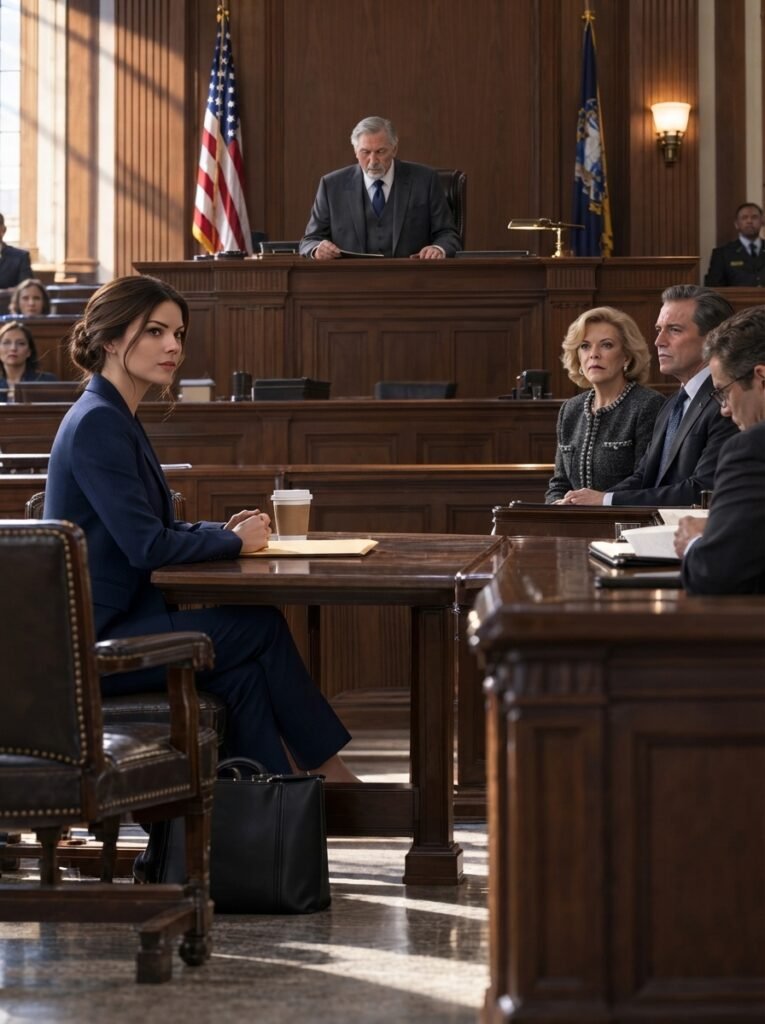
The judge asked my husband whose signature appeared on the authorization for the missing veterans’ money.
David pointed at me.
“Hers.”
He answered quickly, with the confidence of a man who had watched me sign divorce papers in front of witnesses.
Beside him, Sylvia folded her hands on the defense table.
Her cream designer suit was immaculate.
She looked pleased that the judge had finally asked the question they had come to answer.
Judge Thomas held the page beneath the courtroom lights.
“Are you certain?”
David looked at his attorney, then back at the judge.
“I watched her sign.”
He had.
I remembered the white tablecloth, his mother’s martini, and the small metallic sound my wedding ring made when it struck the ice in his water glass.
I had signed my divorce papers that night.
I had never signed this.
My mouth went dry, but I kept my hands still.
Five years with David and Sylvia had taught me what happened when they saw uncertainty.
They pressed until the person in front of them gave way.
There was no lawyer beside me to interrupt.
No family member behind me to squeeze my shoulder.
I had brought a slim manila folder and a courthouse coffee I could no longer bear to drink.
Judge Thomas lowered the page.
Before he could ask another question, Sylvia leaned toward her attorney and whispered something.
He rose at once.
“Your Honor, my clients have been trying for weeks to obtain an honest accounting of their marital property.”
I almost laughed.
Sylvia had threatened to put me out of my own house.
David had called me a thief.
Now they wanted an honest accounting.
Judge Thomas asked the attorney to sit down.
Then he turned another page in the sealed federal file.
For the first time that morning, Sylvia stopped watching me and started watching the folder.
I met David at a fundraiser for a veterans’ housing program.
My father had been an Army mechanic.
He could take apart an engine with patient, precise hands, but after he came home, he struggled to let anyone help him with the things he couldn’t repair.
A woman at a benefits office once spent an entire afternoon finding a missing record for him.
He remembered her name for the rest of his life.
After he died, I began volunteering at events that helped veterans get housing and home repairs.
At the fundraiser, I was stacking chairs when David appeared beside me and took half the pile without being asked.
He was funny.
He listened when I spoke about my father.
He walked me to my car through a cold Washington rain and stood there getting soaked while we talked.
When I told him I worked for the government, he grinned.
“Something you’re allowed to tell me about?”
“Grant compliance,” I said.
“That sounds thrilling.”
“It has its moments.”
I didn’t discuss active reviews at home.
The rules were clear, and I preferred to leave work at work.
David said he liked that about me.
He had grown up surrounded by people who announced every achievement before anyone thought to ask.
For a while, he seemed to mean it.
Sylvia was warmer when we first met, too.
She headed the organization behind the fundraiser, the Homefront Assistance Fund.
At dinner she asked about my father’s service and told me how much she admired people who cared about veterans.
A few months after David and I began dating, I disclosed the relationship at work.
Homefront’s paperwork crossed the desks in my division.
My supervisor moved a review away from me, as the rules required.
I was relieved that no one would have reason to question my work.
David brought flowers to my apartment that evening.
He called the disclosure proof that I was too honest for Washington.
We married the following spring.
The house we lived in had belonged to my grandmother.
It was modest, with a porch that needed painting and a kitchen window that stuck in humid weather.
David liked its location.
I loved the marks in the pantry doorframe where my grandmother had measured me as I grew.
The deed stayed in my name.
At the time, that seemed like an ordinary detail.
We had a whole marriage to build.
For the first two years, David still met me at the door when I came home.
We made dinner too late and ate it at the kitchen counter.
When my father’s birthday came around, David remembered without being reminded.
Then his business began to do well—or so he said.
His suits became sharper.
He started taking calls outside.
When I asked what he was working on, he told me it was too complicated to explain over dinner.
I recognized the answer.
I had given him versions of it about my own work.
I tried to respect his privacy.
Sylvia did not offer me the same courtesy.
She began calling me “the little clerk” at family dinners.
If I bought a new coat, she asked whether government salaries had improved.
At restaurants, she made a performance of paying the bill, then looked at me until I thanked her.
David used to defend me.
Eventually, he joined in.
“He can’t tell you much about his work either,” I told Sylvia once.
David put down his wineglass.
“That’s because there’s actually something to tell.”
Everyone at the table heard him.
He turned back to his food as if he hadn’t said anything cruel.
I stayed.
That is the part I had trouble explaining to myself later.
The good years had been real to me, and even during the bad ones, David could still make me remember them.
Some mornings he would set coffee beside me before I woke.
Some evenings he would look almost ready to apologize.
I kept waiting for him to say it.
The first clue came in an envelope addressed to our house.
It was a notice about an overdue payment on a company account.
David’s name appeared beneath the name of an LLC I had never heard him mention.
I left it on the kitchen counter.
When he came home, he took one look at it and said his accountant had made a mistake.
A month later, another notice arrived.
Different company name.
Same mailing address.
I asked about it.
He said I had no idea how consulting businesses worked.
Perhaps I didn’t.
But I knew how to read a bank statement.
Some of the names appeared on tax papers David had asked me to sign the previous year.
I had noticed them then and accepted his explanation that his accountant had reorganized the business.
Now I looked again.
Money moved between the companies in round amounts, sometimes on the same day it arrived.
One name resembled a vendor I remembered from Homefront paperwork.
Because of David, I no longer handled that program.
I did not open an agency database or ask a coworker what they knew.
I made copies of the household documents I was entitled to see and took them to the proper investigative office.
I told them everything, including the relationship that had taken me off the review.
Handing over the envelope felt like betraying my husband.
Keeping it felt worse.
My father had waited too long for help once.
I couldn’t dismiss the possibility that other veterans were waiting while money moved through David’s companies.
After that, I was kept at a distance from the investigation.
People independent of me checked the records.
They did not tell me what they found, and I did not ask them to make exceptions because I was scared.
At home, David grew harder to reach.
He started coming in after midnight.
He left his phone facedown at dinner.
Sylvia called more often, and their conversations stopped when I entered a room.
Once, at a Homefront event, a veteran named Mrs.
Warren told me she had been approved for a ramp outside her front door.
She had received the letter months earlier, but nobody had come to build it.
She was embarrassed to complain.
She thought another family might need the money more.
I helped her find the number printed on her letter.
In the parking lot afterward, I sat in my car with my hands on the steering wheel.
I thought of the companies on the tax papers.
I thought of Mrs.
Warren trying to get down her front steps.
When David invited me to dinner for our fifth anniversary, I wanted to believe he had noticed how far apart we had become.
I even wore the earrings he had given me in our first year together.
For one hour, on the drive downtown, I let myself imagine that we might talk honestly.
The restaurant was French and expensive, with white linen and low brass lamps.
A server showed me toward a private booth at the back.
I saw Sylvia first.
She held a martini.
David sat beside Naomi, a younger woman in a red designer dress.
His hand rested on the seat behind her.
I stopped.
David stood, though he made no move toward me.
“Come on,” he said.
“Sit down.”
There was an empty place set across from them.
I sat because my legs suddenly felt unreliable, and I did not want Sylvia to see.
David slid a thick envelope across the table until it touched my plate.
“Happy anniversary,” he said.
“Those are divorce papers.”
For a moment, I looked at his hands.
I knew the little scar across his thumb from the day he had tried to fix my grandmother’s kitchen window.
I had held that hand when he was frightened for his father in the hospital.
Now it was resting beside the envelope as though we were finishing a business meeting.
Sylvia laughed.
“My son needs a woman who matches his future,” she said.
“Not some government clerk who buys clothes off the rack.”
Naomi looked down.
Her expression had the shape of sympathy, but she stayed where she was.
I opened the envelope.
David’s attorney had prepared an aggressive settlement.
David claimed an interest in the house and wanted me to acknowledge assets connected to his companies.
One page referred to accounts I did not recognize as ours.
“Did your lawyer explain these?”
I asked.
David glanced at Sylvia.
“It’s standard.”
The papers in front of me were divorce papers, and I wanted the marriage to end.
I read the signature pages carefully.
I signed where I could sign without agreeing that his business accounts belonged to me.
I put the remaining pages back in the envelope.
David watched every movement of my titanium pen.
I had carried it for years; my father had given it to me when I started government work.
Sylvia’s smile widened when I finished.
She thought my signature meant she had won.
I slid off my wedding ring.
My finger looked oddly pale beneath it.
Then I dropped the ring into David’s glass of ice water.
It struck the glass with a small, clean clink.
“Enjoy dinner,” I said.
I walked past the server without looking back.
Before I reached my car, my phone began to ring.
David’s name filled the screen.
I let it stop.
He called again.
Only later did I learn what had happened at the booth.
One payment card failed.
David tried another.
That failed too.
Then Sylvia handed over hers, and the server returned with it.
Investigators had identified accounts linked to the companies, and the banks had placed holds on the cards.
The timing had nothing to do with my ring or my signature.
I had not known it would happen that night.
David did not know that.
He called until my phone went quiet, then began sending messages accusing me of freezing his money.
For years, he had treated my work as too dull to ask about.
Suddenly he thought I controlled every bank in Washington.
The calls became threats.
David wanted the rest of the divorce papers signed.
Sylvia wanted the house.
Their attorney sent letters listing property David claimed was his and debts he claimed were mine.
I learned that Naomi had posted a photograph of a Porsche online.
David stood beside it, smiling with the confidence I remembered from our early years.
The post appeared after the restaurant dinner.
I stared at it longer than I should have, wondering whether he had been capable of that smile with me lately.
I saved a copy because the car looked new, and David’s attorney was still insisting his business had almost no value.
Sylvia came to my house on a Thursday afternoon.
Two men followed her up the path with moving boxes.
“You have until sunset,” she said.
She held papers bearing an attorney’s letterhead.
None was an order giving her possession of the house.
I showed her the deed and asked the men to leave the boxes outside.
They exchanged a look, set them on the porch, and went back to their truck.
Sylvia stayed.
“You really think you can do this to my family?”
I wanted to tell her about Mrs.
Warren.
I wanted to ask how many approval letters Homefront had mailed while the money went somewhere else.
I didn’t have enough proof to make that accusation, and the investigation was no longer mine.
I said, “You need to go.”
She looked past me into the hallway, toward the marks on the pantry doorframe.
David had lived there for five years.
He knew what that house meant to me.
He had sent his mother to take it.
Sylvia left without touching a thing.
One of the boxes had begun to soften in the rain by the time I brought it inside.
That evening, I sat on the kitchen floor and cried.
I was angry at myself for crying over a man who had humiliated me, then angry that I could still hear his voice in every room.
I filed my response to their property claim.
I included the deed, copies of the tax papers, and the photograph of the Porsche.
I did not know that Trey had already given investigators records far more complete than mine.
Trey was Sylvia’s son-in-law and Homefront’s chief financial officer.
At family gatherings, he had been the quiet man who cleared plates while Sylvia held court.
David called him spineless.
Trey had kept duplicate ledgers for years.
He had noticed payments labeled as home repairs when no contractor had been hired.
He had asked questions and accepted answers he later came to regret.
When Mrs.
Warren’s file appeared in a group marked completed, though her ramp had never been built, he stopped accepting them.
He copied records and eventually took them to federal investigators.
He had preserved company emails too, including material from years before I knew him.
I learned most of that after the hearing.
On the morning I walked into the courthouse, all I knew was that investigators had submitted a sealed file to Judge Thomas and that I had been told to answer questions truthfully.
Sylvia leaned toward me before the judge entered.
“You’re finished,” she whispered.
“You should have walked away when we gave you the chance.”
I said nothing.
She smiled as though my silence frightened me more than her threat.
Now Judge Thomas had the authorization in his hand, and David had told him the signature was mine.
“Can you identify when you watched her sign this document?” the judge asked.
“At dinner,” David said.
“Which dinner?”
“Our anniversary.”
The judge looked at the date printed above the signature.
“This authorization is dated nine days later.”
David’s attorney leaned toward him, but David spoke first.
“Then she signed another copy.
She handled paperwork all the time.”
I rose when Judge Thomas asked me to.
“I signed the divorce pages at the restaurant,” I said.
“I did not sign an authorization for those accounts.”
Sylvia made a sound of disbelief.
Judge Thomas asked her to be quiet.
The signature looked exactly like mine.
That was the trouble.
Every stroke matched the one I had made with my titanium pen, down to a tiny break in the final letter where I had paused.
The sealed file contained a copy of the divorce page.
An examiner had compared it with the authorization David’s side had provided.
The signatures matched perfectly, including the stray mark left by the pen.
Someone had lifted my signature from the anniversary papers and placed it on a document dated nine days later.
David stopped looking at me.
His attorney had received the authorization from David.
I watched that fact settle over him as Judge Thomas asked another question.
“Why did you submit these accounts as marital property?”
The attorney answered carefully.
He had relied on records supplied by his client.
The judge turned to the first page of Trey’s ledger.
Payments designated for veterans’ housing had passed through three companies connected to David.
Some ended in an account that had paid for the Porsche.
Others had been transferred again, until the names of the original applicants were almost impossible to see.
I saw Mrs.
Warren’s name in a column.
For a second, the courtroom fell away.
I could picture her at the fundraiser, apologizing for asking where her ramp was.
Sylvia rose halfway from her chair.
“Trey had access to every account,” she said.
“If something is wrong, ask him.”
David looked at her sharply.
Until that moment, they had appeared to share one story.
Now each was trying to put distance between themselves and the records.
Judge Thomas called a recess.
He was deciding the property claim before him, he said, not trying a federal fraud case at the divorce table.
But he had enough to question whether David could claim those accounts as lawful marital assets—or use them as grounds to take my house.
In the hallway, David approached me before his attorney caught up.
“Tell him you knew about the companies,” he said under his breath.
“You saw the tax papers.”
“I told him I saw them.”
“Then help me.”
I looked at him.
For five years, I had wanted him to speak to me without his mother supplying the words.
“You copied my signature,” I said.
He glanced away.
His attorney reached us and took him back inside.
The answer I had waited for had finally come, even if David would never say it aloud.
When the hearing resumed, a woman entered the gallery in a plain blue coat.
Naomi.
She sat several rows behind David.
He turned at the sound of the bench moving and stared at her.
She did not smile.
She had gone to investigators after discovering that David had put a company and the Porsche in her name.
At first, she told them, she had believed his account of a thriving business.
Then a notice arrived tying the car to a Homefront payment.
She brought the title documents, her messages with David, and the photographs she had posted.
Sylvia had given Naomi the red dress for the anniversary dinner.
Naomi admitted she had known David was married and had gone anyway.
Her testimony did not make me like her.
It did make me listen.
“Why did you post the car?”
David’s attorney asked.
“David wanted people to see it,” she said.
“He said it showed how well we were doing.
I kept the post up after I went to the investigators because they asked me to preserve what he’d said about it.”
David stared at the table.
Naomi turned toward me.
“I’m sorry,” she said.
I believed that she was.
I also remembered her sitting beside him while I opened the envelope.
Both things could be true.
Trey’s ledger and Naomi’s documents showed more than a husband concealing income.
They showed Homefront payments routed away from approved work, including Mrs.
Warren’s ramp.
The forged authorization was an attempt to make me responsible for accounts I had never controlled.
Judge Thomas denied David’s request to treat those funds as marital assets.
He rejected the effort to take possession of my house.
He ordered the disputed records preserved and made clear that the federal investigation would proceed separately.
My knees shook when he said the house remained mine.
I gripped the edge of the table until I could stand.
Outside the courtroom, David and Sylvia were met by federal agents with warrants issued as part of that separate case.
Sylvia asked her attorney whether he could stop them.
David called my name.
I did not turn around.
I had spent enough mornings waiting to hear him call it.
The federal case took time.
There were interviews, more records, and long stretches when I heard nothing.
Trey testified about the books he had kept.
Naomi gave up the Porsche.
It was sold, and the money became part of the effort to repay what Homefront had taken.
Sylvia and David were charged.
Both eventually entered guilty pleas.
The court ordered restitution, though no order could give families back the months they had spent waiting.
Mrs.
Warren finally got her ramp.
She called me when the contractor finished.
I visited on a bright afternoon and watched her come down it without someone holding her arm.
She insisted I stay for coffee.
I told her many people had helped.
“That doesn’t mean I can’t thank you,” she said.
At home, I painted the porch and fixed the kitchen window.
Some nights I still woke from a dream about the restaurant and had to remind myself where I was.
I had loved David.
Learning what he had done did not erase the years when I believed he loved me.
I thought I knew the worst of it.
Then, after the pleas, part of the sealed file was released to me.
Trey’s preserved emails had been used in the federal case.
An investigator called to say there was an exhibit I might want someone with me to read.
I took it home alone.
The first pages concerned accounts and contractors.
I recognized names I had seen in court.
The last page was a printout of messages between Sylvia and David, sent through company accounts that Trey’s backups had retained.
The date was
eleven days before the fundraiser where I met David
.
Sylvia had forwarded him a notice of an upcoming review.
My name was on it.
At the time, I had been assigned to look at Homefront’s grant paperwork.
David’s reply said he had found out I volunteered at veterans’ events.
Sylvia wrote:
Get close to her.
She’ll have to disclose the relationship, and they’ll move the review.
We need the time.
A minute later, David answered.
I’ll be at the fundraiser.
I know how to talk to her.
I read the messages three times.
I remembered him carrying chairs beside me.
I remembered the rain and the way he had listened when I talked about my father.
Those memories were mine.
The tenderness I had felt was real.
David had arrived with a reason to find me.
The relationship had taken me off Homefront’s review, exactly as Sylvia wanted.
Other people had eventually found the missing money, but Sylvia and David had gained time.
When the investigation caught up with them, they used the signature David had watched me put on our divorce papers to try to make the accounts mine.
I set the printout on the kitchen counter.
Through the window, the porch paint was still bright.
Inside the pantry, my grandmother’s pencil marks remained on the doorframe.
For years, I had wondered when David stopped loving me.
The messages could not tell me whether he ever had.
They told me why he came over to help with the chairs, and why his mother knew so much more about my work than she pretended.
The next morning, I put Mrs.
Warren’s photograph beside the message from the investigator.
In it, she stood on her finished ramp, one hand raised toward the camera.
Then I went to work.