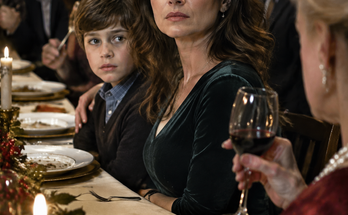
A woman I had never met called me by my first name at my father-in-law’s graveside and said, “He was so happy about the baby.”
My husband’s sisters went white. I thanked her and held my husband’s arm. I am not pregnant. I have not been pregnant in nine years. By the time the last car left the cemetery, I knew whose baby the stranger meant, because she was still standing there, and she was looking at my husband.
“Who was that?” I asked in the car.
“Nobody. One of Dad’s old nurses.”
“She knew my name.”
“Everybody knew your name. Dad talked.”
My name is Christine. I am forty-five. My father-in-law was a good man who called me every Sunday for nineteen years. He never once mentioned a baby.
I endured his daughters going white. I endured my husband’s hand tightening on the wheel. I endured his older sister texting him at the reception, and him reading it under the table, and putting the phone in his pocket without answering me. I endured the younger sister saying, too brightly, “Chris, you look great, have you lost weight?”
The woman had a red coat. She was maybe fifty. She stood at the back through the whole service, and she did not sign the book.
At the reception, in the church basement, I asked the pastor’s wife.
“The lady in the red coat. Do you know her?”
“Oh. That’s Wanda. She was at the hospital every day at the end. I assumed she was family.”
“Which family?”
“I assumed yours, honey.”
Nobody in my family wears a red coat to a funeral.
At the house afterward, the sisters cleaned up my mother-in-law’s kitchen and talked in the low voices women use when the subject is in the next room. I was in the next room.
“She’s going to find out anyway.”
“Not today. Dad’s not even cold.”
“Wanda shouldn’t have come. I told her, “
“You told her? You’ve been talking to her?”
“Since Easter. Somebody had to.”
Then a plate set down hard. Then quiet.
Since Easter. That was seven months.
My husband found me in the hallway.
“You okay?”
“Fine.”
“You look pale.”
“It’s a funeral,” I said.
That night he went to bed at nine. He never goes to bed at nine.
I sat at the kitchen table with my father-in-law’s address book, which my mother-in-law had asked me to take home to send the cards. There was a Wanda. No last name. A phone number. And next to it, in my father-in-law’s shaky hand, a date from this spring, and the letters “OB, 10:30.”
OB. A seventy-eight-year-old man does not have an OB appointment.
I did not sleep. At six I called the number.
She answered on the second ring, like she had been waiting.
“This is Christine.”
“I know.”
“You said ‘the baby.’ At the grave.”
Long breath on the other end.
“I thought you knew. I thought that’s why the girls hated me. I told Travis I wouldn’t come if you didn’t know, and he said, “
“Travis said what?”
“He said you’d been told. In the spring.”
“Told what, Wanda?”
“Christine, I can’t do this on the phone. I’m at the diner on Fourth. I’ll be here till eight.”
I went. In my funeral dress from the day before, because it was on the chair.
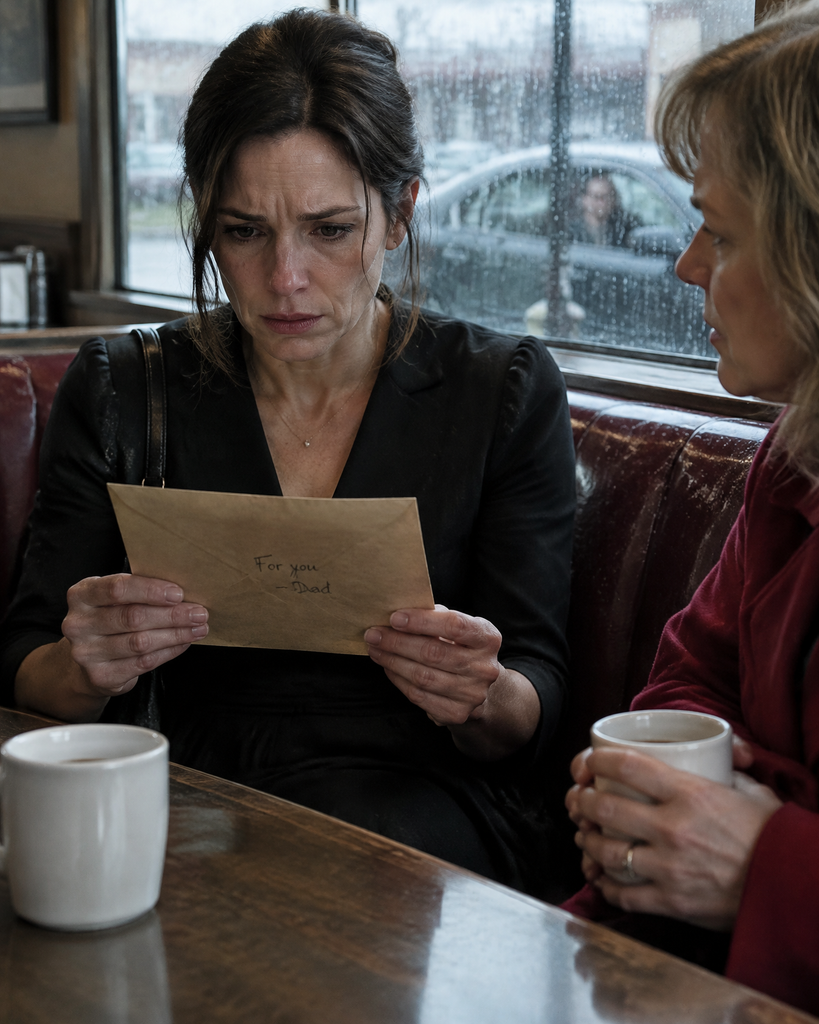
She was in a back booth with a coffee and a manila envelope.
“I was your father-in-law’s home aide,” she said. “Four days a week. For a year. That’s how I met your husband.”
“Met.”
“He came Tuesdays. To sit with his dad. And then he came Tuesdays for me.”
I did not move.
“I’m not proud. I’m telling you because Walter, your father-in-law, knew. He figured it out in March. And when I told him I was expecting, he was the one who drove me to the appointment. Not Travis. Travis wouldn’t. Walter said someone in that family should act like a man.”
“Where’s the baby?”
“She’s with my sister today.”
She. A daughter.
“Walter made me promise something before he went in the last time.” She pushed the envelope across. “He said to give it to you, not Travis, and not the girls. He said you’d know what to do with it, because you’re the only one in that family who ever paid him back for anything.”
“What’s in it?”
“I didn’t open it. It’s got your name on it. In his handwriting.”
I picked it up. Heavier than paper. I turned it over. He had written one more line under my name: “For the house on Maple, which was never in his name alone.”
I opened it at the table. Wanda watched.
Inside was the deed to the rental property on Maple Street. The one my father-in-law bought thirty years ago, the one that paid for his care at the end.
The one my husband always said would go to him and his sisters equally when the estate settled.
Except the deed had my mother-in-law’s name on it. And mine. Signed over last April, notarized, recorded. A sticky note in Walter’s writing said, “Jean agreed. The girls don’t know. It’s yours to sell or keep. Do right.”
There was also a bank statement. A small account, maybe four thousand dollars, in my name and Wanda’s. Joint. Opened in June.
“I didn’t know about that one,” Wanda said quietly.
I looked at the statement, then at her.
“He opened it the week before he went into hospice,” she said. “I got a debit card in the mail with a note that said, ‘For the baby. Christine will know.’”
I sat there with my cold coffee and a dead man’s instructions.
Walter had known his son was a coward. He had known his daughters would close ranks. And he had known I was the only one who would actually look that baby in the face and see a person instead of a problem.
“How old is she?” I asked.
“Three months.”
“What’s her name?”
“Ellie.”
I folded the deed back into the envelope.
“The house brings in about eighteen hundred a month,” I said. “The tenant’s lease is up in February. If you want to move in then, I won’t charge you rent for the first year. After that, we’ll figure something out.”
Wanda stared at me.
“You don’t have to, “
“I’m not doing it for you,” I said. “I’m doing it because Walter asked me to, and because that baby didn’t ask to be born into this.”
“What about Travis?”
“What about him?”
“He’ll fight you.”
“Let him. The deed’s in my name. He can explain to a judge why his father didn’t trust him with it.”
I stood up. Wanda stood too, uncertain.
“I don’t want your thanks,” I said. “I want you to get a lawyer and file for child support. Today. And I want you to stop protecting him.”
She nodded. Her eyes were wet.
I left her there with the bank statement and walked out into the parking lot. It was seven thirty in the morning, and I had been married for nineteen years to a man I apparently did not know.
When I got home, Travis was at the kitchen table with his phone.
“Where were you?”
“Diner.”
“This early?”
“Couldn’t sleep.”
He looked at me for a long time. Then he looked at the envelope in my hand.
“What’s that?”
“Your father’s papers. Your mother asked me to handle the thank-you notes.”
“That’s not what that is.”
I set it on the table between us.
“No,” I said. “It’s not.”
He reached for it. I put my hand on top.
“When were you going to tell me?”
His face did not change, but his hand stopped.
“Tell you what?”
“About Wanda. About the baby.”
He pulled his hand back. He looked at the table, at the window, at his coffee. Anywhere but at me.
“It’s not mine.”
“She says it is. Your sisters know. Your father knew.”
“Dad didn’t, “
“He drove her to her appointments, Travis. Because you wouldn’t.”
That landed. He flinched.
“It was a mistake,” he said. “It didn’t mean anything.”
“It meant enough that there’s a three-month-old with your eyes.”
“You haven’t even seen her.”
“I don’t need to. Wanda’s not a liar. And your father believed her.”
He stood up, paced to the sink, turned around.
“So what, you’re just going to believe some woman you don’t even know? Over me?”
“I’m going to believe your father,” I said. “Who left me the Maple Street house and a bank account with her name on it. Because he knew you wouldn’t do the right thing.”
His face went white. Then red.
“He had no right, “
“He had every right. It was his house. And apparently he trusted me more than he trusted you.”
Travis stared at me. I watched him try to decide which lie to tell next. I had seen that look before and not known what it was. Now I did.
“I’m filing for divorce,” I said. “You can stay here until the end of the month. After that, I want you out.”
“Chris, “
“Nineteen years,” I said. “And you let me sit at that funeral and smile at people while your sisters and some stranger knew more about your life than I did.”
“I was going to tell you.”
“When?”
He did not answer. That was the answer.
I picked up the envelope and walked out of the kitchen. I heard him say my name again, but I did not stop. I went upstairs and called a lawyer I had found on my phone in the diner parking lot. Then I called my mother-in-law and told her I had something to drop off, and that she and I needed to talk.
She cried. But she did not argue. She had known since Easter, same as the girls.
I gave Wanda my lawyer’s number that afternoon. By the end of the week, she had filed. Travis tried to convince me it was all some kind of shake-down, that Wanda was lying, that the baby could be anyone’s. But he never took a paternity test. And he moved out on the twenty-eighth without being asked twice.
The divorce took four months. I kept the house we lived in. He got his car and half the savings and whatever his mother decided to leave him when her time came. I kept Maple Street. The lawyer said he could fight it, but it would cost him more than it was worth, and he would lose.
He did not fight.
Wanda moved into the Maple Street house in March with Ellie and her sister. I met the baby once, briefly, when I dropped off the keys. She looked like my husband. She had his nose and his serious little forehead. I did not hold her. I was not ready for that.
But I made sure the heat worked, and I told Wanda that if she needed anything fixed to call me first, not some landlord hotline.
Walter had been right. I was the only one in that family who would do it. Not because I was kind, or good, or better than anyone else. But because he had asked me to, and because for nineteen years he had called me every Sunday and treated me like I mattered.
So I made sure his son’s baby had a roof.
It was the least I could do. And it was more than Travis ever did.