The Final Page
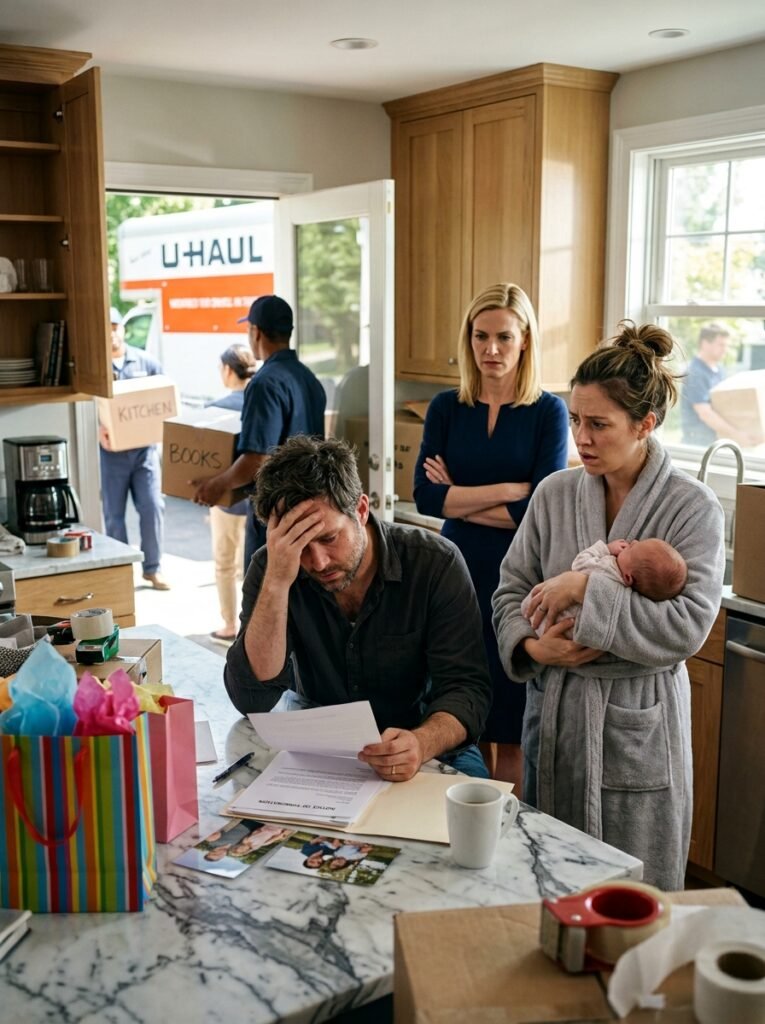
I turned to the final page with shaking hands.
Clipped to it was a small black flash drive. Taped beside it, in Hannah’s steady handwriting, was a single line:
“Play this for your lawyer before you decide to fight me for Grace.”
I already knew. Somewhere in the pit of my stomach, before I ever plugged it in, I knew exactly what was on it, and I knew it would end me.
Three weeks earlier, I had been careless. Vanessa and I had been drinking at her apartment, and I’d been loud and stupid and cruel in the specific way a man is cruel when he thinks no one who matters can hear him. I had complained about Hannah. I had called the sleepless nights with our newborn “a prison.” I had said — God forgive me, I actually said — that I sometimes wished we’d never had the baby, that Grace had “ruined” the life I wanted, that I was just waiting for the right moment to get out clean.
I remember the night, now that I let myself remember it instead of running from it. I remember thinking, in the moment, that I was being funny. That complaining about my exhausted wife to a woman who found me charming was harmless venting, the kind of thing men do. I had told myself a whole comfortable story in which I was the victim — trapped, unappreciated, tied down by a woman who’d “let herself go” into motherhood while I still had life left to live. That is the lie every unfaithful person tells themselves, I’ve since learned. You cannot betray someone you’re still seeing clearly, so first you have to make them small in your own mind. I had spent months quietly shrinking Hannah down into an obstacle, so that cheating on her would feel less like a crime and more like an escape. And on that particular night, drunk and stupid, I said the shrunken version out loud.
I had said it into a phone lying face-up on Vanessa’s coffee table.
And at some point that night, whether I’d pocket-dialed my own home or whether Vanessa herself had grown tired of me and sent it along, that recording had reached my wife.
Hannah had my voice. My own voice, saying the most unforgivable things a husband and father can say, three weeks before I came home to an empty house.
I plugged in the drive later that night, alone, because I had to know. And I sat in my silent kitchen and listened to a stranger who sounded exactly like me describe his wife and his daughter as burdens, and I understood, finally and completely, that Hannah had not destroyed my life.
I had. She had simply documented it, and handed it back to me, and walked out the door.
When the Fun Ran Out
I want to tell this part honestly, because I’ve spent a long time since learning to tell the truth, and it’s the only thing I have left that’s worth anything.
The first thing I did, after the panic, was call Vanessa. Not Hannah’s sister again, not Hannah’s parents — Vanessa. Because in the wreckage of my marriage, my broken instinct still reached for the woman who had felt like an escape from it. I told her everything. The empty house. The envelope. The custody petition. The recording.
I thought she would come over. I thought she would help.
There was a pause on the line, and then Vanessa said, in a voice I had never heard her use, “Trevor, this sounds like a really messy situation. I don’t think I should be involved in your custody stuff. That’s a lot.” And then, a few days later, she stopped answering altogether. Within two weeks she had transferred to a different department, and within a month she was posting photos with someone else — someone, I noticed, without a pregnant wife at home.
That was the first lesson the empty house taught me. The woman I had thrown away my family for had never actually wanted a life with me. She had wanted the fun, glamorous, no-consequences version of me — the man with the diamond bracelets and the free afternoons and no diapers to change. The instant I became a man with real problems, a real child, and real accountability, she was gone. She had never been the prize. She had been the excuse.
Hannah, meanwhile, had known this about her before I ever did. That was in the envelope too, in a way. Hannah had understood that the affair wasn’t the disease; it was the symptom. The disease was that I had wanted to be a person with no responsibilities at exactly the moment my wife and daughter needed me to be a person with them.
I think about the timeline constantly now. The affair started six months into Hannah’s pregnancy — which means that while my wife’s body was changing, while she was frightened and hopeful and building a nursery and reading books about how to keep our daughter safe, I was already halfway out the door with a coworker who thought pregnancy was something that happened to other, less interesting women. Hannah gave birth to Grace while I was texting Vanessa from the hospital waiting room. I stood in that delivery room with tears in my eyes, meaning every word of my promises, and I was lying even as I said them, because a man cannot keep a promise he is actively breaking. I have had to make peace with the fact that the most sacred moment of my life and the most shameful one were the same moment. That is the kind of person I was. Not a monster in a story. Just an ordinary, selfish man who wanted the reward of a family without the cost of being in one.
I hired a lawyer. He read the file, watched the highlighted charges, saw the photographs, and then I made him listen to the recording, because he needed to know what we were up against. When it finished, he took off his glasses and rubbed his eyes and said, very quietly, “Trevor, I’m going to be straight with you. There is no version of this where you win custody. There is only a version where you behave well enough, for long enough, that you eventually earn the right to be in your daughter’s life at all. I’d start now.”
I started that night. Not because I suddenly became a good man — I want to be honest, I didn’t, not that fast. I started because I was terrified of losing Grace, and terror was the only door my selfishness had left unlocked. The becoming-a-better-man part came slower, and it came through the work, not before it. That is something else the empty house taught me: you do not feel your way into acting right. You act right, over and over, on the days you don’t feel like it, until one day you look up and discover the feeling has quietly moved in behind the actions. Nobody tells you that when you’re the kind of man buying diamonds for the wrong woman. You think character is something you have. It turns out character is something you do, on a Tuesday, when no one’s clapping.
The Hearing
The next months were the worst and the most honest of my life.
I learned exactly what Hannah had uncovered, and the scale of it humbled me to the ground. The credit card statements. The hotels. The jewelry. And the piece that mattered most to the court, the “financial misconduct during the child’s infancy” — I had, over those months, quietly drained a chunk of the savings account Hannah and I had opened for Grace. Money we’d set aside for our daughter’s future, spent on perfume and handbags for a woman who wouldn’t return my calls once things got hard. I had literally taken from my newborn to give to my mistress. Seeing it laid out in yellow highlighter was like being shown a photograph of a man I didn’t want to admit was me.
Hannah had prepared all of it while recovering from childbirth, on no sleep, nursing our daughter through the night. While I was playing teenager in fitting rooms, my exhausted wife had been quietly, methodically building the case that would protect her child from her child’s own father. I have never in my life been so ashamed of anyone, or so awed by anyone, and they were the same person.
The custody hearing was not a battle. My lawyer had been right; there was nothing to fight. I sat in that courtroom and watched Hannah walk in — thinner, tired, but with a spine of pure steel — holding herself with a dignity I had spent three months of shopping trips proving I didn’t deserve to stand next to.
She did not gloat. She did not even look angry. She looked like a woman who had grieved our marriage already, completely, in private, and had come to court only to finish the paperwork on something that was already dead.
That was the thing that finally broke through whatever was left of my self-pity — the calm. I had braced for a furious woman, a vengeful woman, someone I could quietly cast as unreasonable so I could keep feeling like a victim. Instead I got a mother who had done all her crying where I couldn’t see it, who had turned her devastation into a plan while I was still congratulating myself in fitting rooms, and who now sat across a courtroom with nothing left to prove. You cannot argue with that kind of composure. You can only sit in the ruins of what you did and finally understand the size of what you lost — not a wife who would scream and fight to keep you, but a woman strong enough to let you go without one.
Her attorney laid out the petition. Full custody. Supervised visitation for me, contingent on my behavior. Repayment of the money I’d taken from Grace’s account. Financial support calculated down to the dollar.
And then the judge turned to me and asked if I had anything to say. I looked at Hannah across that courtroom, and every excuse I’d ever made evaporated, and the only true thing left in me came out.
“She’s right,” I said. “About all of it. I did everything in those papers. I don’t deserve my family.” My voice broke. “I’m only asking the court for the chance to become the kind of father my daughter can be safe around. Not for me. For Grace.”
The judge studied me for a long, long moment. And then she began to read her ruling.
Earning the Smallest Thing
The court gave Hannah everything she asked for, and it was right to.
Full legal and physical custody. My visits with Grace, supervised, in a neutral facility, one hour at a time, dependent entirely on my conduct. Repayment of every dollar I’d stolen from my own daughter’s savings. Support payments that reflect, correctly, that a child’s father is obligated to that child whether or not he behaved like it.
I did not fight a single term. Fighting was the old me. The old me is the reason I was standing in that courtroom in the first place.
Here is what happened after, in the years since, and I tell it not to make myself the hero, because I am not the hero of this story. Hannah is. I am the cautionary part.
I went to therapy — real therapy, the hard kind, the kind that makes you look at the man who said those things on that recording and admit he lives inside you. I paid back the money. I never missed a support payment. And I showed up, every single supervised hour, on time, sober, present, for a daughter who at first had no idea who I was.
It took two years before the visits stopped being supervised. It took another year before Grace, four years old now, started reaching for my hand on her own. Every inch of trust I have with my daughter today, I earned back one hour at a time, and I know, in my bones, that I am lucky beyond anything I deserve to be allowed to earn it at all. A different woman would have simply been done with me, and would have been within her rights.
I keep the note now, the one that was on top of the envelope. You chose her. Now you can have her. Don’t look for us. I keep it in my wallet, folded small, and I take it out when I feel the old selfishness stir, when I catch myself wanting to be a person with no consequences again. It is the truest thing anyone has ever written to me. It is the sentence that saved what little of me was worth saving. Some men get an intervention. Some get a wake-up call. I got an empty house and eleven words in my wife’s handwriting, and it was exactly as much mercy as I had earned, which is to say it was more than I deserved.
Hannah and I are not friends. We are something more careful than that — two people who share a daughter and have built a fragile, functional truce for her sake. She remarried two years ago, a genuinely good man who is kind to Grace, and I made myself be glad about it, because Grace deserves a house full of adults who don’t do what I did. Watching my daughter be loved by the family I blew apart is my penance, and I have decided to accept it as a gift instead, because bitterness is just the old disease wearing a new coat.
People who hear this story sometimes want me to be angrier at Hannah. For erasing herself so completely. For the recording. For not giving me a chance to explain.
But there was nothing to explain. That’s what I finally understood, sitting alone in that empty house with an envelope full of my own choices spread across the counter.
Hannah didn’t take my family from me. I gave it away, one boutique at a time, one lie at a time, one night on Vanessa’s couch at a time. All my wife did was refuse to keep absorbing it. She looked at a man who had chosen someone else, and she believed him, and she let him have exactly the consequence-free life he’d said he wanted — minus the wife and daughter he’d treated as the price of admission.
You chose her, the note said. Now you can have her.
The cruelest part, the part I’ll carry forever, is that she was right. I had chosen. I just didn’t understand, until the house was empty, that I’d been choosing against the only two people who ever actually loved me.
I get one hour, then two, then an afternoon, with my daughter now. I do not waste a single second of any of them.
It is so much less than I once had.
It is so much more than I earned.