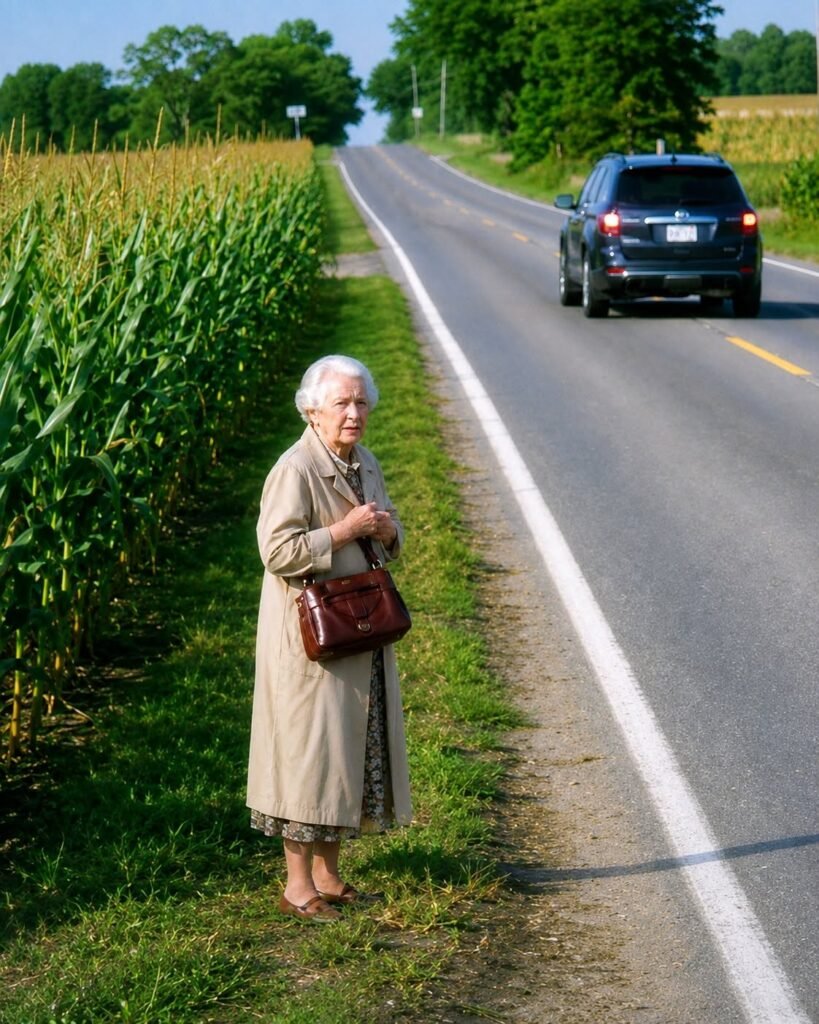
After we laid my husband to rest, my son drove me to a quiet road outside town and said, “This is where you get out. The house and the business are mine now.”
I stood in the dust, clutching my bag, as he pulled away without looking back. No phone. No cash. And that’s when I realized—I wasn’t alone. I was free… but he had no idea what I’d put in place before his father passed away…
The gravel crunched under my funeral shoes like it had been waiting for me.
I watched my son’s SUV roll forward, hesitate for half a second—just long enough to pretend this wasn’t real—then pick up speed and disappear past the bend where the cornfields start and the town stops pretending it’s still the center of the world.
I didn’t scream his name. I didn’t throw my hands up. My throat was too dry for drama, and my heart was too tired for begging.
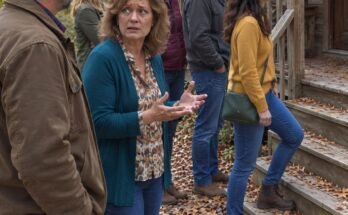
Three days ago, I stood at the cemetery with a paper program folded in my hands and my husband’s favorite hymn stuck in my head even though we weren’t the hymn-singing type. People brought comfort the only way they knew how—Costco trays, foil pans, paper plates stacked on my counter like a quiet army. Neighbors hugged me and whispered, “He was a good man,” the way Americans say goodbye when they don’t have better language for loss.
My children flew in like they were arriving for an appointment.
My son carried himself the way men do when their lives are scheduled in fifteen-minute blocks—eyes already elsewhere, phone always face-down, like he didn’t want the screen to betray how quickly he could move on.
He talked about flights, meetings, the interstate traffic he’d “have to beat” on the way back. My daughter arrived with expensive sunglasses and a brittle smile, hugging me like she was performing tenderness for an audience.
That first night after the funeral, the house felt too quiet for two grown kids who used to fill it with noise. I made coffee out of habit and stood at the sink staring at the yard, at the bare branches that would bud soon, at the life my husband and I had built with our hands.
Then my son opened his laptop on the dining table—our dining table—and said, “We should talk about next steps.”
Next steps.
Not grief. Not memories. Not even, “Mom, are you sleeping?” Just next steps, like I was a file that needed closing.
They spoke softly, politely, the way you speak when you’re trying to move an older woman out of the way without calling it what it is. They used words like “practical” and “manageable,” and my daughter kept nodding like she’d rehearsed the nods in a bathroom mirror.
In the morning, they handed me a suitcase I didn’t recognize and told me we were going to “look at a place” that would be “good for me.”
I said, “I’m not going anywhere.”
My son smiled like he’d heard that sentence before, like resistance was just a phase. “Just come take a look, Mom. It’s easier if we do this calmly.”
So I walked through my own house—my own rooms—like a guest. I passed the living room where my husband used to fall asleep during football games. I passed the hallway where the paint still held the faint marks of my kids’ height lines.
I picked up my purse, heavier than it should’ve been, and followed them to the car because something in me wanted to see how far they’d go.
They didn’t head toward town. They didn’t get on the interstate. My son turned onto the kind of road you take when you don’t want witnesses—two lanes, no shoulders, fields on both sides, the sky wide enough to swallow a person whole.
Then he pulled over.
He turned to me and said it again, calm as a weather report: “This is where you get out.”
My daughter’s mouth opened, then closed. No argument. No refusal. Just that same brittle silence, like she was afraid any sound might crack the plan.
I stepped out. The air smelled like damp earth and early spring. Dust clung to my hem. The car door shut behind me with a soft, final click.
No phone. No cash.
Or so they believed.
I held my bag close and watched the SUV shrink until it became nothing but movement in the distance. And for the first time since the funeral, my chest loosened—not because it didn’t hurt, but because I finally understood what this was.
A clean cut. A release.
I slid my hand into the deepest pocket of my purse and felt the sharp corner of something they never knew existed—something that still carried my name from long before I became “Mom.”
Then I started walking.
The envelope cut into my fingertips with every step.
I had hidden it inside the lining of my purse six weeks earlier, sitting at the kitchen table while my husband, Daniel, slept upstairs with the oxygen machine sighing beside him.
My maiden name was written across the front.
Margaret Ellis.
Not Margaret Mercer.
Not Mrs. Daniel Mercer.
Just me.
The road rose slightly ahead, and each step pulled at my calves. Funeral shoes are made for standing on carpet beside caskets, not for walking county roads. After ten minutes, the backs of my heels were burning.
After fifteen, I heard an engine.
I kept walking.
A faded blue pickup slowed beside me.
The window rolled down.
“Margaret?”
I stopped.
Sam Ortega leaned across the passenger seat.
Sam had run our machine shop floor for twenty-two years. He was seventy now, officially retired, though Daniel used to joke that Sam would haunt the loading dock after death just to make sure nobody stacked steel wrong.
His weathered face tightened when he saw me.
“What the hell are you doing out here?”
I looked back at the empty road.
“My son dropped me off.”
Sam’s expression didn’t change at first.
Then it did.
Slowly.
The muscles around his mouth hardened.
“Get in.”
I opened the door.
The truck smelled like coffee, old leather, and sawdust.
The instant I sat down, my body began shaking.
Not dramatically.
Just enough that my teeth clicked once.
Sam noticed.
He didn’t ask me if I was all right.
He reached behind the seat, pulled out a red thermos, and poured coffee into the plastic cap.
“Drink.”
I took it with both hands.
The coffee was too hot and too strong.
It was perfect.
Sam put the truck in gear.
“Where to?”
I looked at the envelope in my lap.
“Dawson & Pierce.”
His eyes flicked toward me.
“Law office?”
“Yes.”
“Today?”
“Right now.”
He nodded once.
We drove.
The courthouse clock said 11:42 when we pulled into town.
Daniel’s attorney, Ruth Dawson, was already waiting inside.
So was a man I had never met in person.
He stood when I entered.
“Mrs. Mercer.”
“Margaret.”
He corrected himself immediately.
“Margaret.”
His name was Colin Reeves, senior fiduciary officer at First Plains Trust.
My son knew nothing about him.
That had been the point.
Ruth locked the conference room door.
Sam started to leave.
I caught his sleeve.
“Stay.”
He looked at me carefully.
“You sure?”
“No.”
That almost made him smile.
He sat.
Ruth placed a leather folder on the table.
“You have the original?”
I opened my purse.
The envelope slid onto the polished wood.
For a moment, nobody touched it.
Outside, someone laughed in the hallway. A copier started. Ordinary office sounds, absurdly normal.
Ruth opened the envelope.
Inside was a notarized directive signed by Daniel and me eight weeks earlier.
Then another document.
Then another.
My son believed his father had left him the house and business.
Technically, he had.
In the version of the will we let him know about.
But the operating shares of Mercer Tool & Fabrication had been transferred into an irrevocable family trust three months before Daniel died.
I held fifty-one percent voting control for life.
My son, Brandon, would inherit forty percent only after my death—and only if he met the trust’s conduct requirements.
My daughter, Leah, would inherit nine.
The house was no longer part of Daniel’s estate either.
It belonged to Ellis Holdings.
My company.
A company created with the inheritance I received from my father thirty-seven years ago.
The same inheritance Daniel had refused to touch when we were young because he said, “Your father left that to you. We build ours together.”
For decades, the money sat mostly unnoticed, invested, reinvested, quietly growing while the machine shop became the visible center of our lives.
Three months before Daniel died, we used it.
Not to hide assets.
To protect them.
From exactly what had happened that morning.
Ruth folded her hands.
“Margaret, I need you to understand something before we proceed.”
“I do.”
“Once I notify Brandon’s counsel, the temporary management authority he believes he has is suspended.”
“Yes.”
“The bank will freeze any extraordinary transfers.”
“Yes.”
“And if he has already attempted to sell, pledge, or encumber business assets—”
“He tried yesterday.”
Everyone looked at me.
I pulled another item from my bag.
A folded printout.
Daniel’s old bookkeeper, Nancy, had emailed it before Brandon confiscated my phone.
A proposed line of credit.
Four million dollars.
Secured against the company’s equipment and receivables.
Brandon had submitted it less than twenty-four hours after his father’s funeral.
Sam’s hand flattened on the table.
“That bastard.”
I flinched.
Not because the word was wrong.
Because he was still my son.
Ruth saw it.
She softened her voice.
“Do you want to stop?”
The room went still.
This was the choice Daniel and I had known might come.
Not whether I could stop Brandon.
Whether I would.
I stared at the loan application.
Four million dollars.
Brandon had spent the last ten years telling us the business was old-fashioned.
Too slow.
Too local.
He wanted automation, expansion, private equity, rapid scaling.
Daniel always listened.
Then asked the same question.
“How many jobs do we lose?”
Brandon hated that question.
He called it sentimental.
Daniel called it arithmetic.
Eighty-six people worked at Mercer Tool.
Eighty-six families.
Their mortgages.
Their kids’ braces.
Their Friday dinners.
Their lives were not columns Brandon got to erase so he could make a company look prettier in a pitch deck.
I touched the edge of the paper.
“Proceed.”
Ruth nodded.
Colin opened his laptop.
By 12:16, three banks had been notified.
By 12:40, Brandon’s temporary access to major corporate transactions had been suspended.
At 12:51, he called Ruth.
She placed the phone on speaker.
His voice exploded into the room.
“What did she do?”
Ruth looked at me.
I stared at the phone.
“Your mother exercised her legal authority.”
“She doesn’t have authority.”
“She does.”
“That’s impossible.”
“No, Brandon.”
His breathing came fast through the speaker.
“Put her on.”
Ruth covered the microphone.
“You don’t have to.”
“I know.”
I leaned forward.
“I’m here.”
Silence.
Then:
“Mom?”
The change in his voice almost undid me.
Not anger.
Not yet.
Shock.
“You should have left me on that road longer,” I said.
Silence again.
“What are you talking about?”
“You know exactly what I’m talking about.”
“Mom, listen, you’re upset—”
“No.”
My voice came out sharper than I expected.
“I was upset at your father’s funeral. I was upset when I packed his shoes into boxes. I was upset when I woke up at three this morning reaching for a man who isn’t there.”
I breathed.
“You leaving me on a county road without a phone wasn’t grief. It was a decision.”
Sam looked down.
Ruth didn’t move.
Brandon lowered his voice.
“Where are you?”
“With my attorney.”
“Why?”
I almost laughed.
“Because you abandoned me and tried to borrow four million dollars against a company you don’t own.”
He said nothing.
Then the line went dead.
Leah called seven minutes later.
I let it ring twice.
Then answered.
“Mom.”
Her voice cracked.
“Mom, where are you?”
“Safe.”
“Oh my God.”
I closed my eyes.
For one small, foolish second, I wanted her to say she had tried to stop him.
She didn’t.
“Brandon said you froze everything.”
“Yes.”
“Why?”
The disappointment was so complete it felt almost peaceful.
“Were you in the car this morning?”
Silence.
“Leah.”
“Yes.”
“Did you hear him tell me to get out?”
“Yes.”
“Did you tell him to stop?”
Her breathing hitched.
“No.”
“Then don’t ask me why.”
She started crying.
Quietly.
The way she had as a child when she didn’t want her father to hear.
“Mom, I didn’t know he was going to leave you there.”
“But when he did?”
No answer.
That was answer enough.
I hung up.
For the next forty-eight hours, the truth surfaced in pieces.
Brandon had not come home for the funeral just to bury his father.
He had come because he believed Daniel’s death triggered ownership.
Before Daniel was even dead, Brandon had been speaking with Wayland Capital, a private-equity group based in Chicago.
He had promised them controlling access to Mercer Tool.
He planned to use the four-million-dollar line as bridge financing, restructure the business, sell the land, move production two states south, and eliminate at least fifty-three positions.
There were emails.
Draft term sheets.
Text messages.
A valuation report conducted without Daniel’s knowledge.
And one message that made my hands go numb.
Brandon to a Wayland executive:
Mom won’t be a problem. She hasn’t made a real business decision in thirty years.
I read it twice.
Then I handed the printout back to Ruth.
She watched me.
“Margaret?”
“I’m fine.”
Sam, sitting by the window, said quietly, “No, you aren’t.”
I looked at him.
He didn’t apologize.
That evening, I went home.
Not because Brandon allowed it.
Because the house was mine.
His code had already been disabled.
When I opened the front door, the smell hit me first.
Daniel’s coffee.
Impossible, of course.
Just old grounds in the machine.
But grief isn’t interested in logic.
I gripped the doorframe.
The house blurred.
For the first time since the roadside, I cried.
Not elegant tears.
Not widow tears.
I folded on the kitchen floor with my coat still on and made a sound I didn’t recognize.
Sam stood in the doorway until I could breathe again.
Then he sat on the floor across from me.
No speech.
No advice.
Just presence.
After a while, I whispered, “He knew.”
Sam nodded.
“Daniel?”
“Yes.”
“How much?”
“All of it, I think.”
I looked up.
Sam’s face changed.
“What?”
He reached into his jacket.
“Your husband gave me something.”
My heart stopped.
“When?”
“Two weeks before he died.”
Sam placed a small brass key on the floor between us.
“Safety-deposit box.”
I stared at it.
“He told me not to give it to you unless Brandon showed his hand.”
My fingertips went cold.
“Why didn’t Daniel tell me?”
“He said you’d protect the boy.”
The words hurt because they were true.
Sam’s eyes reddened.
“He said, ‘Margaret has spent her whole life standing between our children and consequences. I won’t let her do it this time.’”
I covered my mouth.
The refrigerator hummed behind us.
A branch scratched the kitchen window.
Daniel had known me.
Even dying, he had known exactly where I would break.
The next morning, Ruth, Sam, and I went to the bank.
Inside the box was a flash drive.
A handwritten letter.
And a second set of corporate records.
I opened the letter first.
Maggie,
If Sam has given you this, then Brandon chose ambition over decency.
I’m sorry.
Not because he became this way on his own. We helped.
We praised him for being driven when he was cruel. We called him confident when he dismissed people. I taught him the business, but I failed to teach him that a business is people.
You tried harder than I did.
But you also rescued him too often.
So did I.
This time, don’t.
My vision blurred.
I kept reading.
The flash drive contains recordings from my last meetings with him. I made them because I stopped trusting what he said when you weren’t in the room.
There is one more thing you need to know.
Leah came to me in January.
I looked up.
My breath caught.
I read on.
She told me Brandon had approached Wayland. She begged me not to confront him because she thought she could talk him out of it.
She was afraid of him, Maggie.
Not physically.
Financially.
He co-signed the mortgage on her condo years ago. Then he bought out the note without telling her. He has been using it to control her.
Do not excuse what she does.
But know the whole truth before you decide who she is.
I lowered the letter.
For a long time, nobody spoke.
Then Ruth said, “We should hear the recordings.”
Daniel’s voice filled the small bank conference room.
Weak.
Breathy.
Still unmistakably him.
“You’re planning to sell.”
Brandon answered.
“I’m planning to modernize.”
“Answer me.”
A pause.
“Yes.”
“And your mother?”
“She’ll adjust.”
“She owns part of the company.”
“On paper.”
My hand flew to my mouth.
Daniel coughed.
Then:
“She built this place with me.”
“Dad, Mom did payroll and birthday cakes.”
Sam stood so abruptly his chair hit the wall.
I couldn’t move.
Daniel’s voice became quieter.
“No, son. Your mother mortgaged her inheritance when we almost lost the shop in ’94.”
Silence.
“She negotiated the Miller contract in ’01.”
Another silence.
“She found the accountant who caught the embezzlement in ’08.”
Brandon said nothing.
“She stepped back because you kids needed somebody home and because I liked being the man people credited.”
My eyes closed.
Daniel continued.
“That’s my shame. Don’t make it hers.”
A chair scraped on the recording.
Brandon’s voice hardened.
“You’re sick.”
“Yes.”
“You’re not thinking clearly.”
Daniel laughed once.
“I’m thinking clearer than I have in years.”
Then came the line that changed everything.
“If you ever treat your mother like she’s disposable, you lose my shares.”
The recording ended.
Nobody breathed.
Ruth turned toward me.
“Margaret, this is significant.”
I knew what she meant.
The trust condition wasn’t arbitrary.
Daniel had documented it.
Brandon had been warned.
And then he had abandoned me on that road anyway.
The emergency board meeting took place Friday morning.
Brandon arrived with two attorneys.
Leah arrived alone.
She wouldn’t look at me.
Sam sat with the employee representative.
Ruth sat beside me.
Brandon remained standing.
“This is ridiculous.”
His lawyer touched his arm.
He shook him off.
“You’ve locked me out of my own company because Mom got emotional.”
I looked at him.
“Sit down.”
He laughed.
That was his last mistake.
Because everyone heard it.
The disrespect.
The certainty.
The belief that nobody in the room mattered as much as he did.
I pressed play.
Daniel’s voice came through the speakers.
Brandon’s face changed within thirty seconds.
By the time Daniel said, If you ever treat your mother like she’s disposable, you lose my shares, Brandon was white.
The room stayed silent after the recording ended.
Then Colin Reeves opened the trust documents.
“Under Section Nine, Paragraph Four, Brandon Mercer’s contingent voting interest is revoked upon documented coercion, abandonment, or material exploitation of Margaret Ellis Mercer.”
Brandon stared at him.
“What?”
“Your interest is revoked.”
“That’s not enforceable.”
“Your attorney may challenge it.”
Brandon turned to me.
“You set me up.”
“No.”
My voice shook.
I hated that it shook.
But I didn’t stop.
“Your father gave you a door. You walked through it.”
He slammed both palms onto the table.
“You manipulated a dying man!”
Leah flinched.
Sam stood.
I lifted one hand.
He stayed where he was.
Brandon’s face twisted.
“You think you can run this company?”
There it was.
The oldest wound.
The one Daniel had named.
I looked at my son and felt something inside me stop asking for his approval.
“I already did.”
His mouth opened.
I continued.
“For thirty-eight years.”
The room was so quiet I could hear the air-conditioning vent.
“I did payroll when your father couldn’t afford an office manager. I negotiated contracts when he was too proud to admit he hated negotiation. I managed cash flow through two recessions. I trained Nancy. I built the health plan. I refinanced the building.”
Brandon slowly sat.
“You thought I made birthday cakes.”
I leaned forward.
“I did that too.”
His eyes dropped.
Then Leah spoke.
“I knew.”
Everyone turned.
Her hands were clasped so tightly in her lap the knuckles had gone white.
“About Wayland.”
Brandon looked at her.
“Shut up.”
She recoiled.
That one sentence exposed more than I understood.
I saw Daniel’s letter again.
Afraid of him financially.
Leah swallowed.
“He told me he would call my mortgage if I interfered.”
Brandon’s attorney whispered something urgent.
He ignored him.
“That’s a lie.”
Leah reached into her purse.
Her hands trembled.
She placed her phone on the table.
“I saved the voicemail.”
Brandon stopped moving.
She pressed play.
His voice:
Stay out of this, Leah. I own the note on your place. You want to protect Mom’s feelings, fine. Do it after I’m done. Until then, remember who can put you on the street.
The recording ended.
Leah was crying silently.
I couldn’t look at Brandon.
Not yet.
I looked at my daughter.
“How long?”
“Six months.”
“Why didn’t you tell me?”
Her face folded.
“Dad was dying.”
“So?”
“I thought you’d choose him.”
My breath caught.
She shook her head quickly.
“Not Dad. Brandon.”
She wiped her cheek.
“You always cleaned up after him. You always said, ‘He doesn’t mean it like that.’”
Each word landed because each one was true.
“When he wrecked Grandpa’s truck, you paid the deductible.”
I remembered.
“When he took money from my college account for that startup, you made him repay it but never told Dad.”
I remembered that too.
“When he screamed at me after my divorce, you told me he was worried.”
My hands went cold.
Leah looked at me.
“I thought if I told you, you’d explain him to me again.”
No accusation could have hurt more.
Because she wasn’t cruel.
She was exhausted.
I reached across the table.
She stared at my hand.
For a second, I thought she wouldn’t take it.
Then she did.
Her fingers were ice-cold.
“I’m sorry,” I whispered.
She began to sob.
Not loudly.
Just one broken inhale after another.
Brandon stood.
“You’re all insane.”
No one stopped him.
At the door, he turned.
His eyes found mine.
“You’ll regret this.”
I thought of the road.
The dust.
The car disappearing.
“No,” I said.
“I already regretted the years before it.”
He left.
The consequences were swift because he had created them himself.
Wayland withdrew.
The bank reported irregularities in his financing disclosures.
His attempted pledge of company assets without authority triggered litigation.
The note he held over Leah became evidence in a coercion claim.
And once lawyers began examining his records, they found personal expenses charged through a consulting entity tied to Mercer Tool.
Hotels.
Flights.
Club memberships.
A leased sports car.
Nearly two hundred thousand dollars over four years.
Not enough to make him a criminal mastermind.
Enough to destroy any argument that he had acted for the company’s good.
The board terminated him for cause.
His trust interest reverted into an employee-benefit foundation Daniel and I had quietly created.
That was the part Brandon never understood.
The shares he lost did not come to me.
They went to the people he planned to fire.
Over the next eighteen months, the foundation gained a permanent twenty-five percent employee ownership stake.
Sam cried when we announced it.
He tried to hide it by pretending something was in his eye.
Nancy hugged me so hard my glasses shifted.
One machinist named Curtis, who had worked there since he was nineteen, stood in the back row and whispered, “Daniel would’ve liked this.”
I couldn’t answer.
I just nodded.
Brandon challenged the trust.
He lost.
He appealed.
He lost again.
By the second defeat, Wayland had already hired someone else.
The condo note was transferred out of his control.
His reputation in the industry collapsed—not because I spread stories, but because people read court filings.
He moved to Dallas.
For almost a year, we did not speak.
Leah stayed.
Not in my house.
That mattered.
She rented a small apartment near town and started seeing a counselor. She found work with a nonprofit that helped women refinance debt after divorce.
The irony made both of us laugh the first time she mentioned it.
Our relationship did not repair itself with one hug.
Some mornings she called.
Some weeks she didn’t.
Once, over coffee, she said, “I’m still angry at you.”
I held my cup.
“I know.”
“You keep saying that.”
“Because I do.”
She looked at me.
“You don’t have a defense?”
“I have explanations.”
“That’s not the same thing.”
“No.”
She stared down at the foam in her coffee.
Then she whispered, “I missed you.”
My throat tightened.
“I missed you too.”
She reached across the table.
This time, I let her make the first move.
The strangest part was learning how much of my marriage I had misunderstood.
Daniel had loved me.
I knew that.
But love does not make a person automatically brave.
In his final letter, he had confessed something I never expected.
Maggie, I spent years accepting praise for things we did together because the world offered it to me and I was vain enough to take it.
I told myself you didn’t mind.
Maybe sometimes you didn’t.
Maybe sometimes you were too busy surviving to argue.
If I could change one thing, I would have said your name more often when people said mine.
I read that paragraph until the paper softened at the fold.
For months, I was angry at him.
That surprised me.
People expect widows to make saints of dead husbands.
I couldn’t.
Not after he finally told me the truth.
I loved him too much to turn him into someone simpler than he was.
So I argued with him in the kitchen when no one was there.
“You should’ve told me.”
The refrigerator hummed.
“You should’ve said something when Brandon started changing.”
Rain tapped the windows.
“You should’ve made me stop rescuing him sooner.”
Then one night I laughed in the middle of my own rant.
Because Daniel would have answered:
Maggie, you never listened when I told you anything before.
And he would have been right.
A year and a half after the funeral, Brandon called.
I nearly didn’t answer.
His name filled the screen.
My hand hovered over it.
Then I picked up.
“Hello?”
For several seconds, there was only breathing.
“Mom.”
His voice was different.
Not kinder.
Smaller.
“I’m in town.”
I stared out the kitchen window.
The maple tree was bright orange.
“What do you want?”
“To talk.”
I could have said no.
Maybe I should have.
But healing is not the same as reopening a door.
Sometimes it is just standing on the other side of one without being afraid.
“Tomorrow,” I said.
“At the shop.”
He arrived at four.
No SUV.
No expensive watch.
He wore jeans and a gray jacket.
We sat in Daniel’s old office.
I had never redecorated it completely.
His coffee mug was still on the shelf.
Brandon noticed.
“You kept that.”
“Yes.”
He sat across from me.
For a long time, neither of us spoke.
Then he said, “I was wrong.”
I almost looked away.
He swallowed.
“I know that doesn’t fix anything.”
“No.”
“I thought Dad was weak at the end.”
My jaw tightened.
“He wasn’t.”
“I know.”
He rubbed his palms against his knees.
“I kept thinking if I moved fast enough, nobody could stop me.”
He gave a small, humorless laugh.
“Turns out moving fast just meant I hit the wall harder.”
I said nothing.
His eyes reddened.
“I left you on that road.”
“Yes.”
“I knew you didn’t have your phone.”
“Yes.”
“I told myself Leah would make me turn around.”
I stared at him.
“She didn’t.”
“No.”
“So you kept driving.”
His face crumpled.
For one moment, I saw the six-year-old boy who used to climb into my bed during thunderstorms.
Then the man returned.
“I’m sorry.”
I breathed slowly.
“What are you asking me for?”
“Nothing.”
I waited.
He looked toward Daniel’s mug.
“I came because I keep hearing Dad’s recording.”
His voice cracked.
“Not the trust part.”
He swallowed.
“The part where he said you built this place with him.”
His fingers clenched.
“I didn’t know you.”
That sentence broke something open inside me.
Not because it was cruel.
Because it was true.
“No,” I said softly.
“You didn’t.”
He nodded.
“I’d like to.”
I closed my eyes for a second.
Then opened them.
“I don’t know if you get that.”
He looked down.
“That’s fair.”
“But if anything happens between us, it starts without money.”
His eyes lifted.
“No business.”
He nodded.
“No inheritance.”
Another nod.
“No pretending what happened was a misunderstanding.”
His mouth trembled.
“I understand.”
“And you apologize to Leah without asking her to forgive you.”
“I will.”
I leaned back.
“Then maybe someday we drink coffee.”
Tears slipped down his face.
He wiped them quickly.
“Okay.”
He stood.
At the door, he stopped.
“Mom?”
“Yes?”
“I remember the birthday cakes.”
Despite myself, I smiled.
“So do I.”
He laughed once.
Then left.
Six months later, he and Leah sat at the same Thanksgiving table.
Not beside each other.
Not healed.
But present.
That was enough.
Sam carved the turkey because Daniel had always been terrible at it.
Nancy brought three pies despite being asked for one.
Leah arrived with a man named Marcus she insisted was “just a friend,” which fooled absolutely nobody.
Brandon came alone.
He brought rolls.
Store-bought.
Burned on the bottom because he reheated them incorrectly.
I laughed until I had to sit down.
For the first time in years, he laughed too without checking whether anyone was impressed.
After dinner, I found Leah in the hallway.
She stood in front of the height marks.
Her fingers traced the faded pencil lines.
“Look.”
I stepped beside her.
BRANDON — 13.
LEAH — 10.
Then, lower:
LEAH — 8.
She smiled faintly.
“Dad cheated. I stood on my toes.”
I laughed.
She leaned her head against my shoulder.
From the dining room came Sam’s voice telling Brandon he was loading the dishwasher wrong.
Brandon said, “There’s a wrong way?”
Three people answered at once.
“Yes.”
Leah smiled.
Then her expression changed.
“Mom?”
“Hmm?”
“Did Dad know Brandon would come back?”
I looked toward the kitchen.
“No.”
“Did you?”
“No.”
She studied me.
“So why did you leave the trust shares open for him to earn back five percent someday?”
I turned.
“What?”
She frowned.
“In the amendment.”
My heart stopped.
“What amendment?”
Leah stared at me.
Then she disappeared into the study.
She returned holding a folder Ruth had delivered that afternoon.
Inside was a final handwritten codicil from Daniel.
I had never seen it.
My hands trembled as I read.
If Brandon one day spends five consecutive years working outside the company, repays every dollar he owes, reconciles with his sister without coercion, and earns Margaret’s trust—not asks for it, earns it—then five percent may be restored at Margaret’s sole discretion.
I sat down.
At the bottom, Daniel had written one more line.
Maggie believes consequences and love cannot live in the same house.
She is wrong.
Make her learn that too.
I laughed.
Then I cried so suddenly Leah dropped beside me.
“What?”
I handed her the page.
She read it.
Her mouth fell open.
“That sneaky old man.”
“Yes.”
“Are you mad?”
“Furious.”
We both laughed through tears.
Across the room, Brandon had gone quiet.
He didn’t ask what the paper said.
That mattered more than he knew.
I folded the codicil and put it back into the envelope.
Not today.
Maybe not ever.
The promise wasn’t his.
It was mine to decide.
That was the final gift Daniel had left me.
Not a way to restore our son.
A way to understand that boundaries were not the opposite of love.
Sometimes they were its most honest form.
Spring came late the next year.
On the anniversary of Daniel’s death, I drove alone to the road where Brandon had left me.
The fields were green now.
Wind moved through them in long silver waves.
I parked on the shoulder.
Then I stepped out.
Same place.
Different shoes.
I walked to the patch of gravel where I remembered standing with my purse clutched against me.
For a while, I listened.
Birds.
A distant tractor.
Wind.
Nothing dramatic.
I had imagined this moment many times.
I thought I might scream.
Or cry.
Or feel triumphant.
Instead, I felt my husband’s absence.
That was the wound underneath all the others.
Not Brandon.
Not the business.
Daniel.
I closed my eyes.
“I did it,” I whispered.
The wind moved through the grass.
“I stopped rescuing them.”
My throat tightened.
“And I stopped rescuing you too.”
I smiled through tears.
“You were allowed to be flawed.”
My fingers curled around the old brass safety-deposit key in my pocket.
“So was I.”
A vehicle slowed behind me.
I turned.
Leah’s car.
She pulled over.
Brandon sat in the passenger seat.
Neither of them got out immediately.
Then Leah opened her door.
“You didn’t tell us you were coming.”
“I didn’t know I was.”
Brandon stepped out more slowly.
His eyes moved to the road.
He knew.
Of course he knew.
He walked toward me and stopped several feet away.
No hug.
No performance.
“Can I stand here?”
My chest tightened.
“Yes.”
So the three of us stood beside the road.
For a long time.
Cars passed occasionally.
Nobody spoke.
Then Brandon looked toward the bend where he had driven away.
“I think about it every day.”
I didn’t tell him not to.
Leah folded her arms against the wind.
“I do too.”
I looked at her.
She met my eyes.
“I should have opened the door.”
“Yes.”
A tear slid down her cheek.
“I’m sorry.”
I took her hand.
Brandon’s breathing changed.
I looked at him.
He didn’t reach for me.
That was how I knew he had begun to understand.
So I reached first.
Not for his hand.
For his sleeve.
Just enough to tell him he wasn’t invisible.
His eyes closed.
We stood there until the wind turned cold.
Then Leah said, “Mom, can we go home?”
The word caught me.
Home.
Not your house.
Not Dad’s place.
Home.
I looked down the road one last time.
The dust.
The silence.
The place where I had thought my children abandoned me.
Maybe they had.
But that wasn’t the whole truth anymore.
It was also the place where I stopped abandoning myself.
I climbed into the back seat.
Brandon turned.
“You okay back there?”
I raised an eyebrow.
He almost smiled.
“Just asking.”
“I’m fine.”
Leah started the engine.
This time, when we pulled away, no one was left standing on the shoulder.
We drove toward town as evening settled over the fields.
At the first stoplight, Brandon looked back again.
“Mom?”
“Yes?”
“Sam says I still load the dishwasher wrong.”
Leah snorted.
“You do.”
“I’ve watched tutorials.”
“That somehow makes it worse.”
I laughed.
A real laugh.
The light turned green.
We drove on.
When we reached the house, the porch lamp was already glowing.
Nancy had left a casserole in the refrigerator.
Sam had dropped off firewood.
Marcus’s truck was parked crooked near the barn because apparently he was no longer “just a friend.”
Life had filled the empty places without asking permission.
I stood on the porch while Leah unlocked the door.
Behind the glass, the hallway height marks caught the warm light.
Daniel’s old jacket still hung on one hook.
I had never moved it.
Maybe someday I would.
Maybe I wouldn’t.
Brandon paused beside me.
“You want me to get that?”
He pointed to my bag.
I looked at him.
Then handed it over.
Not because I couldn’t carry it.
Because I could.
And because trust, when it returns, does not come back as a grand gesture.
It comes back in ounces.
A bag.
A phone call.
A seat at Thanksgiving.
A question asked instead of an assumption made.
A road traveled twice.
Inside, Leah called, “Mom, where are the good plates?”
“Same place they’ve been for twenty years.”
“I don’t live here!”
“You lived here for eighteen.”
“That was a long time ago.”
Brandon walked into the house carrying my bag.
I stayed outside one more second.
The sky above the fields had turned violet.
A thin line of gold still burned at the horizon.
I thought of Daniel.
Of the shop.
Of the envelope hidden in my purse.
Of my father’s money waiting quietly all those years.
Of a woman I had almost forgotten existed beneath wife and mother and bookkeeper and widow.
Margaret Ellis.
I smiled.
Then I stepped through the door.
Leah was arguing with Brandon about plates.
Marcus was opening wine.
Sam had apparently let himself in through the back and was complaining about the thermostat.
The house was loud.
Imperfect.
Alive.
I closed the door behind me.
And this time, nobody was taking me anywhere I hadn’t chosen to go.