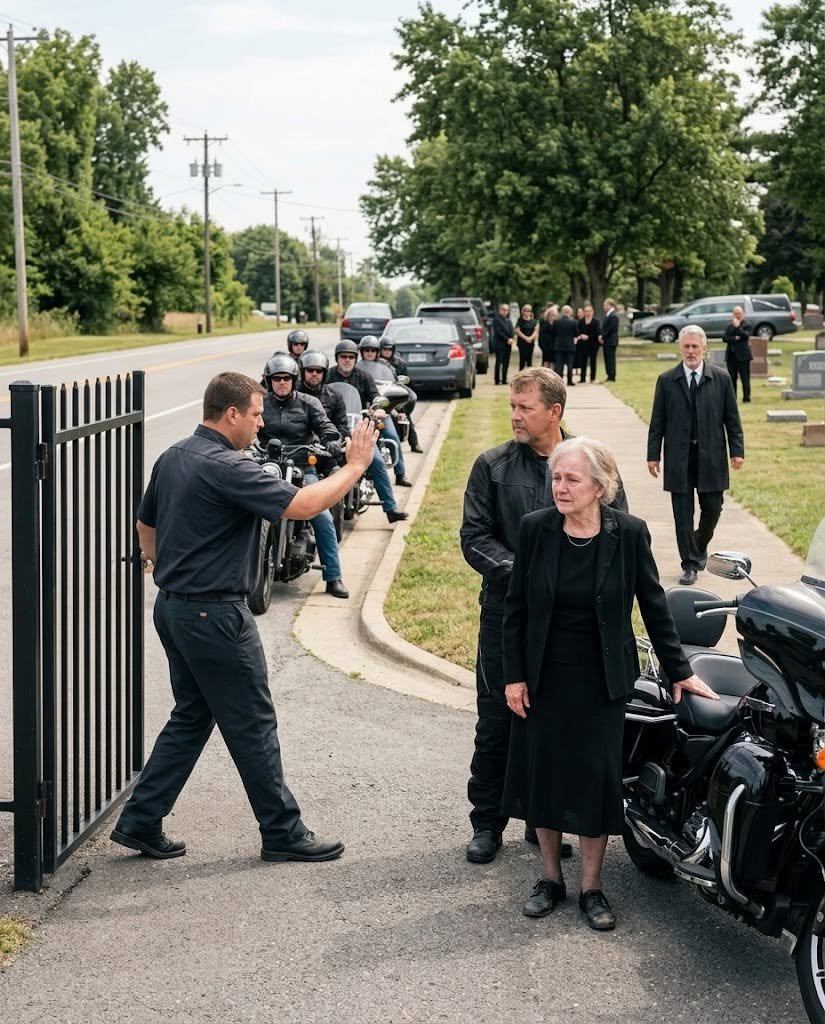
The cemetery employee’s hand hovered over the chain across the service lane as the older man stood beside him, forcing everyone at the entrance to remember why the rule existed in the first place. The widow who had arrived on the back of a motorcycle was no longer just a woman trying to reach her husband’s funeral. She was standing beside a story that had been misunderstood for nearly four decades.
The gray-haired man looked at the silent motorcycles parked along the road and then back at the widow. He had spent most of his life remembering the sound of those engines, not as a disturbance, but as the last connection he had to his father.
Thirty-seven years earlier, he had been a nine-year-old boy watching adults make decisions about grief that he did not understand. His father’s funeral was supposed to be a goodbye, but to him, something important was missing.
His father had ridden motorcycles with a group of friends, and the boy knew those engines better than almost anything else. The sound meant his father was coming home. It meant the day was ending. It meant the person he loved was nearby.
When he asked his father’s friends to ride behind the hearse, he was not asking for attention. He was asking for one final piece of the life he had just lost.
The cemetery refused.
The answer was simple to the people enforcing the rule. Motorcycles were not allowed on the property, and they did not want exceptions.
But the man who would become the widow’s husband saw a child standing in front of a painful goodbye. He saw a little boy who only wanted to hear his father’s friends follow him one last time.
So he made a choice.
He did not race through the cemetery. He did not rev the engine. He did not turn the funeral into a performance.
He led thirteen motorcycles through the entrance at walking speed.
The engines moved slowly behind the hearse while the boy stood beside his mother and listened to the sound he had been asking for.
The cemetery administration was angry afterward. They believed the rule had been challenged, and within days motorcycles were formally banned from entering the grounds.
For many people, that became the entire story.
A group of riders broke a rule, and a rule was created because of them.
But that was only the first half.
The part almost nobody knew was what happened after the funeral.
The next morning, the same man who had led the motorcycles through the gate returned alone. He carried his helmet under one arm and came without a crowd, without an argument, and without expecting anyone to celebrate what he had done.
He apologized to the cemetery workers for putting them in the middle of a difficult situation.
He explained that he understood their decision.
Then he promised he would never ride through those gates again.
And he kept that promise.
For thirty-seven years, he followed the rule he had helped create.
When other riders passed away and their friends wanted to honor them, he parked outside and walked in. When people blamed him for the ban, he did not defend himself. He simply accepted that the decision he made for a grieving child had consequences.
His wife knew only part of the story.
She knew her husband had cared deeply about his friends. She knew he had spent years riding with people who became like family. She knew he carried memories from those days.
But she did not know that he had quietly carried responsibility too.
That was the truth waiting at the cemetery gate.
The morning of her husband’s funeral had already been difficult before the car stopped working. Her sedan had died miles from the cemetery, leaving her standing beside the road in funeral clothes with nowhere to go.
Her black shoes had collected dust as she walked beside the disabled car, trying to figure out how she would make it to the service.
Then a motorcycle stopped.
The rider did not know her husband’s history. He did not know the cemetery rule. He only saw an older woman stranded on one of the hardest days of her life.
He offered her a place behind him.
She held onto his jacket as they traveled toward the cemetery, but when she mentioned that motorcycles were not allowed inside, the rider learned something he never expected.
Her husband was the reason.
At first, it sounded impossible.
The man who had spent decades respecting the restriction had become known as the person who caused it.
The rider called his club, but not to challenge the cemetery.
He called because he needed help getting one widow to the place where she needed to say goodbye.
When the other motorcycles arrived, they listened before they acted.
They heard about the boy.
They heard about the funeral.
They heard about the promise made afterward.
And they understood something important.
This was never about getting motorcycles through a gate.
It was about honoring a person who had spent his life keeping his word.
So they rode only as far as they were allowed to go.
They brought the widow to the entrance, helped her off the bike, and lined up along the road.
Then they shut off their engines.
Eleven motorcycles sat quietly outside the cemetery while the funeral continued inside.
No argument.
No demands.
No attempt to rewrite the past.
Just respect.
The cemetery employee approached the entrance when he saw the motorcycles. He knew the policy. He knew the history. He raised his hand and explained that the riders could not enter the property.
The widow nodded.
She already understood.
But then someone inside the cemetery began walking toward them.
It was the gray-haired man.
He was not looking at the motorcycles.
He was looking at her.
The widow had never met him, but he knew exactly who she was.
He told her that he had been nine years old when her husband rode through the cemetery.
He told her he was the child who asked to hear those engines.
The widow covered her mouth as the pieces came together.
Her husband had never told her the full story.
Maybe because he did not want praise.
Maybe because he believed the important part was not what he did that day, but what the little boy needed.
The man explained that her husband did not break the rule because he wanted people watching.
He broke it because a child was about to lose his father and he wanted that child to feel less alone.
That memory had stayed with him his entire life.
The cemetery employee heard the story differently now.
The rule had always been about the motorcycles.
But the reason behind the motorcycles was about compassion.
The widow stood there holding onto the memory of a husband who had carried a secret act of kindness for decades.
She had spent years knowing the man she loved.
Now she was learning one more thing about him on the day she lost him.
He was willing to accept being misunderstood if it meant a child could have one meaningful moment with his father.
That kind of choice does not disappear.
It travels through time.
The boy who was comforted by those engines became the man standing at the gate years later.
The riders who arrived that morning did not force a door open.
They honored the same lesson the widow’s husband had eventually learned.
Sometimes respect is not about getting what you want.
Sometimes it is about knowing exactly why something matters.
The cemetery rule remained.
The motorcycles remained outside.
But the story behind the rule changed.
What looked like defiance became sacrifice.
What looked like a violation became a promise.
What looked like a problem became proof that one decision made decades earlier had mattered to someone.
For the widow, the funeral became more than a goodbye.
It became the final chapter of a story her husband never finished telling her.
And for the man who had once been a nine-year-old boy waiting to hear his father come home, it became the moment he could finally thank the person who made sure his father was not alone on his last ride.