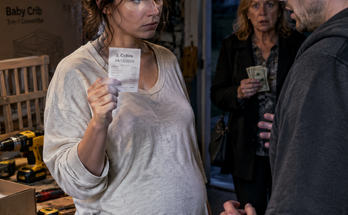
She smiled at the sales associate.
“She’s very generous. She always takes care of family.”
The associate smiled politely, but her eyes moved toward the unpaid boxes stacked on the counter.
Everyone in the room understood what was happening.
Everyone except Rita.
Or maybe she understood and simply believed the consequences would never reach her.
Gordon pulled out his phone.
The first call went directly to voicemail.
The second call did too.
His jaw tightened.
“Where is she?” Rita asked.
Gordon did not answer.
Instead, he walked away from the counter and called again.
Still nothing.
Because for the first time in years, I had chosen not to answer.
At the clinic, I sat in the parking lot with Pearl beside me.
The Florida sun was bright, but I felt strangely calm.
Not happy.
Not yet.
But calm.
My whole marriage had been built on me proving my value.
My value as a wife.
My value as a provider.
My value as someone who could fix every problem.
But sitting there after hearing my doctor say the words “medical emergency,” I finally understood something.
I had spent years protecting people who would not protect me.
Pearl looked at me quietly.
“Are you going back there?”
I stared through the windshield.
Back home.
Back to Gordon.
Back to Rita.
Back to pretending everything was normal.
The old Jocelyn would have gone.
She would have apologized.
She would have paid the bill.
She would have found a way to make everyone comfortable.
But that woman was exhausted.
That woman was sick.
And that woman was finally listening to herself.
“No,” I said.
Pearl nodded slowly.
“Good.”
“I need to think.”
“You need to breathe first,” she replied.
For the first time in months, I allowed myself to do exactly that.
At the boutique, Gordon’s embarrassment turned into anger.
Not embarrassment because he had done something wrong.
Anger because someone had interrupted the life he believed he deserved.
He stepped outside and called me again.
When I did not answer, he sent a message.
Gordon: This isn’t funny. Come here now.
A minute later:
Gordon: Your mother-in-law is waiting.
Then:
Gordon: Don’t make this difficult.
I looked at the messages when I turned my phone back on.
I read every word.
And something inside me became very clear.
He was not asking if I was okay.
He was not asking why I disappeared.
He was not asking whether my appointment went well.
His only concern was the card.
The money.
The inconvenience.
I locked my phone.
Then I did something I had not done in years.
I smiled.
When Gordon finally arrived home that evening, he slammed the front door so hard the picture frames shook.
“Jocelyn!”
I was sitting at the dining table reviewing my medical documents.
Not crying.
Not apologizing.
Just reading.
Rita walked in behind him, still wearing the same designer outfit from that morning.
Except now her confidence had cracks.
“You embarrassed us,” she said immediately.
I looked up.
“Excuse me?”
“The store staff treated us like criminals.”
Gordon threw his keys onto the counter.
“Do you know what you caused today?”
I almost laughed.
Not because it was funny.
Because it was unbelievable.
“I caused?”
“Yes,” Gordon snapped. “You told my mother she could shop.”
“I told her she could shop for thirty minutes.”
Rita crossed her arms.
“You said anything I wanted.”
I looked at her.
Then at Gordon.
Then back at the medical folder sitting beside me.
“You’re right.”
They both relaxed slightly.
They thought I was surrendering.
They thought I was going to apologize.
They were wrong.
“You wanted to know what I could give you,” I said quietly.
Gordon frowned.
“What are you talking about?”
“I gave you years.”
The room went silent.
“I gave you my time. My money. My energy. My health.”
Gordon rolled his eyes.
“Don’t exaggerate.”
I slowly opened my medical folder.
“The doctor says stress has contributed to my condition.”
Rita waved her hand.
“Oh please. Everyone is stressed.”
I looked directly at her.
“Yes. But not everyone has family members who treat their illness like an inconvenience because there is a sale at a shopping mall.”
Her expression changed.
Only slightly.
But enough.
Gordon stepped closer.
“You’re being dramatic.”
“No,” I said. “I’m finally being honest.”
I pulled out my phone and placed it on the table.
On the screen was the bank notification.
A message I had received earlier.
Your credit card has been temporarily locked due to suspicious activity.
Gordon stared at it.
“You locked the card?”
“Yes.”
His face changed.
“You can’t do that.”
I almost smiled.
“Actually, I can.”
“But that’s our card.”
I looked at him.
“No, Gordon.”
I spoke slowly.
“That is my account.”
The silence that followed was heavier than any argument we had ever had.
Because for the first time, Gordon realized something.
The person he depended on the most had stopped depending on his approval.
That night, Gordon slept in the guest room.
Not because I asked him to.
Because he was angry.
Angry that I had boundaries.
Angry that I had stopped making his life easy.
I stayed awake in my room, staring at the ceiling.
I thought about every warning sign I ignored.
Every time I said:
“He’s just stressed.”
“She’s just older.”
“They don’t mean it.”
But people show you who they are when you need them the most.
And when I needed them…
They chose handbags.
The next morning, I made an appointment with a financial advisor.
Not because I planned revenge.
Because I planned freedom.
I reviewed every account.
Every payment.
Every expense.
For years, I had unknowingly built a life where everyone benefited except me.
That ended now.
I separated my finances.
I contacted my attorney.
And I started making decisions based on one question:
What protects Jocelyn?
Not Gordon.
Not Rita.
Me.
Three days later, Gordon came home early.
For once, he looked nervous.
“Can we talk?”
I looked up from my laptop.
“About what?”
He sat across from me.
“The card.”
Of course.
The card.
Not my health.
Not my appointment.
Not the diagnosis.
The card.
“The store called again,” he said.
“I know.”
“They said the purchase was canceled.”
“Yes.”
He rubbed his forehead.
“You made me look terrible.”
I closed my laptop.
“Gordon, do you know what the doctor said to me?”
He looked away.
That was my answer.
He didn’t know.
He never asked.
And that hurt more than I expected.
“I could have ended up in the hospital,” I whispered.
He stayed silent.
“I was in pain that morning. You saw it.”
“I thought you were okay.”
“No,” I said. “You thought I would keep going.”
The words hit him.
Because they were true.
For the first time, he had no excuse.
No explanation.
No argument.
Just the truth sitting between us.
Gordon sat across from me for a long time without speaking.
For years, silence between us had always meant one of two things.
Either he was waiting for me to apologize…
or he was waiting for me to fix the problem.
But this time was different.
This time, I was not rushing to fill the silence.
I let him sit with it.
Finally, he sighed.
“Jocelyn, I think you’re making this bigger than it needs to be.”
There it was.
The sentence I had heard a hundred times.
The sentence that had slowly taught me to doubt my own feelings.
A problem was never a problem if it happened to me.
My exhaustion was “normal.”
My pain was “stress.”
My concerns were “overreactions.”
But his inconvenience?
That was an emergency.
I looked at him carefully.
“Do you actually believe that?”
Gordon looked confused.
“Believe what?”
“That my health is less important than a shopping trip.”
“That’s not what I said.”
“You didn’t have to.”
He looked away.
For a moment, I saw something I had not seen in years.
Not anger.
Not arrogance.
Fear.
Because Gordon was beginning to realize that I was no longer the woman who would quietly accept everything.
The following week changed everything.
I returned to work part-time while following my doctor’s instructions.
My company had been more understanding than I expected.
My manager, Daniel, called me into his office after noticing how tired I looked.
“Jocelyn, you have spent years solving everyone else’s problems,” he said. “When was the last time someone solved yours?”
I didn’t have an answer.
Because I couldn’t remember.
I had become the person everyone called when something went wrong.
A technical emergency.
A financial problem.
A family crisis.
But when I had a crisis…
Everyone was busy.
That realization hurt.
But it also freed me.
At home, things became uncomfortable.
Not because I was fighting.
Because I stopped fighting.
I stopped explaining.
I stopped defending every decision.
When Gordon asked why dinner wasn’t prepared, I simply said:
“I was resting.”
When Rita called and asked why I hadn’t invited her to another shopping event, I replied:
“Because my priorities have changed.”
She laughed.
“You’re still upset about that little misunderstanding?”
Little misunderstanding.
That phrase stayed in my mind.
A little misunderstanding.
That was what she called risking my health.
That was what she called ignoring my doctor.
That was what she called treating me like a bank account.
“No, Rita,” I said calmly.
“I’m not upset about the shopping trip.”
“Then what?”
“I’m disappointed that it took a medical warning for me to realize how little my needs mattered to you.”
She became quiet.
For once, she had nothing to say.
A month later, I received a letter from my attorney.
The financial review was complete.
And the results shocked even me.
Over the years, thousands of dollars had gone toward things I never approved.
Luxury purchases.
Trips.
Personal expenses.
Gordon had slowly convinced himself that because we were married, my income belonged to him.
But marriage did not mean permission.
Love did not mean unlimited access.
And generosity did not mean allowing someone to drain you.
I sat in my office holding the papers.
Not angry.
Just disappointed.
Because the numbers proved something my heart had been trying to deny.
Gordon had not accidentally taken advantage of me.
He had built a lifestyle around me allowing it.
That evening, I placed the documents on the kitchen table.
“We need to talk.”
Gordon looked at the papers.
“What is this?”
“The truth.”
He opened the folder.
As he read, his expression changed.
“You hired a lawyer?”
“Yes.”
“Without telling me?”
I stared at him.
“You spent years making financial decisions without telling me.”
“That’s different.”
“Why?”
He opened his mouth.
Then closed it.
Because there was no answer.
Rita arrived twenty minutes later after Gordon called her.
Of course, he called his mother.
He always did.
She entered the house like she was entering a courtroom.
“This has gone too far.”
I looked at her.
“What has?”
“You are destroying your marriage over money.”
I shook my head.
“No, Rita.”
I pointed toward the documents.
“I’m protecting myself because money revealed the truth about my marriage.”
She frowned.
“You’re acting like we used you.”
I smiled sadly.
“You didn’t use me because you needed help.”
I looked at Gordon.
“You used me because you expected help.”
The difference was everything.
Gordon became defensive.
“You’re acting like I’m some kind of villain.”
“No.”
I stood up.
“That would actually be easier.”
He looked confused.
“What do you mean?”
“I could forgive someone who made one terrible mistake.”
I paused.
“But this wasn’t one mistake.”
I counted on my fingers.
“You ignored my pain.”
Another finger.
“You pressured me to cancel medical care.”
Another.
“You expected me to pay for things you couldn’t afford.”
Another.
“You never asked if I was okay.”
My voice remained calm.
“That wasn’t a mistake, Gordon. That was a pattern.”
The room became silent.
For the first time, Gordon looked at me differently.
Not as his wife.
Not as his provider.
But as someone he might actually lose.
“Jocelyn…”
His voice softened.
“I can change.”
Those words would have broken me months earlier.
Because I wanted to believe them.
I wanted the man I married to suddenly appear.
But promises are easy when consequences arrive.
I looked at him.
“I hope you do.”
His eyes lifted.
“You do?”
“Yes.”
A small amount of hope appeared on his face.
Then I continued.
“But you have to change for yourself.”
The hope disappeared.
“Not because you’re afraid of losing my money.”
A week later, I moved into a small apartment near the beach.
It wasn’t as large as our house.
It didn’t have expensive furniture.
It didn’t have a perfect kitchen.
But it was mine.
For the first time in years, my home felt peaceful.
I woke up when my body needed rest.
I cooked when I wanted.
I watched sunsets without checking my phone for someone demanding something from me.
And slowly…
my health improved.
Six months later, I returned to the doctor.
After reviewing my tests, he smiled.
“You’re doing much better.”
I smiled.
“I finally listened.”
He nodded.
“Sometimes the hardest person to take care of is yourself.”
I thought about those words for a long time.
Because they were true.
I had spent my life being strong for everyone else.
I forgot that I deserved strength too.
One afternoon, I received a message from Gordon.
I know I hurt you. I’ve been going to counseling. I’m learning things I should have understood years ago.
I read it quietly.
Then another message came.
I’m sorry I only realized your value when I felt like I was losing you.
I put the phone down.
I didn’t hate him.
I didn’t want revenge.
I simply understood something important.
Forgiveness did not mean returning to the same place where you were hurt.
Sometimes forgiveness meant letting go and moving forward.
A year after that shopping trip, I walked into the same luxury boutique at the Galleria.
Not because I wanted to prove anything.
Not because I wanted revenge.
I was there because I wanted to buy something for myself.
A simple necklace.
Something I had always liked.
The sales associate recognized me.
“Welcome back.”
I smiled.
“Thank you.”
She looked around.
“Shopping for someone special?”
I touched the necklace.
“Yes.”
She smiled.
“Who?”
I looked at my reflection in the mirror.
And for the first time in a very long time…
I answered honestly.
“Me.”
The necklace rested against my collarbone as I walked out of the boutique.
It was not the most expensive piece of jewelry I had ever bought.
Actually, it was probably one of the simplest.
But it meant more than every diamond, watch, and designer item I had purchased for other people.
Because this time, I did not buy it to prove my worth.
I bought it because I finally believed I had worth.
That was something Gordon never understood.
The problem was never the money.
The problem was that somewhere along the way, I had forgotten I was a person before I was a provider.
When I returned to my apartment that evening, I found an envelope waiting outside my door.
No return address.
No name.
Only my handwriting on the front.
My old handwriting.
The kind I used years ago when I still wrote notes to myself.
I opened it slowly.
Inside was a letter I had written three years earlier.
A letter I had forgotten about.
It was part of a journal exercise my therapist had recommended during a stressful period.
The first sentence made my heart stop.
“If you are reading this, Jocelyn, I hope you finally learned that love should not require you to disappear.”
I sat down.
And I kept reading.
“I hope you stopped apologizing for needing things. I hope you stopped feeling guilty for saying no. I hope you realized that being loved means being cared for, not being useful.”
Tears filled my eyes.
Because the woman who wrote that letter had been trying to warn me.
I just wasn’t ready to listen.
Until now.
A few days later, Gordon asked to meet.
I almost said no.
The old Jocelyn would have agreed immediately.
She would have worried about hurting him.
She would have worried about being unfair.
But the new Jocelyn asked herself a different question.
“Will this bring me peace?”
The answer was yes.
So I agreed.
We met at a quiet café near the water.
Gordon looked different.
Not physically.
But something about him had changed.
The confidence was gone.
The certainty.
The assumption that I would always be there.
He looked like a man who had finally realized he could lose something valuable.
Not my money.
Me.
“I know I don’t deserve another chance,” he said.
I stayed quiet.
“I spent years thinking because you were strong, you didn’t need support.”
I looked at him.
“That was never true.”
He nodded.
“I know that now.”
I looked out toward the ocean.
“Gordon, do you know what hurt the most?”
He swallowed.
“What?”
“Not the shopping trip.”
His eyes lowered.
“It was waking up every day knowing that if I stopped giving, I was afraid nobody would love me.”
He looked up.
“I loved you.”
I smiled sadly.
“Maybe you did.”
That answer surprised him.
“But love without respect becomes painful.”
He looked away.
“I should have protected you.”
“Yes.”
The honesty made him uncomfortable.
But I continued.
“Not because you were my husband.”
I touched my necklace.
“But because I was a human being standing in front of you.”
Gordon told me about the months after I left.
The boutique had eventually canceled the purchase.
Rita had been furious.
She blamed him.
Then she blamed me.
Then she blamed everyone except herself.
But when Gordon stopped paying for everything, reality arrived quickly.
The expensive lifestyle disappeared.
The luxury dinners stopped.
The shopping trips ended.
And for the first time, Rita had to face the life she had built around someone else’s sacrifice.
“She said you changed,” Gordon admitted.
I smiled.
“I did.”
He nodded.
“She doesn’t understand why you won’t come back.”
I looked at him.
“I think she understands.”
“What do you mean?”
“She just doesn’t like the answer.”
Months passed.
Gordon continued therapy.
He apologized without asking for anything in return.
That was the first real apology he had ever given me.
Not:
“I’m sorry you feel that way.”
Not:
“I’m sorry this became a problem.”
But:
“I’m sorry I hurt you.”
There was a difference.
A real difference.
And I respected the effort.
But respect did not erase history.
Some doors can reopen.
Others are meant to stay closed.
One year after our separation, Gordon visited my apartment.
He looked nervous.
“I have something for you.”
He handed me a small box.
I opened it.
Inside was a simple silver bracelet.
Nothing flashy.
Nothing expensive.
Just meaningful.
On the inside were engraved words:
“Choose yourself.”
I looked at him.
“I know I’m too late to change the past.”
He paused.
“But I hope you know I’m proud of you.”
That surprised me.
Because years earlier, I had spent so much time trying to make him proud of me.
Now he was telling me he was proud.
And somehow…
I didn’t need it anymore.
“Thank you,” I said.
And I meant it.
Two years later, my life looked completely different.
I became a mentor at my company, helping younger employees avoid burnout.
I started traveling again.
I spent weekends by the ocean.
I reconnected with friends I had neglected while trying to satisfy people who were never satisfied.
Pearl remained my closest friend.
One afternoon, we sat together watching the waves.
“You know what’s funny?” she said.
“What?”
“Everyone thought you were going to lose everything when you left Gordon.”
I smiled.
“And?”
She looked at me.
“You gained everything.”
I looked at the ocean.
She was right.
I didn’t lose my marriage.
I lost the version of myself that believed I had to earn love.
Years later, I ran into Rita at a charity event.
She looked older.
Quieter.
Different.
For a moment, neither of us spoke.
Then she surprised me.
“Jocelyn.”
I nodded.
“Rita.”
She looked uncomfortable.
“I owe you an apology.”
I waited.
“I treated you like you were responsible for making everyone happy.”
She looked down.
“And I forgot you were hurting too.”
It wasn’t perfect.
It didn’t erase everything.
But it was honest.
And sometimes, closure comes not from someone else changing…
but from no longer needing them to.
“I appreciate you saying that,” I replied.
And then I walked away.
Not angry.
Not bitter.
Free.
That evening, I returned home and placed my keys on the table.
My apartment was quiet.
Peaceful.
Mine.
I stood by the window and watched the sunset.
I thought about the woman I used to be.
The woman who drove through pain because other people wanted luxury.
The woman who ignored her own suffering because she was afraid of disappointing others.
The woman who thought being needed meant being loved.
I wished I could go back and tell her one thing.
You are not valuable because of what you provide.
You are valuable because you exist.
And no shopping trip…
no expensive gift…
no person’s approval…
is worth losing yourself.
I touched the necklace around my neck.
The same one I bought that day.
The day everything changed.
And I smiled.
Because the greatest thing I ever purchased…
was not a designer bag.
Not a piece of jewelry.
Not anything money could buy.
It was my own freedom.